OUR
Which Chihuahua are you and why?
¿Qué Chihuahua eres y por qué?
Ninde Chihuahua uri kandi kuki?
Wewe ni Chihuahua gani na kwa nini?
What is today's date?
¿Cuál es la fecha de hoy?
Itariki yuyu munsi niyihe?
Tarehe ya leo ni nini?
What is the title of the lesson you will be working on today?
¿Cuál es el título de la lección en la que trabajarás hoy?
Nuwuhe mutwe w'isomo uzakora uyu munsi?
Je, kichwa cha somo litakalofanyia kazi leo ni kipi?
Any other information I need to know to help you be successful today?
¿Alguna otra información que deba saber para ayudarlo a tener éxito hoy?
Andi makuru yose nkeneye kumenya kugirango agufashe gutsinda uyu munsi?
Taarifa nyingine yoyote ninayohitaji kujua ili kukusaidia kufanikiwa leo?
I can make a valid conclusion in any geometric context.
Puedo llegar a una conclusión válida en cualquier contexto geométrico.
Nshobora gufata umwanzuro wemewe murwego urwo arirwo rwose.
I can accurately construct a well-supported verbal/algebraic argument in any geometric context in an unfamiliar setting.
Puedo construir con precisión un argumento verbal/algebraico bien fundamentado en cualquier contexto geométrico en un entorno desconocido.
Nshobora kubaka neza gushyigikirwa neza mu magambo / algebraic impaka muburyo ubwo aribwo bwose bwa geometrike muburyo butamenyerewe.


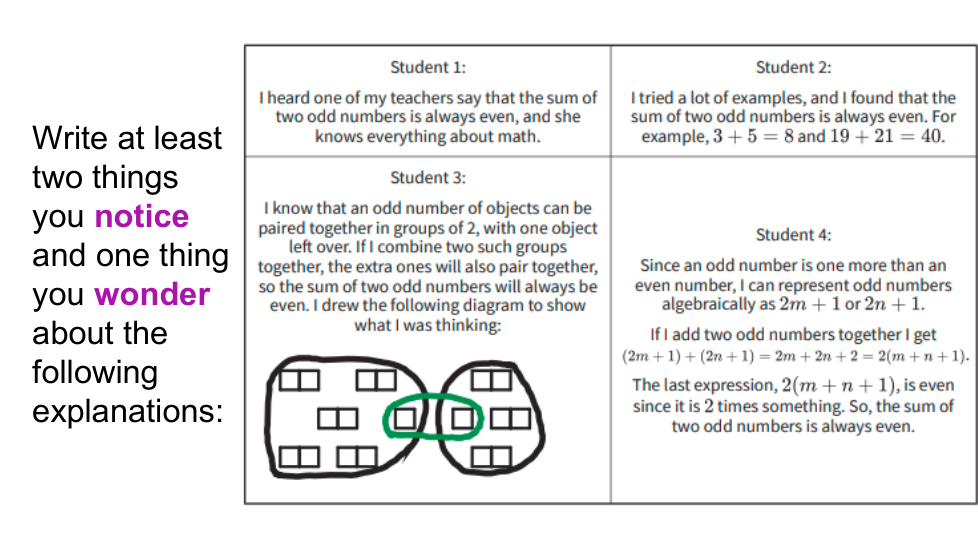
Write at least two things you notice about the following explanations:
Escribe al menos dos cosas que notas sobre las siguientes explicaciones:
Write one thing you wonder about the following explanations:
Escribe una cosa que te preguntes sobre las siguientes explicaciones:


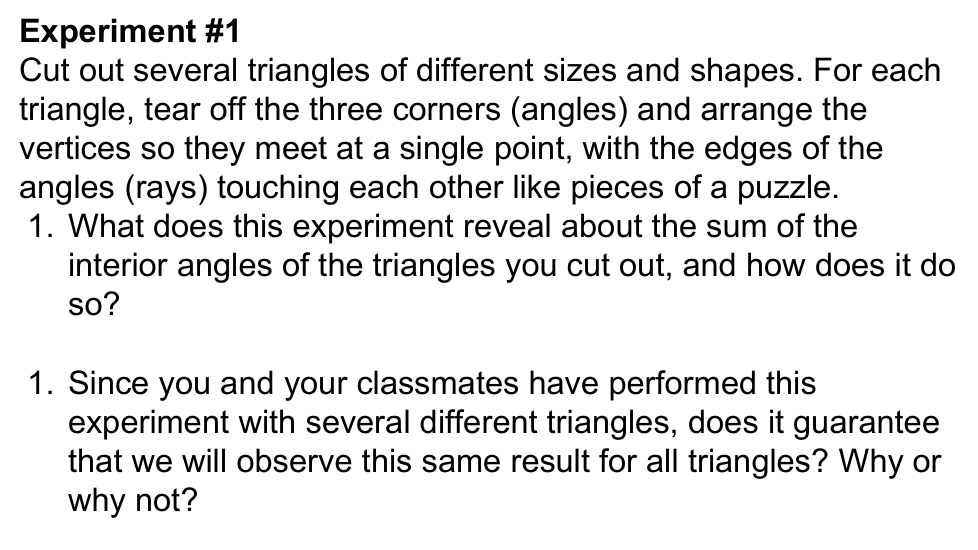
What does this experiment reveal about the sum of the interior angles of the triangles you cut out, and how does it do so?
¿Qué revela este experimento sobre la suma de los ángulos interiores de los triángulos que recortaste y cómo lo hace?
Since you and your classmates have performed this experiment with several different triangles, does it guarantee that we will observe this same result for all triangles? Why or why not?
Dado que usted y sus compañeros de clase han realizado este experimento con varios triángulos diferentes, ¿garantiza que obtendremos el mismo resultado para todos los triángulos? ¿Por qué o por qué no?

How are you doing today?
¿Cómo estás hoy?
Experiment #2
Perhaps a different experiment will be more convincing. Use https://www.geogebra.org/m/sgne8mt9 to:
Locate the midpoints of each side of your cut out triangle by folding the vertices that form the endpoints of each side onto each other.
Rotate your triangle 180o about the midpoint of one of its sides. Trace the new triangle onto your paper and color-code the angles of this image triangle so that corresponding image/pre-image pairs of angles are the same color.
Now rotate the new “image” triangle 180o about the midpoint of one of the other two sides. Trace the new triangle onto your paper and color-code the angles of this new image triangle so that corresponding image/pre-image pairs of angles are the same color.

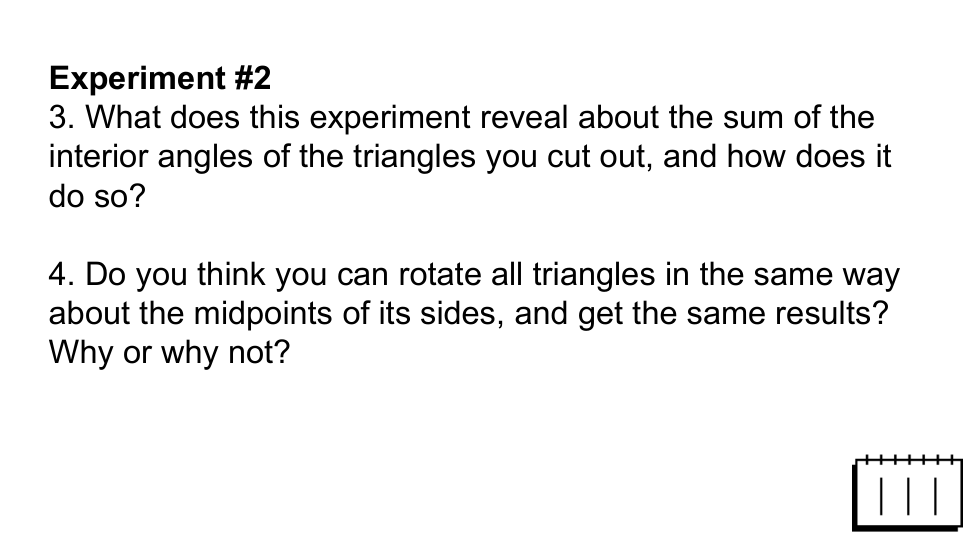
What does this experiment reveal about the sum of the interior angles of the triangles you cut out, and how does it do so?
¿Qué revela este experimento sobre la suma de los ángulos interiores de los triángulos que recortaste y cómo lo hace?
Do you think you can rotate all triangles in the same way about the midpoints of its sides, and get the same results? Why or why not?
¿Crees que puedes rotar todos los triángulos de la misma manera alrededor de los puntos medios de sus lados y obtener los mismos resultados? ¿Por qué o por qué no?

These ways of knowing showed up in our work today when we conjectured:
Estas formas de conocimiento aparecieron en nuestro trabajo hoy cuando conjeturamos:

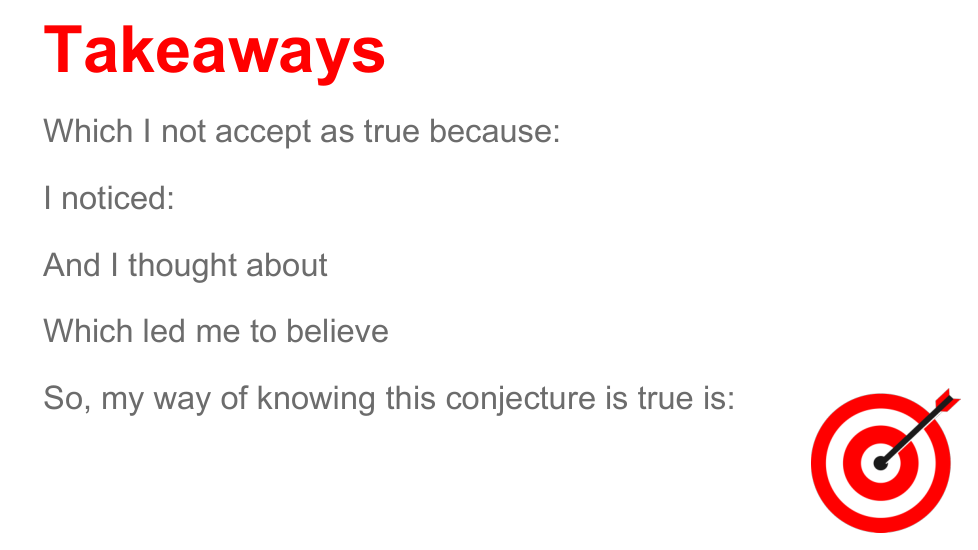
I noticed:
Me di cuenta de:
and I thought about
y pensé en


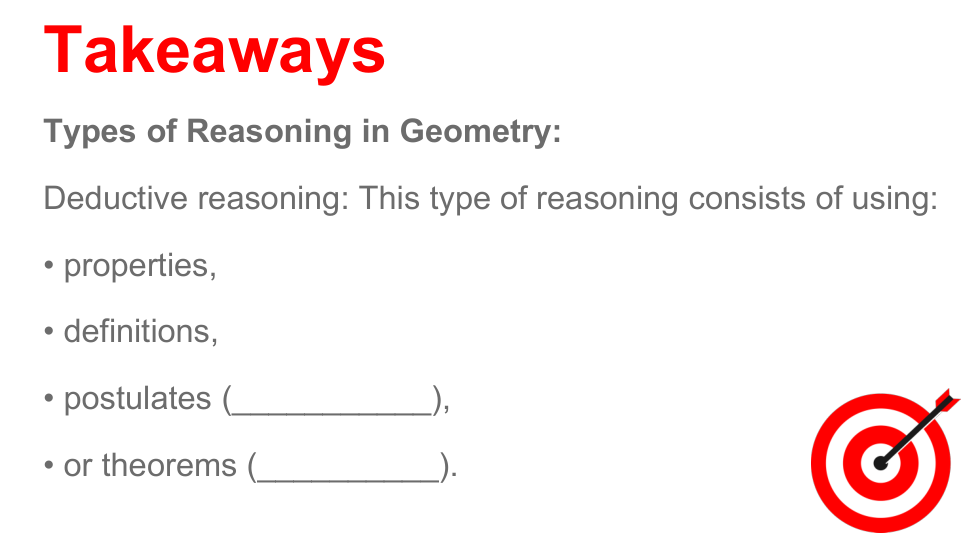
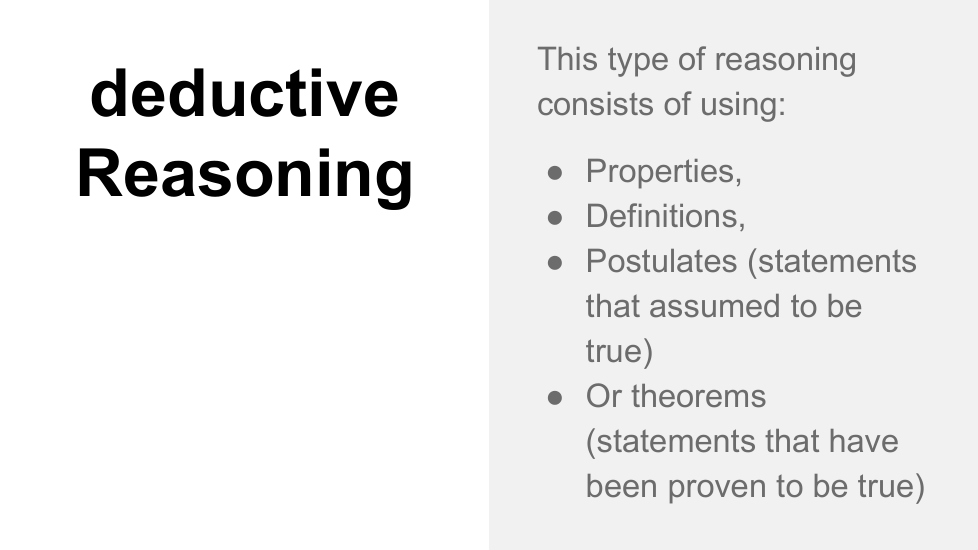
postulates
postulados
or theorems
o teoremas


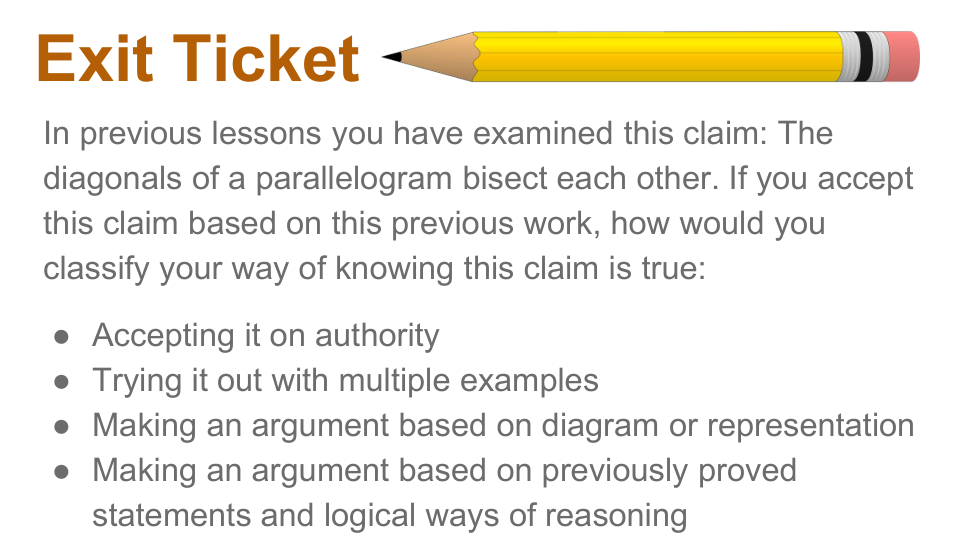
Based on your current way of knowing this claim is true, should it be classified as a conjecture or a theorem?
Según su forma actual de saber que esta afirmación es verdadera, ¿debería clasificarse como una conjetura o un teorema?
I can make a valid conclusion in any geometric context.
Puedo llegar a una conclusión válida en cualquier contexto geométrico.
Nshobora gufata umwanzuro wemewe murwego urwo arirwo rwose.
What score do you give yourself?
Ni ayahe manota wiha wenyine?
Dhibco noocee ah ayaad naftaada siisaa?
Unajipa alama gani?
¿Qué puntuación te das a ti mismo?
Cite your evidence from the assignment and explain how it supports your score, based on the success criteria.
Cite su evidencia de la tarea y explique cómo respalda su puntaje, según los criterios de éxito.
Tanga ibimenyetso byawe uhereye kumikoro hanyuma usobanure uburyo ishyigikira amanota yawe, ukurikije ibipimo byatsinze.
Taja ushahidi wako kutoka kwa kazi na ueleze jinsi inavyoauni alama yako, kwa kuzingatia vigezo vya mafanikio.
I can accurately construct a well-supported verbal/algebraic argument in any geometric context in an unfamiliar setting.
Puedo construir con precisión un argumento verbal/algebraico bien fundamentado en cualquier contexto geométrico en un entorno desconocido.
Nshobora kubaka neza gushyigikirwa neza mu magambo / algebraic impaka muburyo ubwo aribwo bwose bwa geometrike muburyo butamenyerewe.
What score do you give yourself?
Ni ayahe manota wiha wenyine?
Dhibco noocee ah ayaad naftaada siisaa?
Unajipa alama gani?
¿Qué puntuación te das a ti mismo?
Cite your evidence from the assignment and explain how it supports your score.
Cite su evidencia de la tarea y explique cómo respalda su puntaje.
Taja ushahidi wako kutoka kwa kazi na ueleze jinsi inavyosaidia alama yako.
Soo qaado caddayntaada hawsha oo sharax sida ay u taageerto dhibcahaaga.
Tanga ibimenyetso byawe uhereye kumikoro hanyuma usobanure uburyo ishyigikira amanota yawe.
What is the sum of the interior angles of every triangle?
¿Cuál es la suma de los ángulos interiores de cada triángulo?
which led me to believe
lo que me llevó a creer
So, my way of knowing this conjecture is true is
Entonces, mi forma de saber que esta conjetura es cierta es
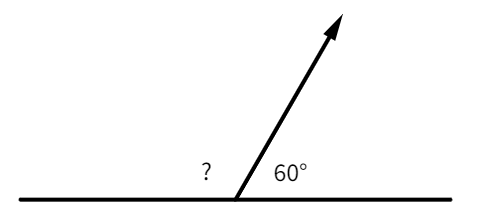
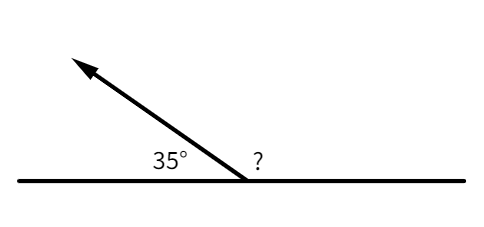
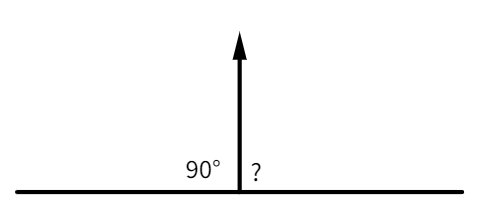
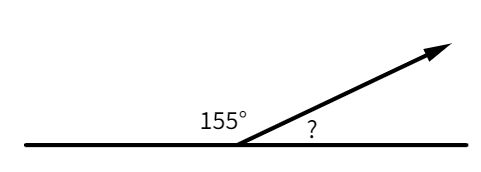
Every time I have drawn a ray with its endpoint on a line and measure the two angles formed with a protractor, they add up to 180o. So, adjacent angles that form a straight line are supplementary.
Cada vez que he dibujado un rayo con su extremo en una recta y mido los dos ángulos formados con un transportador, suman 180o. Entonces, los ángulos adyacentes que forman una línea recta son suplementarios.
You know triangles that have a right angle are classified as right triangles. And you know the sides of a right triangle have a relationship described by the Pythagorean theorem. So you have concluded that when you have a triangle with a right angle you can use the Pythagorean theorem to find missing sides.
Sabes que los triángulos que tienen un ángulo recto se clasifican como triángulos rectángulos. Y sabes que los lados de un triángulo rectángulo tienen una relación descrita por el teorema de Pitágoras. Así que has concluido que cuando tienes un triángulo con un ángulo recto puedes usar el teorema de Pitágoras para encontrar los lados que faltan.
You know triangles that have a right I know the Pythagorean Theorem only works for right triangles because I read it in a book. It said it is a relationship to only be used with right triangles.
Sé que el Teorema de Pitágoras solo funciona para triángulos rectángulos porque lo leí en un libro. Dijo que es una relación que solo debe usarse con triángulos rectángulos.
We tore off the corners of a triangle and placed them together to have a straight line. Since we had everyone in our class do it we know the angles of a triangle will add up to 180o.
Arrancamos las esquinas de un triángulo y las colocamos juntas para formar una línea recta. Como hicimos que todos en nuestra clase lo hicieran, sabemos que los ángulos de un triángulo sumarán 180o.
I know you can always turn a quadrilateral into two triangles because of the way they look. Just draw a picture of any quadrilateral and then connect opposite corners and you will have two triangles. It works because of the drawing, try it.
Sé que siempre puedes convertir un cuadrilátero en dos triángulos por su apariencia. Simplemente haz un dibujo de cualquier cuadrilátero y luego conecta las esquinas opuestas y tendrás dos triángulos. Funciona gracias al dibujo, pruébalo.
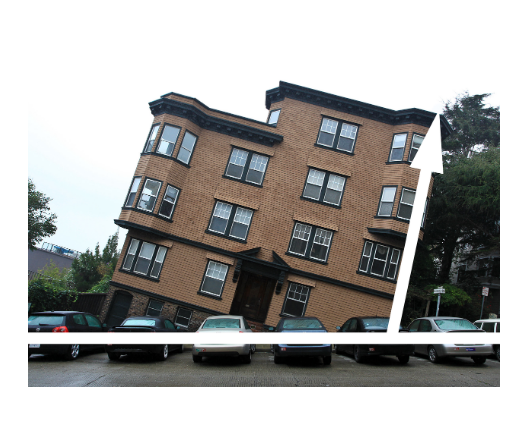
Draw or create at least 2 diagrams of a real life linear pair.
Dibuja o crea al menos 2 diagramas de un par lineal de la vida real.
Linear pairs could be defined as being supplementary angles because they always add up to 180o. Are all supplementary angles linear pairs? Explain.
Los pares lineales podrían definirse como ángulos suplementarios porque siempre suman 180o. ¿Todos los ángulos suplementarios son pares lineales? Explique.
B will be the vertex.
B será el vértice.
H will be the vertex.
H será el vértice.