If this figure is dilated with a scale factor of 3, what will be the new coordinates of point N'?
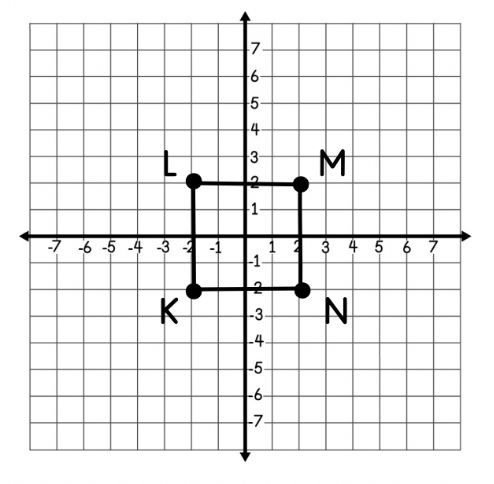
If this figure is dilated with a scale factor of 3, what will be the new coordinates of point N'?
If this figure is dilated with a scale factor of 3, what will be the new coordinates of point N'?
If point B (-4, 16) is dilated using a scale factor of 0.25, what will be the new coordinates?
Which of the following algebraic representations will enlarge a figure?
Dilations preserve congruence.
Dilations preserve orientation of the figure.
Dilations preserve orientation of the vertices.
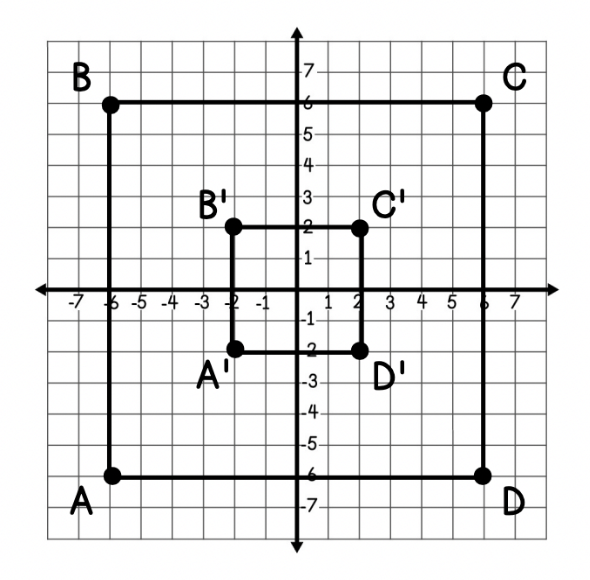
What scale factor was used to dilate ABCD to A'B'C'D'?
A rectangle is dilated by a scale factor of 1.5. How will the dilation affect the perimeter of the rectangle?
A rectangle is dilated by a scale factor of 1.5. How will the dilation affect the AREA of the rectangle?
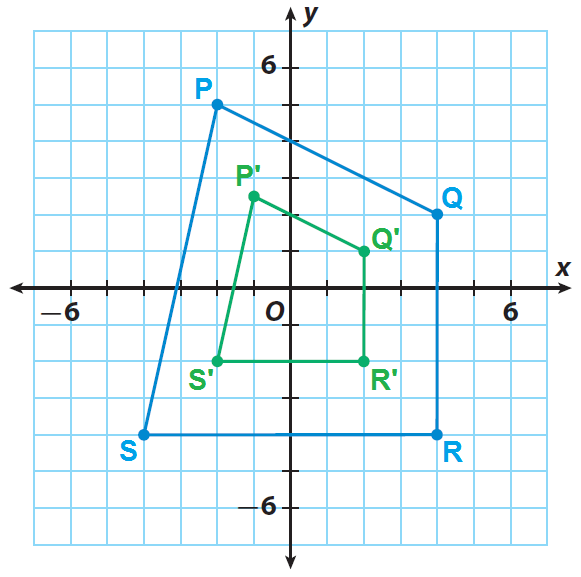
What scale factor was used to dilate PQRS to P'Q'R'S'?