AND a baby kitten!! :-(
Solve:
use x= for your answer
Solve:
use x= for your answer
Given:
from #2, what is the extraneous solution?
Given:
find
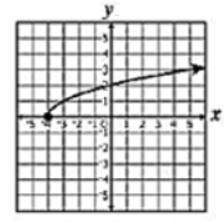
The graph of function g is shown below:
Which graph best represents the inverse of g?
The square root parent function has been reflected across the x-axis and then shifted 3 units left and 2 units up. Write an equation to represent this transformation:
(use f(x)= in your answer)
Graph the function that you found in #6 above.
(use numbers for x that will result in a perfect square under the radical)
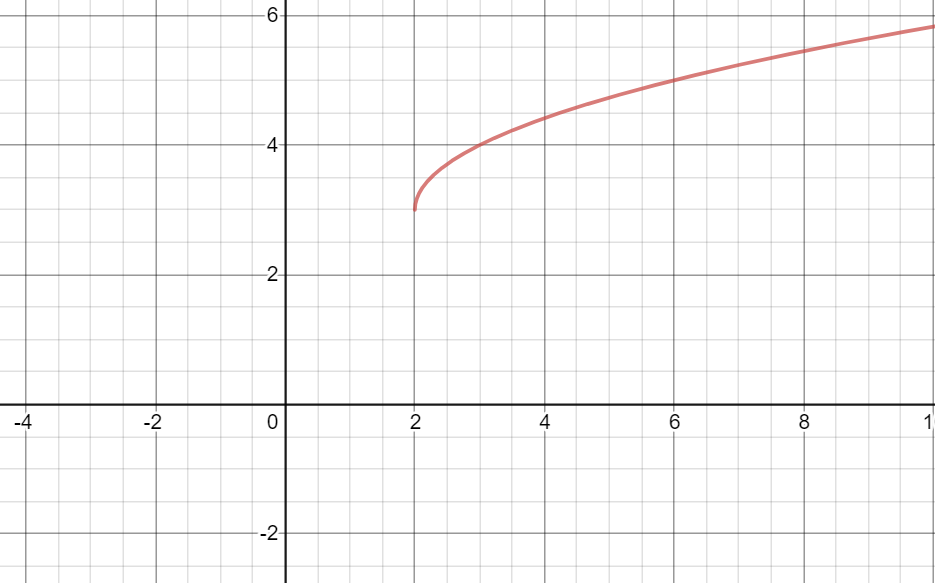
Given the graph:
What is the domain?
(use set notation { }, no spaces )
Given the function:
What is the domain? (you might want to graph this in show your work to help you)
(use set notation { }, no spaces please)
Given the function:
What is the range?
(use set notation { }, no spaces please)
Given the function:
What is the end behavior?
Given the function:
What is the end behavior?
Given:
What is equivalent in simplest radical form?
Given:
Simplify. Express your answer in simplest radical form.
Given:
Simplify. Express your answer in simplest radical form.
Given:
Simplify. Express your answer as an equivalent using fractional exponents.
Given:
Simplify. Express your answer in simplest radical form.
Given:
Simplify. Express your answer in simplest radical form.
Given:
Simplify. Express your answer in simplest radical form.
Given:
Simplify. Express your answer in simplest radical form.
Solve:
Answer using x=? (separate by commas if necessary)
Given:
Find:
Given:
Find:
Given:
Are these 2 functions inverses of each other?
Given:
Find:
Given:
Find:
Given:
Find:
Given:
Find:
Simplify:
Express your answer in simplest radical form.
Upload your work here
Upload your work here
Upload your work here
Upload your work here
Given the graph:
What is the range?
(use set notation { }, no spaces )
Given the graph:
What is the increasing interval?
(use interval notation...if none, write none)
Given the graph:
What is the decreasing interval?
(use interval notation...if none, write none)