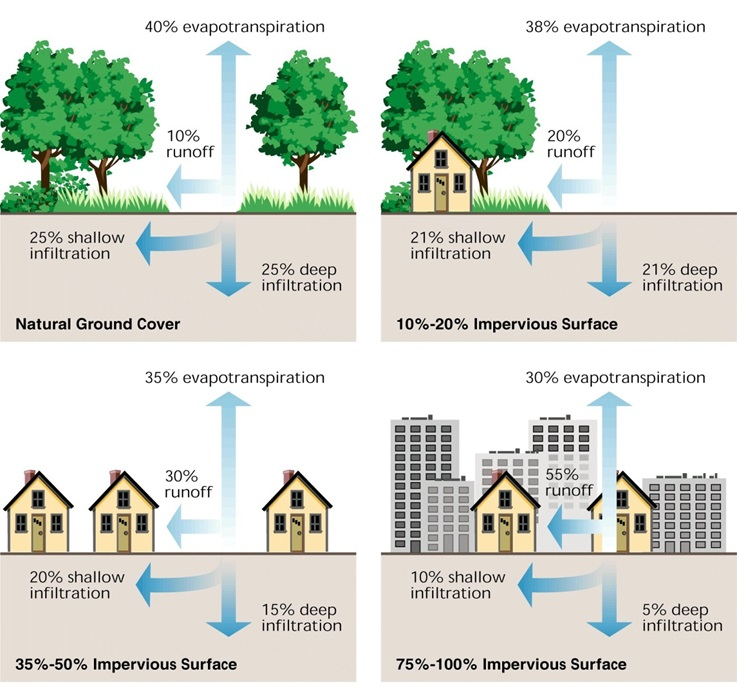
Based on the diagram, what is the cause of increased runoff?
Based on the diagram, what is the cause of increased runoff?
Setup :
Place white bin lid on edge of lab table, and position the wood block under one end so the lid is at an angle.
Wet the 4 sponges, and squeeze out as much of the excess water as you can.
Place sponges side by side on plastic lid. This is your simulated soil profile.
You will need to hold the plastic bin AND the 500 ml beaker under the edge of the lab table to collect the runoff. Discuss with you team who will pour the water, who will hold the collecting vessels, and who will record the timing of runoff collection.
Procedure 1- Simulating concrete and asphalt.
1.a- place the clear plastic sheet over the sponges. This simulates a solid paved surface.
1.b- put 500ml of water into your large beaker.
1.c- Slowly pour the 500ml of water into your Styrofoam cup, holding the “raincloud” over the hard paved surface and begin timing. Be sure to hold the plastic bin and the 500ml beaker under the edge to collect the runoff.
1.d- record the time it takes for 100ml to runoff into the beaker, then again for 200ml, 300ml, 400ml, and 500ml (if you get to 500) .when runoff ceases, record the total volume of water collected.
1.e- pour water back into large beaker for the next experiment.
1.f - Remove clear plastic lid and set aside.
Procedure 2- Simulating permeable surfaces (such as pavers or permeable concrete)
2.a- make sure setup steps 1-5 above are complete
2.b- place mosaic tiles directly on top of the four damp sponges to simulate pavers or permeable concrete.
2.c- make sure you have 500ml of water in your large beaker, and repeat steps 1.c-1.e, timing and recording your data.
2.d- When your data collection if complete, squeeze excess water (if any) from your four sponges before moving on to part 3.
Procedure 3- Gravel roads and pathways
3.a- make sure you have wrung out your sponges and reset steps 1-5
3.b- place a folded shop towel on top of the sponges (this simulates a sand base for the gravel path) and spread a layer of gravel on top of the towel.
3.c- repeat steps 1.c-1.e, timing and recording your data.
3.d – carefully refold the gravel into the towel and place the gravel back into the bowl.
3.e- squeeze out any excess water from the four sponges before moving on to part 4.
Procedure 4- Green spaces and green roofs
4.a- make sure you have wrung out your sponges from part 3 and reset according to steps 1-5
4.b- place a potted plant on the top sponge on your plastic ramp, this will simulate a garden, green space, or green roof.
4.c- repeat steps 1.c-1.e, timing and recording your data.
4.d- when you finish, pour out all water and place all supplies back in your lab bin. Move on to follow up questions and graphs.
Upload your data
What was the total volume of storm water runoff for each surface?
1. Concrete
2. Pavers
3. Gravel path
4. Green space
Which surface produced the greatest volume of runoff?
Did it also have the fastest rate of water runoff?
Explain why.
Describe how this might affect the way water enters gutters, storm drains and rivers.
Which surface produced the lowest volume of water runoff?
Did it also have the slowest rate of water runoff?
Explain why.
Describe how this might affect the way water enters gutters, storm drains and rivers.
Explain why reducing urban runoff would be beneficial to a city?
Identify THREE ways that cities could reduce urban runoff.
Describe how each strategy could reduce storm water runoff.
Based on the diagram, what is the cause of increased runoff?