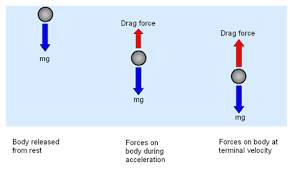
Terminal velocity is the maximum velocity (speed) attainable by an object as it falls through a fluid (air is the most common example).
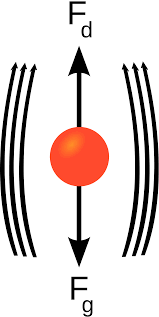
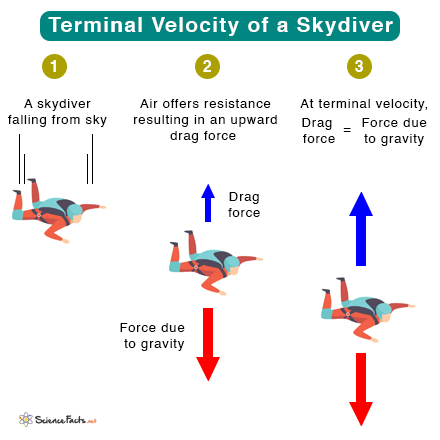
It occurs when the sum of the drag force (Fd) and the buoyancy is equal to the downward force of gravity (FG) acting on the object.
1 point
1
1 point
1
Question 2
2.
Terminal velocity is the _______ velocity attainable by an object as it falls through a _______.
Word Bank:
minimum
psycho
wonder
maximum
medium
mode
fluid
solid
gas
1 point
1
Question 3
3.
_____________________ _______________
Other Answer Choices:
force of gravity
drag force
terminal velocity
psycho pass
1 point
1
Question 4
4.
Terminal velocity is acheived when objects are falling in fluids. Which of these are NOT fluids
1 point
1
1 point
1
Question 6
6.
Which image represents terminal velocity best
1 point
1
Question 7
7.
Which image represents "terminal velocity" best?
1 point
1
Question 8
8.
Which object has no drag at all and is probably not falling in a fluid.
3 points
3
Question 9
9.
Draw an object (any object) in these three cirucmstances with Fd = Drag force and FG = gravity on the objects as arrows. Label your diagram.
Diagram 1: An object at rest, not falling, no drag force.
Diagram 2: An object Falling and accelerating fast
Diagram 3: An object that has reached terminal velocity.
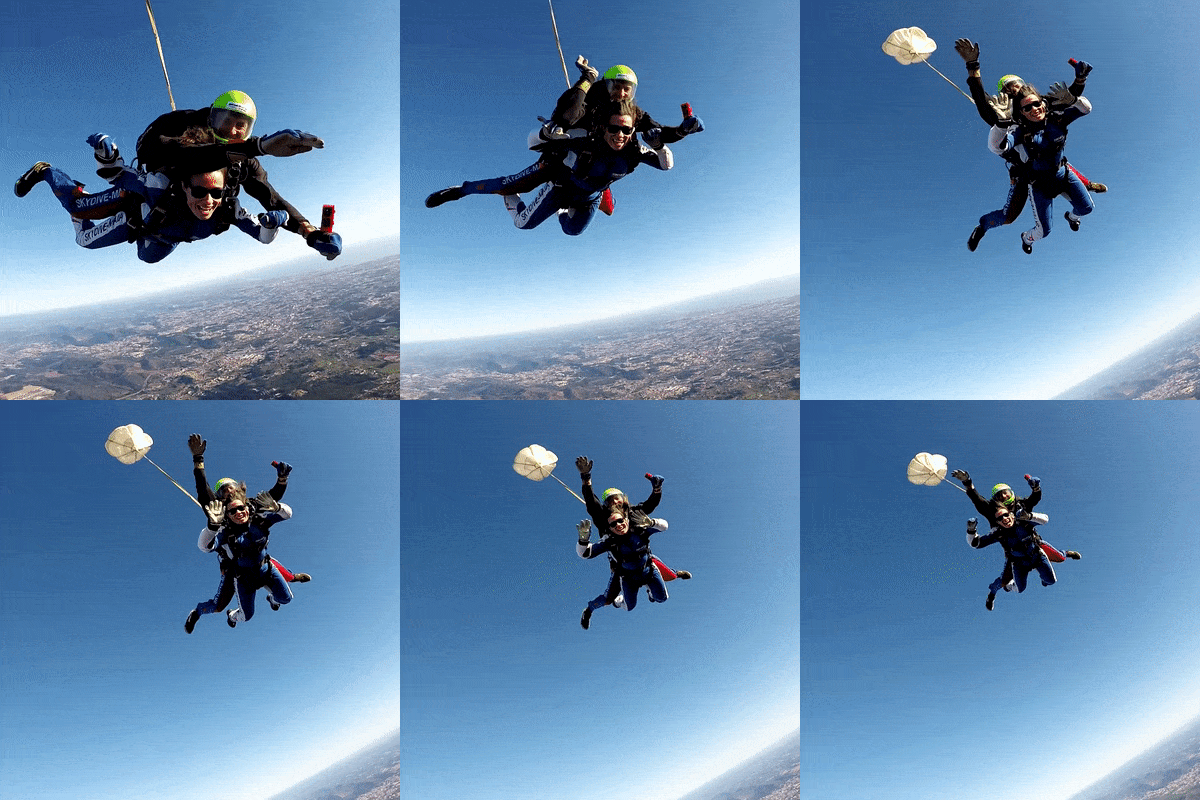
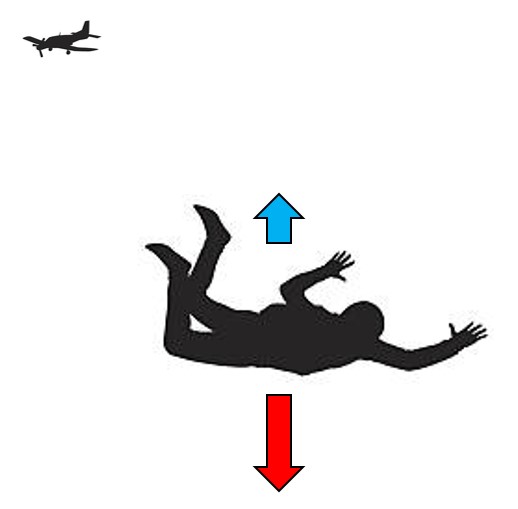
Just after the parachuter jumps out of the plane (before the parachute opens). The relative forces will be unbalanced. Weight force is greater that the friction or drag force.
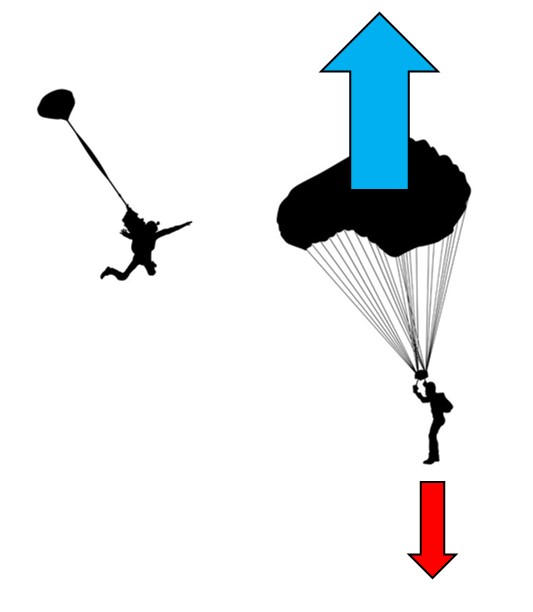
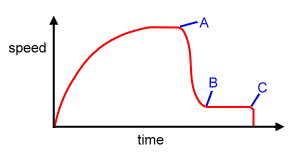
Before the parachute opens the sky diver will have constant acceleration. After 60 seconds, the parachutist pulls the cord and opens her parachute. The parachute reduces the speed of the parachutist when it is just opened because the friction force increases.
1 point
1
1 point
1
Question 11
11.
Just after she jumps out of the plane (before the parachute opens). The relative forces will be UNBALANCED.
A) Why are the forces unbalanced?
B) Which force is greater than the other?
Use evidence from the text to answer
1 point
1
Question 12
12.
Friction force is also called...
1 point
1
Question 13
13.
Just after she jumps out of the plane (before the parachute opens). The relative forces will be
1 point
1
Question 14
14.
After the 60 seconds, the parachutist pulls the cord and opens her parachute.
Explain how the parachute reducesthe speed of the parachutist when it is just opened.
1 point
1
Question 15
15.
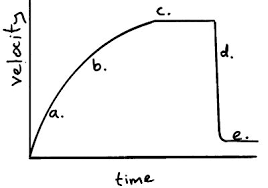
Describe the motion at point a on the graph.
1 point
1
Question 16
16.
If this was the journey of a parachutist, what is happening at point e. ?
1 point
1
1 point
1
1 point
1
Question 19
19.
Terminal velocity is when... acting on the object
1 point
1
Question 20
20.
If we are freefalling, what can we do to slow us down so we do not die when we hit the ground? How does it work?
Use the words in the word bank:
gravity pull drag force increase parachute
1 point
1
Question 21
21.
By how much percent does a parachute slow down "terminal velocity"?
1 point
1
Question 22
22.
Parachutes slow you down till about
1 point
1
Question 23
23.
A parachute is designed to increase the _______ to increase drag.
Word bank:
force
pull
push/pull
wire
electricity
surface area
pressure
density
1 point
1
Question 24
24.
What other things use parachutes?
1.
2.
3.
1 point
1
Question 25
25.
The graph shows the vertical speed of a parachutist. At which point did they open the parachute?
1 point
1
Question 26
26.
Parachutes slow you down by creating a large enough surface area that is designed to create a huge amount of ________.
1 point
1
Question 27
27.
Identify true statements:
There may be more than one true statement!!!
1 point
1
Question 28
28.
Identify true statements:
There may be more than one true statement!!!
An object travelling at terminal velocity moves at a steady speed and constant direction. Acceleration due to gravity on Earth is always the same amount, 9.81 m/s/s.
1 point
1
1 point
1
Question 30
30.
The force of gravity on Earth is always _______ m/s/s