3.0 Acceleration (Teacher - Paced)
star
star
star
star
star
Last updated over 3 years ago
22 Nsɛmmisa

1
1

1
1
1
1

1
1
1

1
1
1
1
1
1
1
According to the diagram, what are the cases in which acceleration exists?
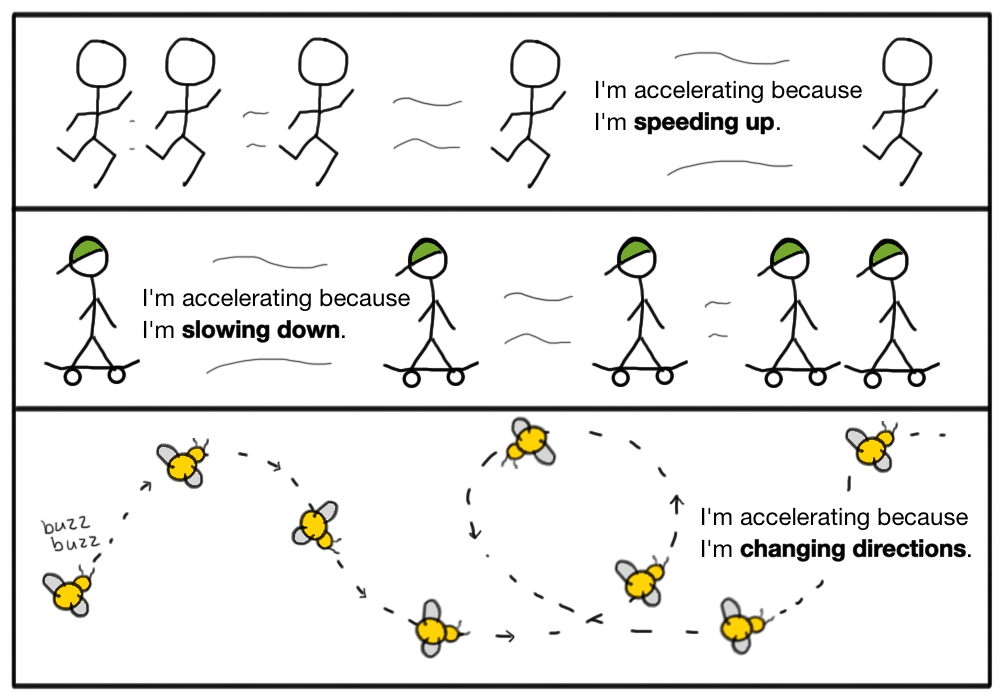
1.
2.
3.
In which of the following images was the brakes put on and the car started to decelerate (decrease in speed)?
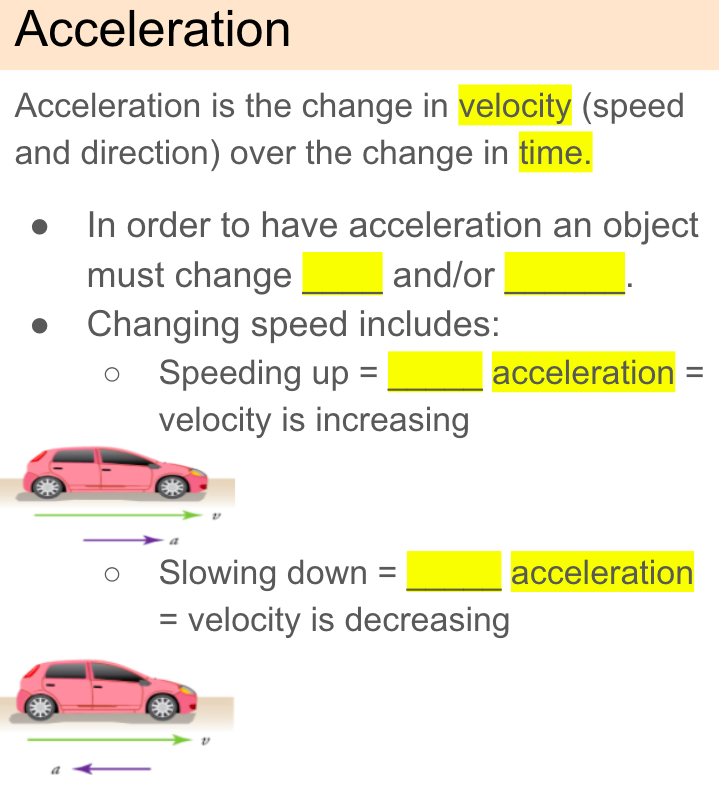
In order to have acceleration an object must change ____ and/or ______.
Directions: For each example, put positively accelerating, negatively accelerating, or not accelerating.
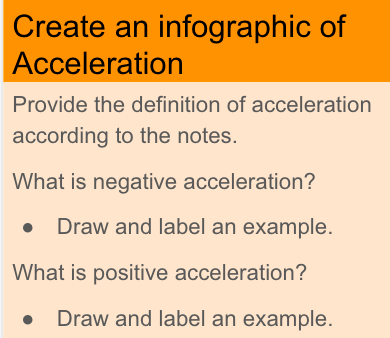
Positive acceleration: The velocity of the object is increasing. The object is speeding up.
Negative acceleration: The velocity of the object is decreasing. The object is slowing down.
No acceleration: The velocity is of the object is staying constant or the object is not moving at all.

A jet moving with a constant velocity at 800 miles per hour along a straight line.
Categorize the following into positive acceleration, negative acceleration, or no acceleration.
Mr. Guesno see's that speed limit is now 40 miles higher on the road he is on, so he starts to put on the gas..
Mr. Guesno see's a red light and he puts his foot on the brakes to slow down.
Mr. Guesno's drove his car at a constant speed of 20 miles per hour
positive acceleration
negative acceleration
no acceleration
Categorize the following into acceleration (change in speed or direction), velocity (speed and direction), or speed (change in distance over time).
The train increased its speed as it left the terminal.
The motorcycle slowed down as it approached the yield sign.
The race car sped up into the turn as it went around the track.
The geese fly 23 mph to the south when they migrate for the winter.
A snail can crawl 2 meters in 2 hours.
The tornado is traveling northwest at 20 mph.
Acceleration
Velocity
Speed
Indicate which type of acceleration and speed the object is having by placing an X in the appropriate square.
Categorize the following into positive acceleration, negative acceleration, or no acceleration.
The runner slowed down before the turn.
The runner sped up to cross the finish line!!!
The runner is running a constant speed of 30 m/s
Positive acceleration
Negative acceleration
No acceleration
Categorize the following into acceleration (change in speed or direction), velocity (speed and direction), or speed (change in distance over time).
The jumbo jet is traveling at 500 mph to the north.
The soccer player ran 50 yards in 5.1 seconds.
The SUV slowed down and turned into a gas station to get gas.
Speed
Velocity
Acceleration
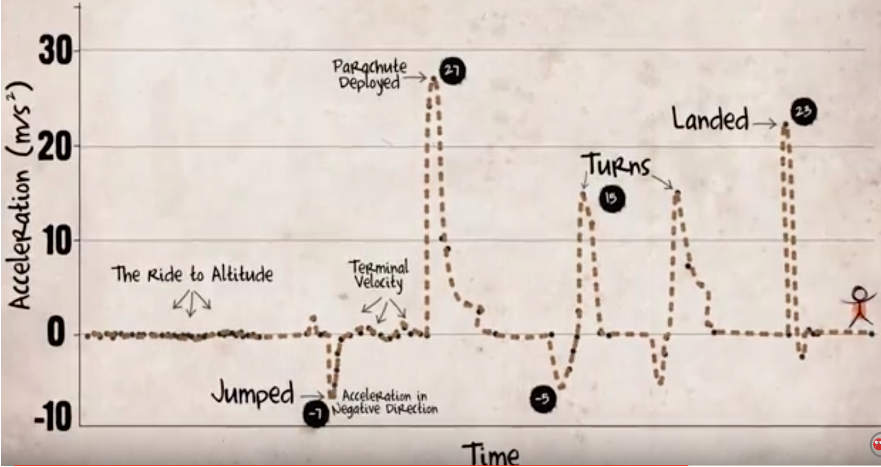
To measure acceleration, the skydiver used a ________ _________, which measures the g-forces.
Acceleration is a _________ in velocity over time.
When you are at a constant velocity in the plane you are ____ accelerating
As soon as you jump out of the plane, your velocity changes because you are accelerating ________.
When the skydiver jumped out of the plane, he had ____________ acceleration of - 7 m/s.
When the skydiver hit ________ velocity, he stopped accelerating.
Use the graph and the words below to answer the questions.
a) What is acceleration?
b) What device can be used to measure acceleration?
c) According to the graph, when is a skydiver’s acceleration the greatest?
d) When is a skydiver’s acceleration the lowest?
Changing speed includes:
* Speeding up = ________ = velocity is increasing in the same direction as acceleration.
Changing speed includes:
* Slowing down = ________ acceleration = velocity is increasing in oposite to the direction the object was accelerating.
A jet that is flying 800 miles per hour see’s huge clouds over the horizon and adjusts to 756 miles per hour.
A jet crosses the huge cloud coverings at 753 miles per hour and the pilot decides it is clear enough, so he adjusts to 802 miles per hour.