Previously, we learned about Discrete Random Variables, which can take on specific values.

Example:
Y = the height of a randomly chosen woman
Previously, we learned about Discrete Random Variables, which can take on specific values.
Example:
Y = the height of a randomly chosen woman
Sometimes, a continuous random variable can be described using a normal density curve
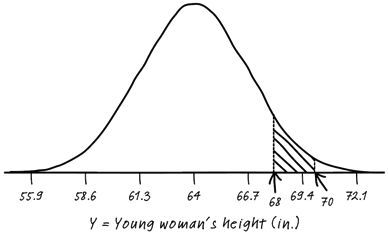
Problem: The heights of young women can be modeled by a Normal distribution
with mean µ = 64 inches and standard deviation σ = 2.7 inches. Suppose we choose a young woman at random and let Y = her height (in inches).
Find P(68 ≤ Y ≤ 70). Round to two decimal places.
Continuous Random Variables can also be modeled by uniform density curves (horizontal line)
Problem: Selena works at a bookstore in the Denver International Airport. She takes the airport train from the main terminal to get to work each day. The airport just opened a new walkway that would allow Selena to get from the main terminal to the bookstore in 4 minutes. She wonders if it will be faster to walk or take the train to work.
Let Y = Selena’s journey time to work (in minutes) by train on a randomly selected day.
The probability distribution of Y can be modeled by a uniform density curve on the interval from 2 to 5 minutes.
What should the height of this density curve be? Answer as a fraction
Find the probability that it will be quicker for Selena to take the train than to walk that day.
Answer as a fraction
Round to two decimal places.
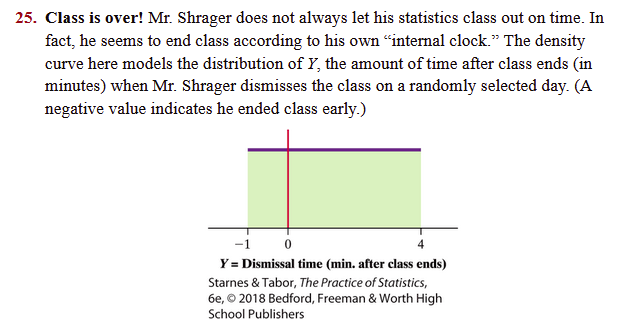
Find the value of P(-1<Y<1). Round to two decimal places.
Interpret the value you found above
What is the Expected Value of Y?
Hint: This is the same as the mean.
Round to two decimal places.
(May require some casual Geometry)
Round to two decimal places.
Round to two decimal places.
Find the probability that the pregnancy lasts between 325 and 345 days. Round to two decimal places.
Write the probability you found above with probability notation.
Find the 80th percentile of the distribution (invNorm may be helpful). Round to two decimal places.