4.1-4.3 Content Check due 12/1 at the beginning of class.
star
star
star
star
star
Last updated over 1 year ago
15 questions
Required
2 points
2
Question 1
1.
Pedro drives the same route to work on Monday through Friday. His route includes one traffic light. According to the local traffic department, there is a 55% chance that the light will be red.
Explain what this probability means.
Required
3 points
3
Question 2
2.
A very good professional baseball player gets a hit about 35% of the time over an entire season. After the player failed to hit safely in six straight at-bats, a TV commentator said, “He is due for a hit by the law of averages.”
Comment on the statement.
Required
4 points
4
Question 3
3.
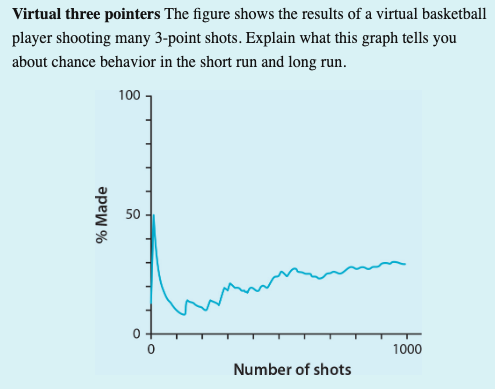
Look at the shape of the graph.
Explain what the shape of this graph tells you about chance behavior in the
1. short run
and
2. long run.
Required
4 points
4
Question 4
4.
A statistics class asked an SRS of 100 students at their school whether they regularly recycle or not.
In the sample, 55 students said that they recycle.
We need to answer: 'Is this convincing evidence that more than half of the students at the school would say they regularly recycle?'
To do this, a simulation was conducted.
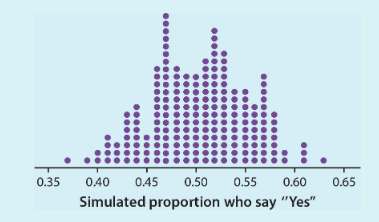
The dotplot below shows the results of a simulation taking 200 SRSs of 100 students from a population in which the true proportion who recycle is 0.50.
Use the simulation results to explain if the sample result (55 out of 100 said “Yes”) gives convincing evidence that more than half of the school’s students recycle.
Hint: Find the decimal percent of samples that had 55 or more students that said 'Yes.' Use this as part of your answer.
Required
4 points
4
Question 5
5.
Use the scenario from #4:
Suppose a sample of 100 students yielded the results that 63 students recycled. Would this result provide convincing evidence that more than 50% of the students at the school recycle?
The dotplot below shows the results of a simulation taking 200 SRSs of 100 students from a population in which the true proportion who recycle is 0.50.
Use the simulation results to explain if the sample result (63 out of 100 said “Yes”) gives convincing evidence that more than half of the school’s students recycle.
Hint: Find the decimal percent of samples that had 63 or more students that said 'Yes.' Use this as part of your answer.
Required
3 points
3
Question 6
6.
Choose a young adult (aged 25 to 29) at random.
The probability is 0.13 that the person chosen did not complete high school,
0.29 that the person has a high school diploma but no further education,
_____ that the person has a high school diploma but not a bachelor's degree,
0.30 that the person has at least a bachelor’s degree.
1. Are these events mutually exclusive? _______
2. What must be the probability that a randomly chosen young adult has some education beyond high school but does not have a bachelor’s degree? _______
3. Use the 'show your work' area to show the math you did to get your answer. I will check the 'show your work' section and adjust points accordingly.
Remember: the sum of the probabilities in a sample space must add to 1.0
Required
1 point
1
Question 7
7.
Same scenario from #6:
Find the probability that the young adult completed high school.
Required
2 points
2
Question 8
8.
Think about #7:
Which probability rule did you use to find the answer?
Why can you use this rule?
Required
2 points
2
Question 9
9.
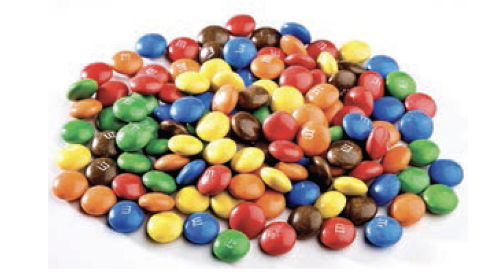
Suppose you tear open the corner of a bag of M&M’S® Milk Chocolate Candies, pour one candy into your hand, and observe the color. According to Mars, Incorporated, the maker of M&M’S, the probability model is

Is this a valid probability model?
Explain why or why not?

Required
4 points
4
Question 10
10.
Randomly select a student who took the 2015 AP® Statistics exam and record the student’s score. Here is the probability model according to the College Board:
Many people consider scores of 3, 4, or 5 as “passing scores” because many colleges award credit or placement to students who earn these scores.
Find the probability that the chosen student scored less than a 3. Use the addition rule for mutually exclusive events. _______ Show your work in the 'show your work' section. Keep your answer as a decimal, keep all decimal places.
Find the probability that the chosen student earned a passing score. _______ Hint: use the complement rule. Show your work in the 'show your work' section, keep all decimal places.
13 points
13
Question 11
11.
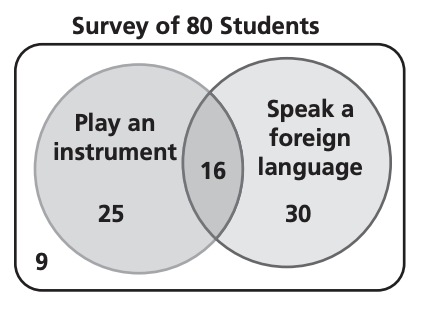
The Venn diagram shows the results of a survey in which 80 students were asked whether they play a musical instrument and whether they speak a foreign language.
Use the Venn diagram to complete the two-way table in the 'show your work' section.
Then use the two-way table to answer each question that follows.
a. How many students play an instrument?_______
b. How many students speak a foreign language? _______
c. How many students play an instrument AND speak a foreign language? _______
d. How many students do not play an instrument and
do not speak a foreign language? _______
e. How many students play an instrument and do not speak a foreign language? _______
Required
5 points
5
Question 12
12.
Using the information from the previous question:
One student is selected at random from the 80 students who took the survey.
Find the probability that the student
a. plays an instrument: _______ Keep all decimal places, keep in decimal form.
b. speaks a foreign language: _______
c. plays an instrument and speaks a foreign language: _______
d. does not play an instrument and does not speak a foreign language: _______
e. plays an instrument and does not speak a foreign language: _______
Required
5 points
5
Question 13
13.
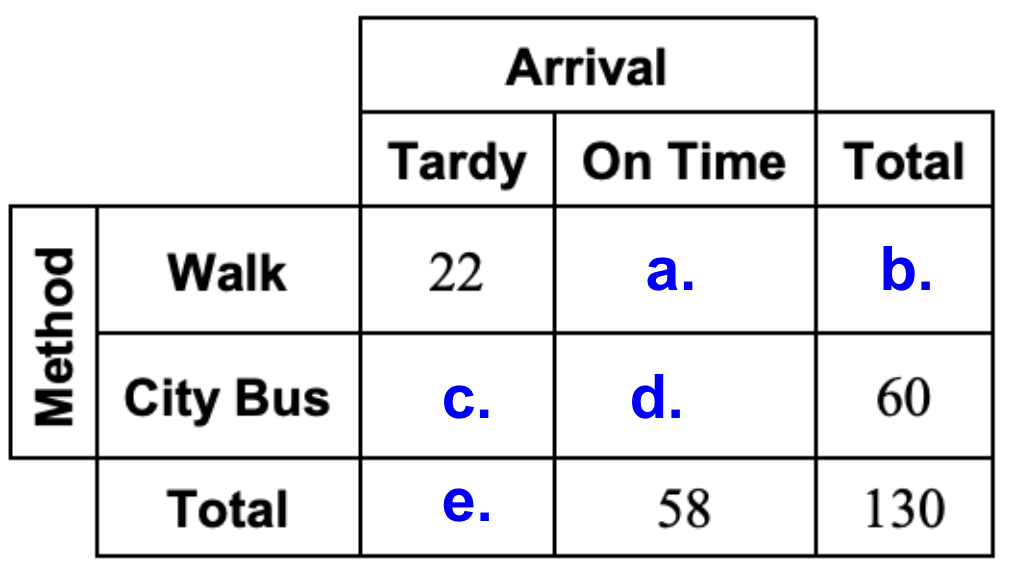
Incomplete information was gathered about methods students use to get to school and their on time records.
Use the following table, fill in the missing numbers.
a. = _______ b. = _______
c. = _______ d. = _______ e. = _______
Required
5 points
5
Question 14
14.
Use the information from the previous table to answer the following questions. Sketch the table on scratch paper for easier access.
Round to three places past the decimal.
a. Find P(Walk & Tardy) = _______
b. Find P(City Bus)= _______
c. Find P(City Bus & On Time) =_______
d. Find P(On Time) = _______
e. Find P(On Time or City Bus) = _______ Hint: use the General Addition Rule
Required
7 points
7
Question 15
15.
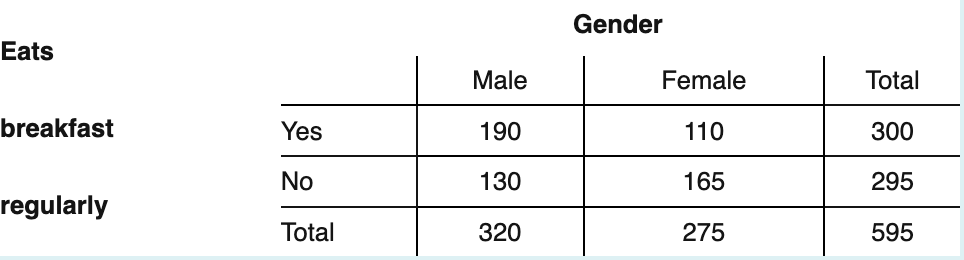
Students in an urban school were curious about how many children regularly eat breakfast. They conducted a survey, asking, “Do you eat breakfast regularly?”
All 595 students in the school responded to the survey. The resulting data are summarized in the two-way table.
Use the information in the table to fill in the Venn Diagram in the 'show your work' section.
Then:
1. find P(Female and Eats Breakfast Regularly) = _______ Round to three places past the decimal, keep your answer in decimal form.
2. find P(Female OR Eats Breakfast Regularly) = _______