Moon Free Response
star
star
star
star
star
Last updated over 2 years ago
19 Nsɛmmisa
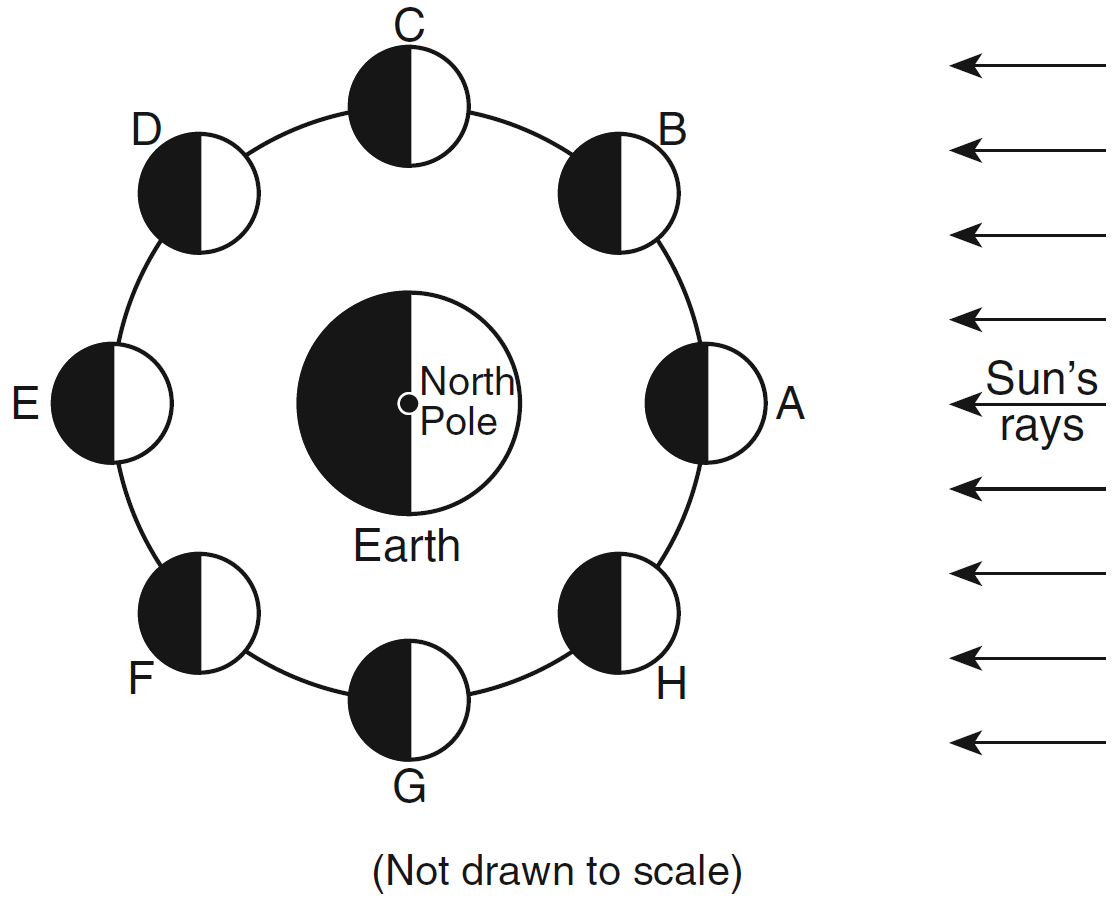
Base your answers to the following questions on the diagram below, which shows the Moon at positions A through H in its orbit around Earth.
1
1
1
Base your answers to the following questions on the diagram below, which shows the Moon at positions A through H in its orbit around Earth.
Which letters represent the two positions of the Moon when the least difference between the levels of high and low ocean tides occur on Earth?
At which Moon position could a lunar eclipse occur?
How many days does it take for the Moon to complete one cycle of phases as viewed from Earth?
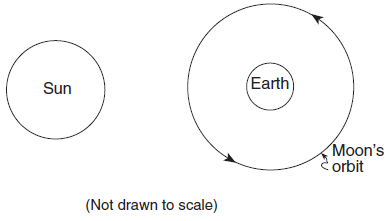
Base your answers to the following questions on the diagram below. The diagram shows the Sun, Earth, and the Moon's orbit around Earth as viewed from space.
Explain why solar eclipses do not occur every time the Moon revolves around Earth.
To represent the Moon's postion in its orbit when a solar eclipse is viewed from earth, draw a circle to represent the Moon's position in its orbit when a solar eclipse is viewed from Earth.
Approximately how many complete revolutions does the Moon make around Earth each month?
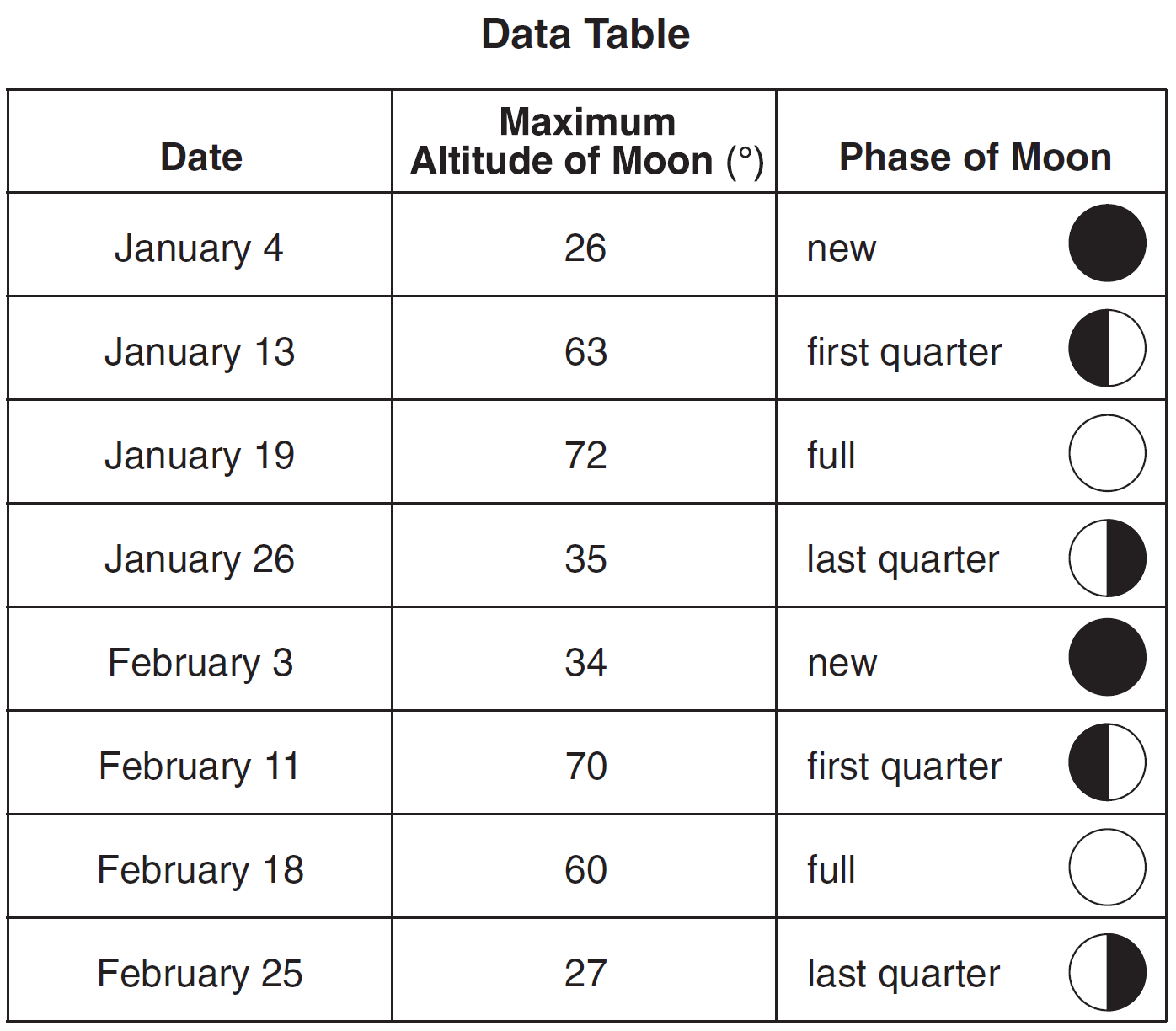
Base your answers to the following questions on the data table below and on the graph. The data table shows the maximum altitude and phase of the Moon observed above the southern horizon on certain dates during January and February at a New York State location. The line on the graph shows the altitude of the noontime Sun observed during the same time period at the same New York State location.
Assuming that February had 28 days, on which date in March did the next full Moon occur?
The diagram shows the Moon's orbit around Earth. Place an X on the orbit to represent the Moon's position on February 18.
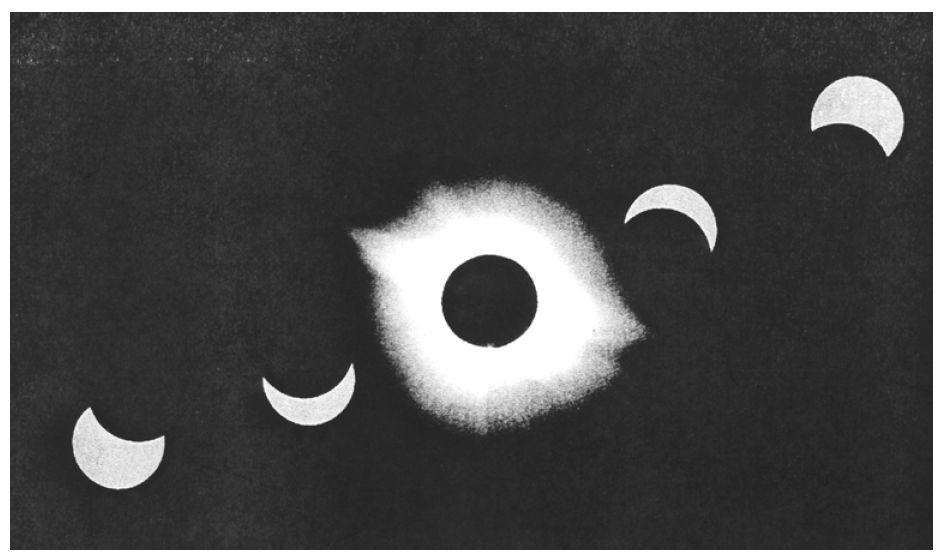
The multiple-exposure photograph below, taken on February 3, shows a total solar eclipse in the middle of the photograph. The maximum altitude of the sun on this date was 34° above the southern horizon at this New York State location.
Based on the data table, explain why this total solar eclipse occurred on February 3.
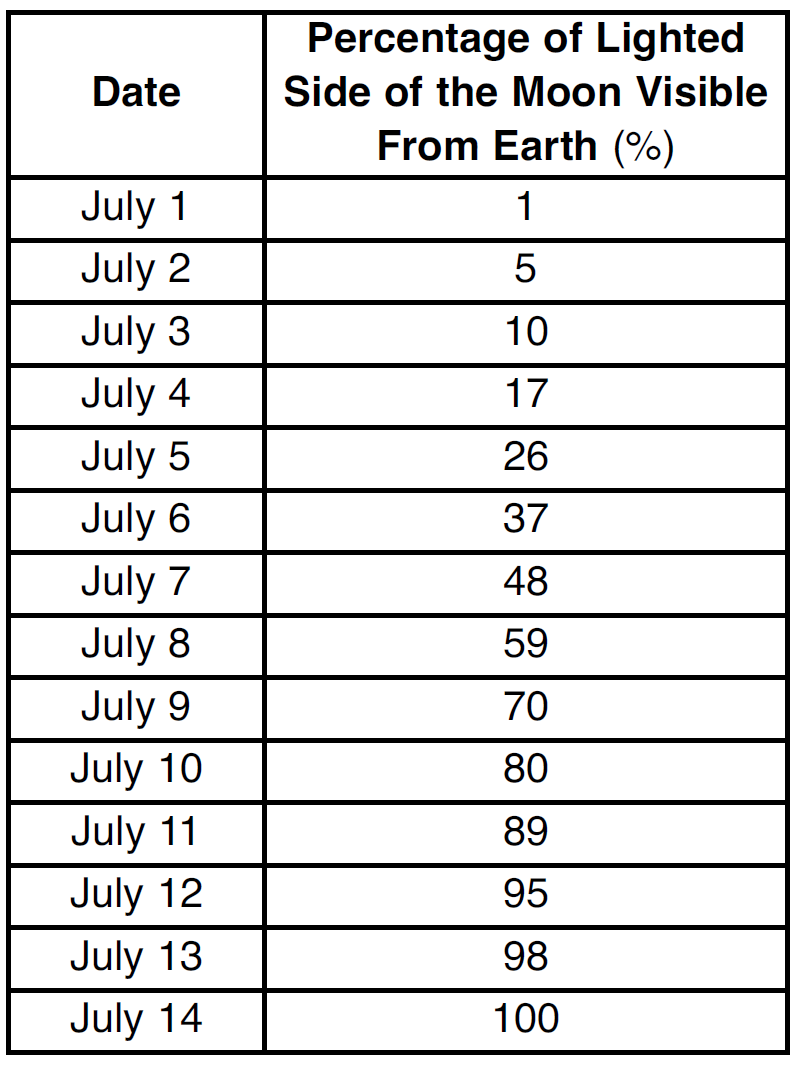
Base your answers to the following questions on the data table below, which shows the percentage of the lighted side of the Moon visible from Earth for the first fourteen days of July 2003.
What motion of the Moon causes the percentage of the lighted side of the Moon visible from Earth to change from July 1 to July 14?
A full Moon phase was observed on July 14. On what day in August was the next full Moon phase observed?
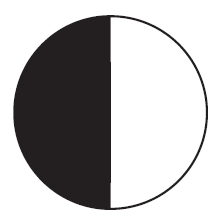
On what July date listed in the table did the Moon appear as shown below?
Why are the phases of the Moon considered to be cyclic?
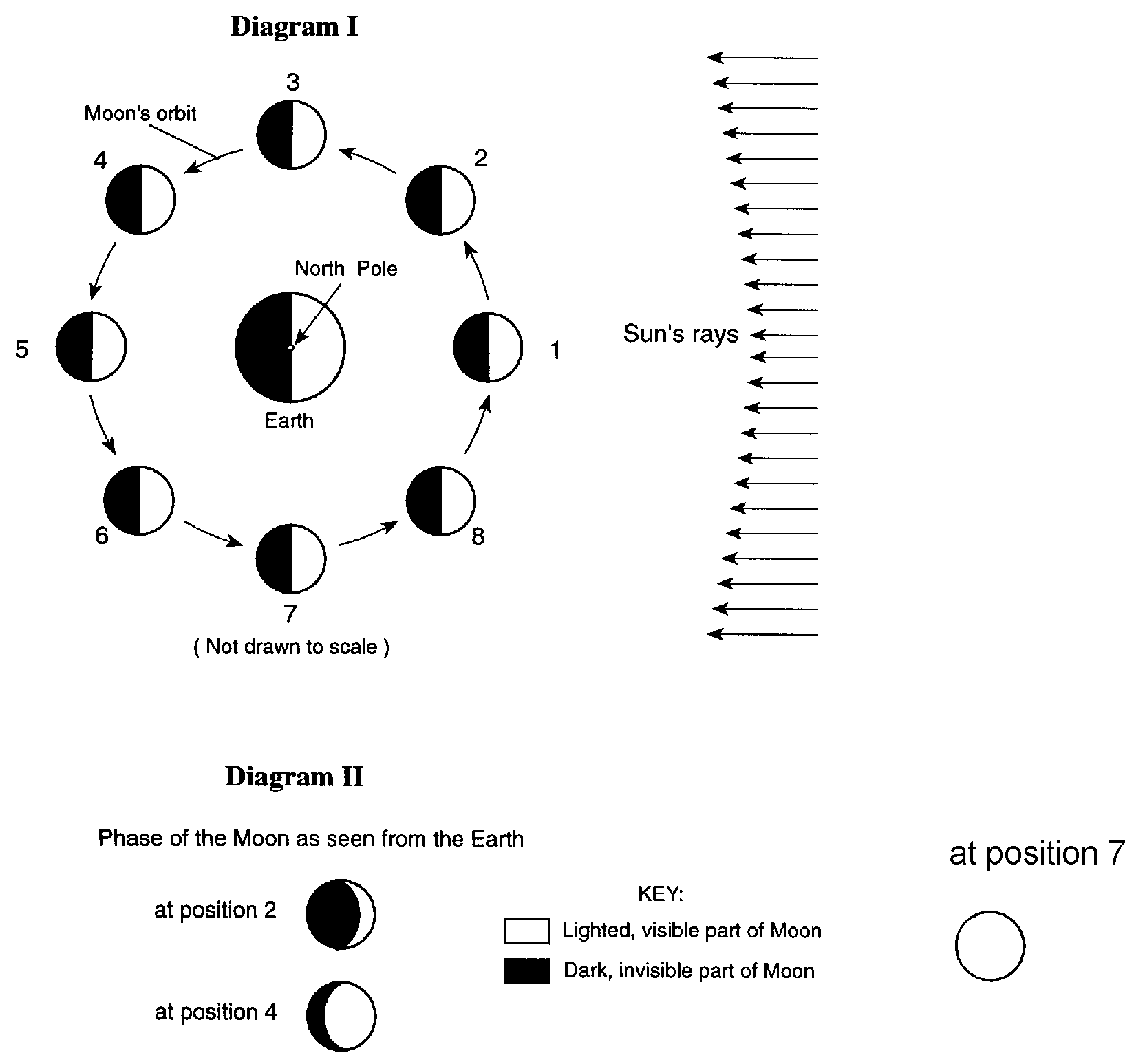
Base your answers to the following questions on the diagrams below. Diagram I represents the Moon orbiting the Earth as viewed from space above the North Pole. The Moon is shown at 8 different positions in its orbit. Diagram II represents phases of the Moon as seen from the Earth when the Moon is at position 2 and at position 4.
State the two positions of the Moon at which an eclipse could occur.
Shade the circle provided to illustrate the Moon's phase as seen from the Earth when the Moon is at position 7
The Blue Moon
A "Blue Moon" is the name given to the second full moon in a calendar month. Because there are roughly 29.5 days between full moons, it is unusual for two full moons to "fit" into a 30 or 31 day month (and impossible to fit into a 28 or 29 day month, so February can never have a Blue Moon). The saying "Once in a Blue Moon" means a rare occurrence, and predates the current astronomical use of the term, which is quite recent. In fact, Blue Moons are not all that rare, on average there will be one Blue Moon every 2.5 years. After 1999, the next Blue Moons will be in November 2001; July 2004; and June 2007. The last one before 1999 was in July 1996.
The term Blue Moon is believed to have originated in 1883 after the eruption of Krakatoa. The volcano put so much dust in the atmosphere that the Moon actually looked blue in color. This was so unusual that the term "once in a Blue Moon" was coined.
"The Blue Moon"
David R. Williams
Explain why a Blue Moon never occurs during the month of February.
What is the greatest number of full-Moon phases, visible from Earth, that are possible in a span of 1 year?
Draw the relative positions of Earth, the Moon, and the Sun, as viewed from space, so that a full-Moon phase would be visible to an observer on Earth. Label Earth, the Moon, and the Sun in your drawing.
Use the circle tool to aid in your drawing, remembering to use different sized circles. Use the text to label them.
The diagram below shows the orbit of the Moon around Earth. Place an X on the orbit to show where the Moon was in its orbit on July 14, 2003.