Micro BM9 Microbial Nutrition and Growth (Chapter 6)
star
star
star
star
star
Last updated 24 days ago
18 questions
Note from the author:
NGSS LS1-2 CCC: Patterns PE: Analyzing and Interpreting Data DCI: LS1.A
Please read carefully before choosing your answer.
3
3
3
3
3
3
3
3
3
3
3
3
3
3
3
Free Response
4
6
Claim, Evidence, and Reasoning
15
Question 1
1.
The term autotroph refers to an organism that
Question 2
2.
Bacteria living in a freshwater stream that are moved to salty seawater would
Question 3
3.
An organism that cannot tolerate an oxygen environment is a(n)
Question 4
4.
A saprobe derives its energy from ________________________.
Question 5
5.
The term facultative refers to
Question 6
6.
When the suffix "phile" is added to a word like meso, you should infer that the organism _________________.
Question 7
7.
The time interval from parent cell to two new daughter cells is called the
Question 8
8.
What type of organisms prefer temperatures above 80°C?
Question 9
9.
Microorganisms require large quantities of this nutrient for use in cell structure and metabolism:
Question 10
10.
Human pathogens fall into the group
Question 11
11.
In ________ conditions, the cell wall will help prevent the cell from bursting.
Question 12
12.
Microbes that form tight-knit relationships with other organisms would include all but the following relationship?
Question 13
13.
Which of the following is true of passive transport?
Question 14
14.
What do colonies on an agar plate indicate?
Question 15
15.
What environmental condition typically increases the rate of binary fission?
Question 16
16.
CCC: Patterns
Imagine you are a microbe living on or in a human. Define your ecological role by explaining how you interact with your human host and the other microbes around you.
For full credit: vocabulary based on relationships/associations must be present, examples, and human and microbe relationships must be present.
Question 17
17.
PE/Data: Analyzing and Interpreting Data:
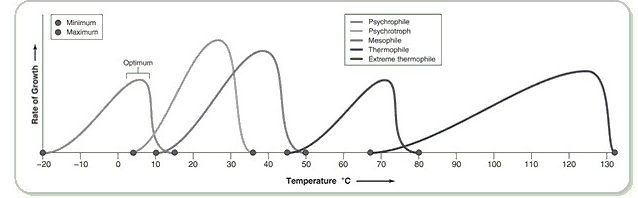
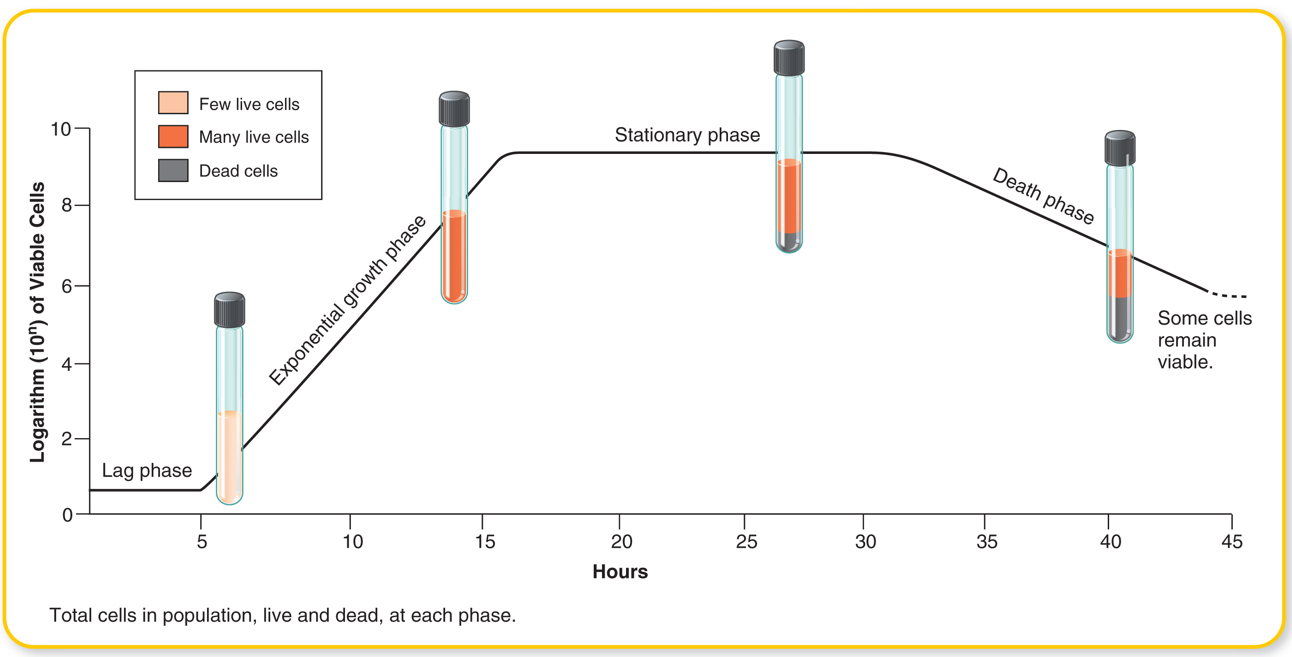
Using the growth curve and the following graph explain the observation below.
A friend of yours is having a picnic.
How would you explain to them that food poisoning could still occur even if the food is refrigerated?
How would you let them know that they should freeze food if there are preparing for the picnic day ahead of time?
For full credit: both the growth curve and the temperature graph must be referenced in your answer.
Question 18
18.
CER: Claim, Evidence, and Reasoning 7pts
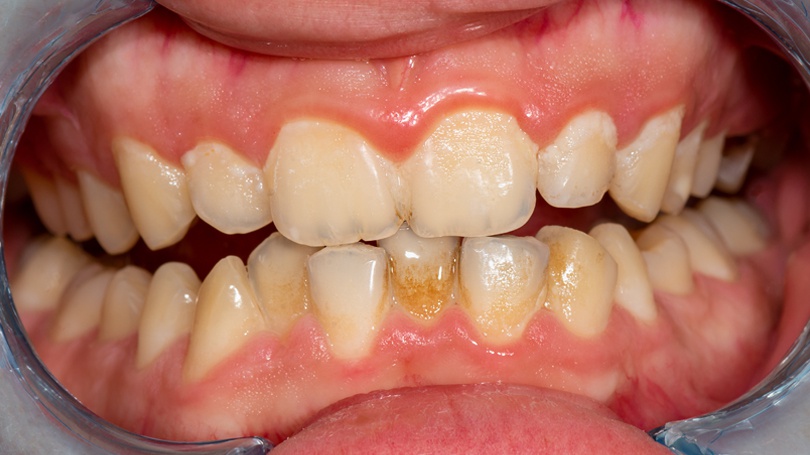
Biofilms:
Biofilms are mixed communities of different kinds of bacteria and other microbes that are attached to a surface and to each other, forming a multilayer conglomerate of cells and intracellular material. Usually there is a “pioneer” colonizer, a bacterium that initially attaches to a surface, such as a tooth or the lung tissue. Other microbes then attach either to those bacteria or to the polymeric sugar and protein substance that inevitably is secreted by microbial colonizers of surfaces. In many cases, once the cells are attached, they are stimulated to release chemicals that accumulate as the cell population grows. By this means, they can monitor the size of their own population. This is a process called quorum sensing. Bacteria can use quorum sensing to interact with other members of the same species, as well as members of other species that are close by. Eventually large complex communities are formed, which have different physical and biological characteristics in different locations of the community. The bottom of a biofilm may have very different pH and oxygen conditions than the surface of a biofilm, for example. It is now clearly established that microbes in a biofilm, as opposed to those in a planktonic (free-floating) state, behave and respond very differently to their environments. Different genes are even activated in the two situations. At any rate, a single biofilm is actually a partnership among multiple microbial inhabitants and thus cannot be eradicated by traditional methods targeting individual infections. This kind of synergism has led to the necessity of rethinking treatment of a great many different conditions.
Question:
"Does a bacterial biofilm exhibit emergent properties that make it 'greater than the sum of its parts'? Make a claim comparing the survival of a biofilm community to the survival of individual, free-floating (planktonic) bacteria."
a. Make a claim by answering the above question.
b. Use evidence from the given information and image to support your claim.
c. Give the scientific reasons/rationale/theory that allow you to use your evidence in support of your claim.
See the rubric to ensure you get the greatest amount of points for your answer.