7-5 Check for Understanding
star
star
star
star
star
Last updated over 3 years ago
8 Nsɛmmisa
Ɛhia
1
Ɛhia
1
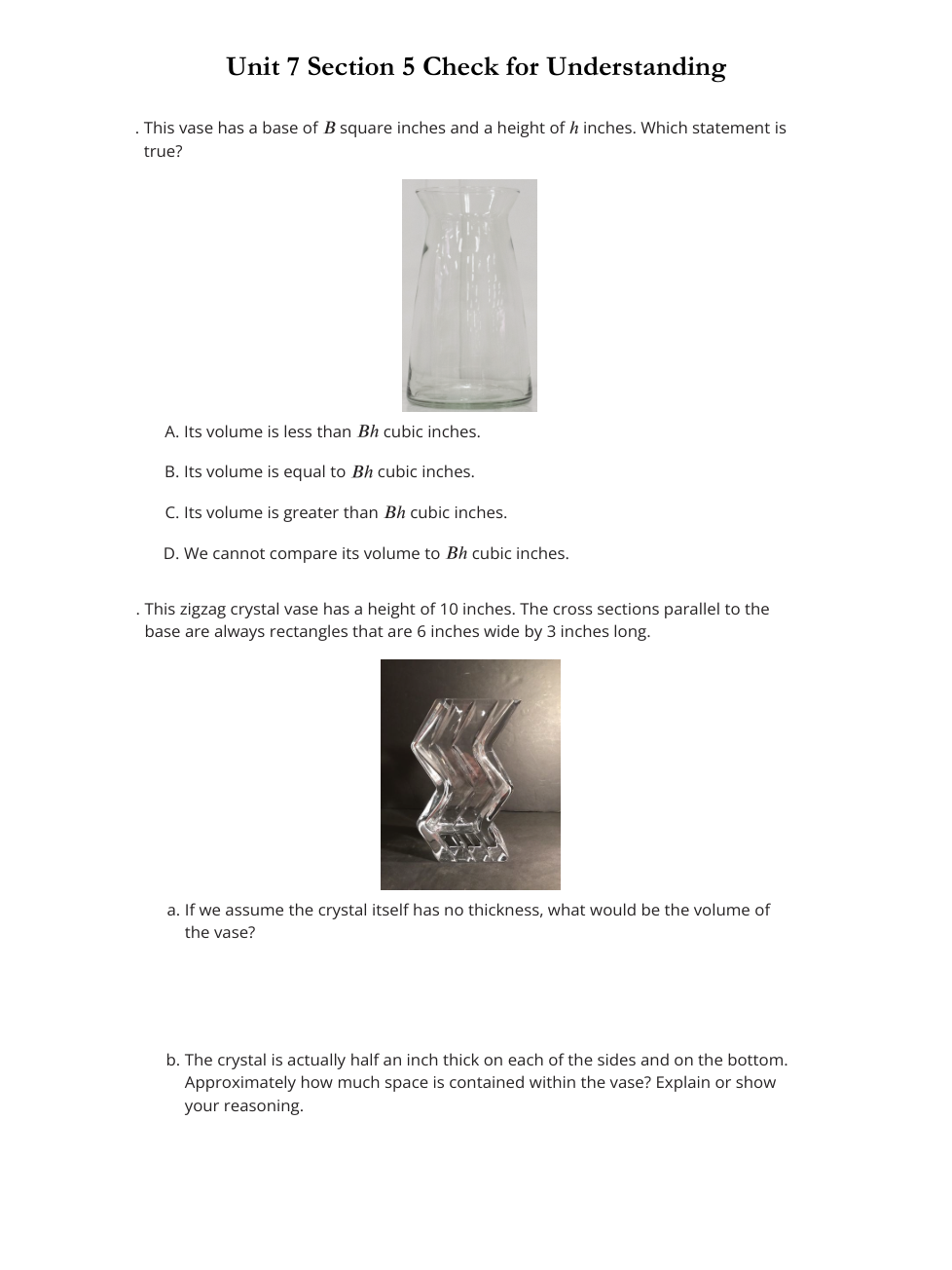
This zigzag crystal vase has a height of 10 inches. The cross sections parallel to the base are always rectangles that are 6 inches wide by 3 inches long. If we assume the crystal itself has no thickness, what would be the volume of the vase? (Round to the nearest tenth.)
This zigzag crystal vase has a height of 10 inches. The cross sections parallel to the base are always rectangles that are 6 inches wide by 3 inches long. The crystal is actually half an inch thick on each of the sides and on the bottom Approximately how much space is contained within the vase? (Round to the nearest tenth.)
The container in the shape of a
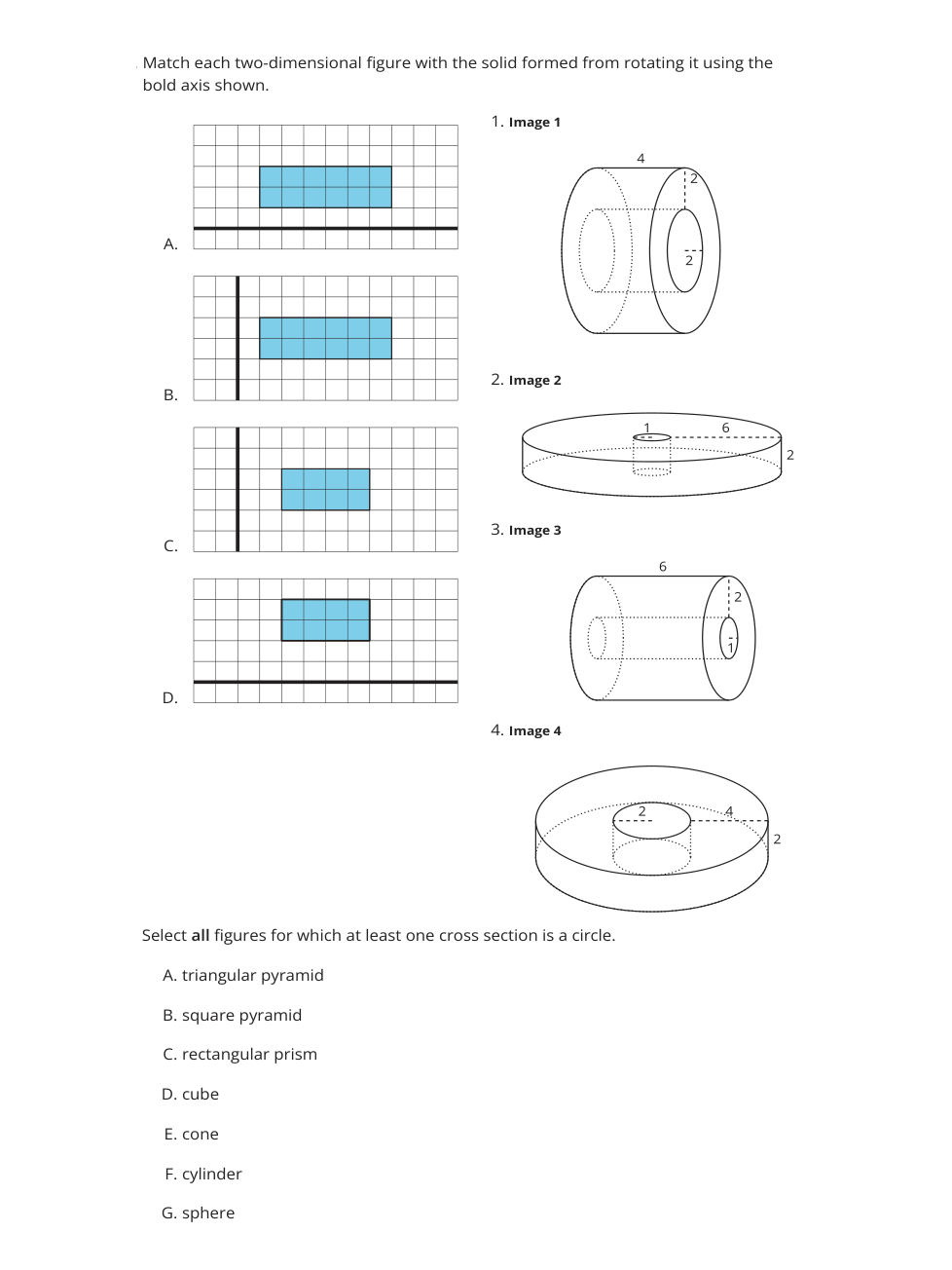
Match each two-dimensional figure with the solid formed from rotating it using the bold axis shown.
| Draggable item | arrow_right_alt | Corresponding Item |
|---|---|---|
C | arrow_right_alt | Image 3 |
A | arrow_right_alt | Image 2 |
D | arrow_right_alt | Image 4 |
B | arrow_right_alt | Image 1 |
Select all figures for which at least one cross section is a circle.
The vase has a base of B square inches and a height of h inches. Which statement is true?
This water bottle has a base with area B square inches and a height of h inches. Tyler thinks the volume of the water bottle is Bh. Elena thinks the volume is less than Bh. Who is correct?
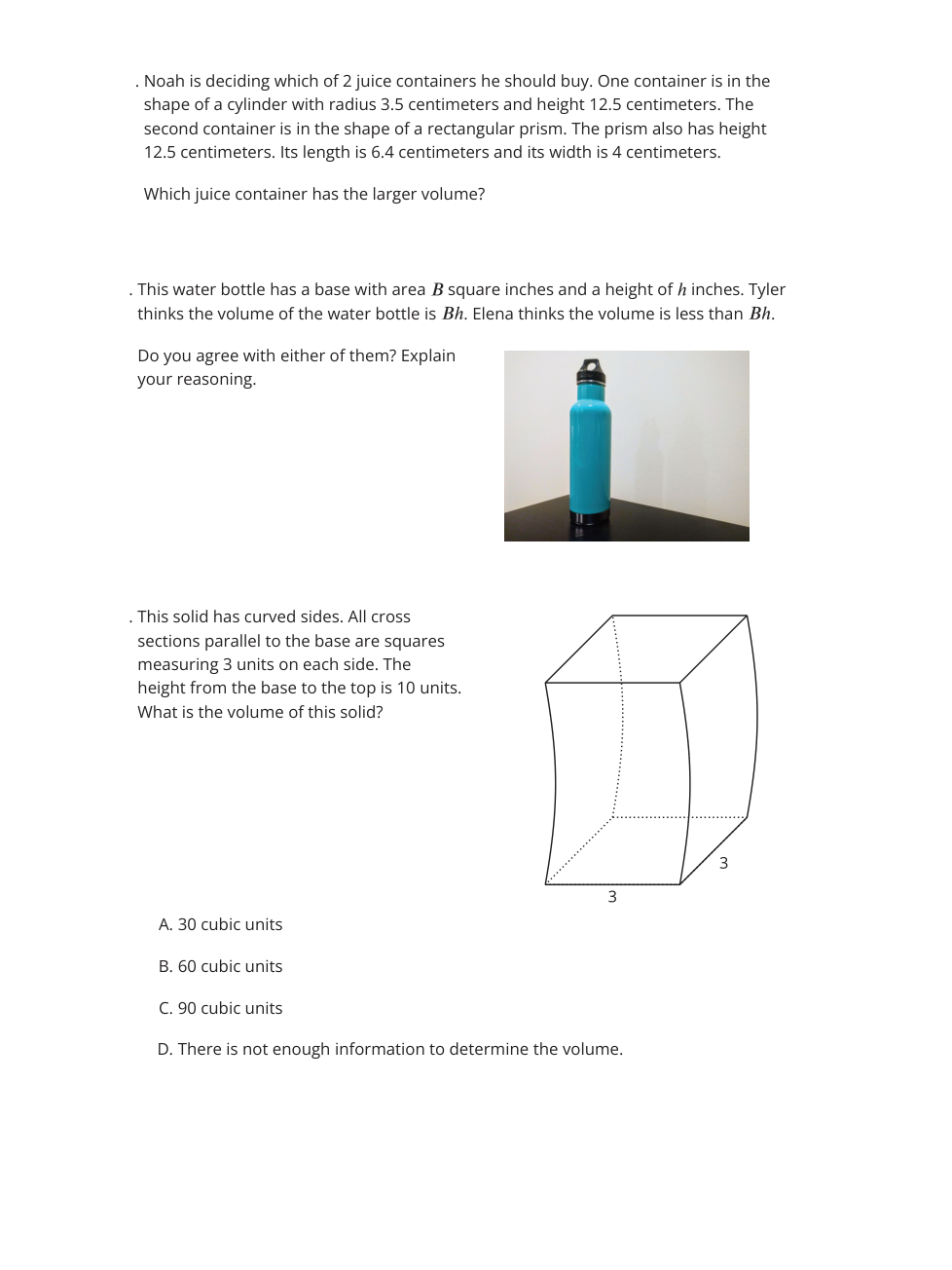
This solid has curved sides. All cross sections parallel to the base are squares measuring 3 units on each side. The height from the base to the top is 10 units. What is the volume of the solid?