Formative (Practice): Geometry C and D

Last updated over 2 years ago
16 questions
The Christmas tradition of decorating evergreen trees began in Germany in the 16th century. With their roughly conical shape, it was possible to decorate them and enjoy their beauty from all sides. (No decorations were put underneath the circular face.)
1

A tree located in Rockefeller Center in New York City is lit every year in early December. The largest tree measured 100 feet tall and has a base diameter of 60 feet. Find the volume of the tree. If every cubic foot weighs 40 pounds, find the total weight of the tree.

1

The trunk of the tree in itself is enormous, to hold up such a massive tree. The bottom half of the truck is roughly the shape of a cylinder, If the volume of the trunk is 314 ft^3 and the radius is 1 ft, then prove that this tree is a hundred feet tall.

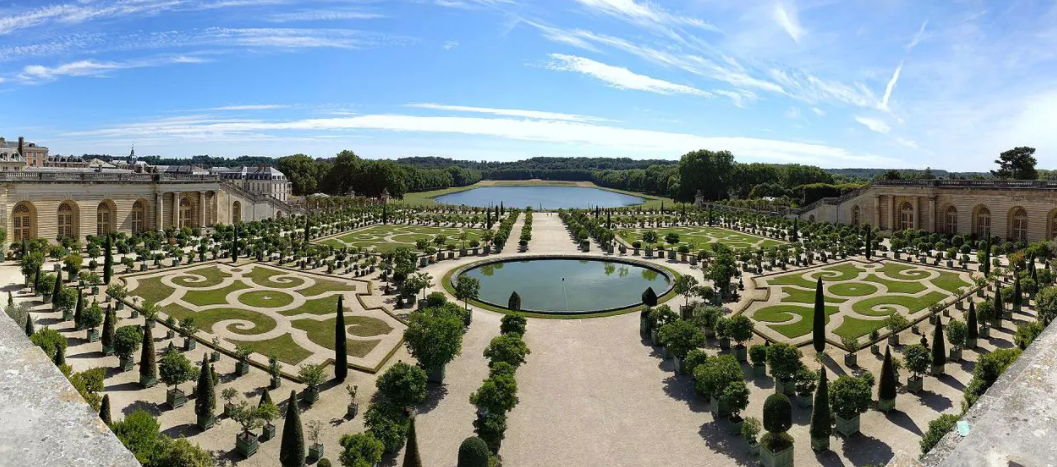
This expansive garden, which sits just to the west of the Palace of Versailles, sprawls across nearly 2,000 acres of land. Much of the landscape is styled as a classic French garden with its signature symmetry and order. The manicured lawns are dotted with flowers, sculptures, and fountains that date back to the time of Louis XIV. Fit for a king, the Gardens of Versailles were named a UNESCO World Heritage Site, along with the palace itself.
1

The circular pool at the centre of the garden has a radius of 50 m, find the length of the path around the pool.

1

The area of the whole garden, which is a square, including the circular pool is 90000 m^2. Find the area of the plantable surface in the garden (ie, the area without the pool) the formula for the area of a square is given by:
Area = Side * Side

1

At a particular time of the day, because of the way the buildings are arranged the sun lights 60° of the pool, find the area of the pool that is lit by the sun.

Near Mexico City is The Temple of the
Feathered Serpent, one of hundreds of pyramids
in the Mesoamerican City of Teotihuacan.
Archaeologists used a robot and found hundreds
of spheres with circumferences ranging from
about 3.5 cm to 12.5 cm.
1

Find the amount of clay they would need to make both the smallest and the largest ball.
If they had 2000 cm^3 of clay, how may small balls could they make?

1
1
1
1
1
1
1
1
1
1