How a Colour-Blind Artist Became the World’s First Cyborg
From prosthetics to pharmaceuticals, humans have been using technology to alter their physical and mental capabilities for thousands of years. Now, with our rapid advances in technology, some people are embracing human augmentation as a means of expressing themselves and experiencing the world in a totally different way.
Neil Harbisson, 33, is one of these people. The artist was born with achromatopsia, or complete colour-blindness. Far from a disability, Harbisson considers his natural world-view to be an asset, though he did want to be able to understand different dimensions to sight. (Read "How Humans Are Shaping Our Own Evolution.")
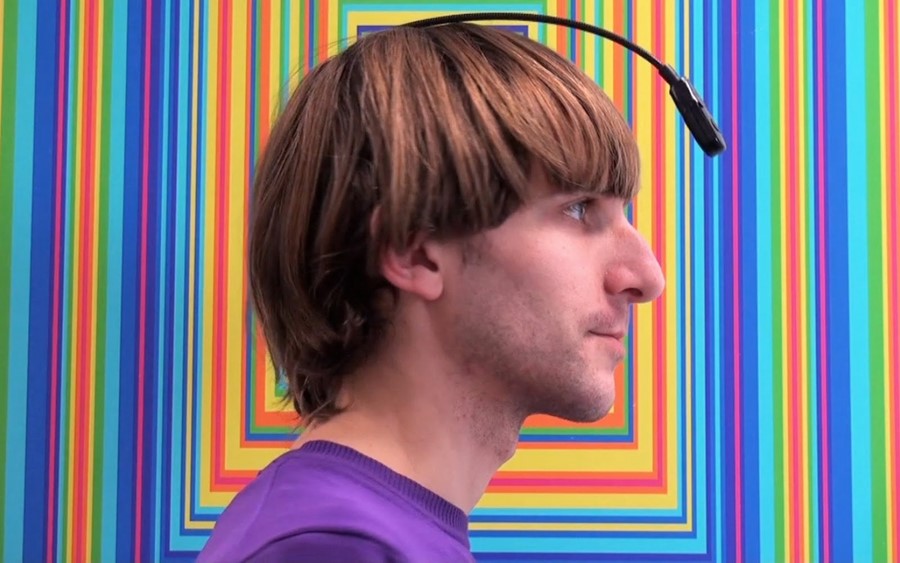
Over the last 13 years, he has been able to “hear” visible and invisible wavelengths of light. An antenna-like sensor implanted in his head translates different wavelengths into vibrations on his skull, which he then perceives as sound.
How do you describe what it's like to be a cyborg?
There is no difference between the software and my brain, or my antenna and any other body part. Being united to cybernetics makes me feel that I am technology.
The definition that [scientist] Manfred Clynes gave for "cyborg" in 1960 was that in order to explore and survive in new environments, we had to change ourselves instead of changing our environment. Now, we do have the tools to change ourselves. We can add new senses, new organs. (Explore a visual timeline of human evolution.)
Why did you create this sense for yourself?
My aim was never to overcome anything. Seeing in grayscale has many advantages. I have better night vision. I memorise shapes more readily, and I’m not easily fooled by camouflages. And black-and-white photocopies are cheaper. I didn’t feel there was a physical problem, and I never wanted to change my sight. I wanted to create a new organ for seeing.
What’s the most unusual aspect to your extrasensory abilities?
At first I could just sense the visual spectrum of light, but I’ve upgraded it to include the infrared and ultraviolet [UV] spectra. One thing is being able to tell if it’s a good or bad day to sunbathe. If I sense there’s a high level of ultraviolet light, it’s not a very good day, so I know to wait a bit or put on some extra sun cream.
When I go walking in the forest, I like the ones with high levels of UV. They’re loud and high-pitched. One would think the forest is peaceful and quiet, but when there’s ultraviolet flowers all around, it’s very noisy.
What are the most memorable questions you get from people about your antenna?
I don’t get any particular questions, but what people think about my antenna changes with time. In 2004, people thought it was a reading light; they’d ask me if I could turn it on. In 2007, it was a hands-free phone, then in 2008 and 2009, it was a GoPro camera. In 2015, many children thought it was some kind of extendable selfie stick. Last year, people started yelling "Pokemon!" at me. In a small village in Italy, an old man asked me if I could make cappuccinos with it.
If people start instead asking, What can you sense with it? I know it will mean it’s become normal, and that people understand it’s a sensory organ.
How has your experience of the world shifted since you got your implant?
My understanding of the world has become more profound. The more you extend your senses, the more that you realise exists. If you’re in the same house for years, there’s a repetition of what you perceive there. If you add a new sense, though, the house becomes new again.
How has your self-perception shifted?
I feel connected with nature in a stronger way. I consider myself trans-species: Having an antenna is common for other species, or sensing in infrared and ultraviolet, but it’s not traditional for humans.
What other technologies could break the boundaries of what is considered human?
Most projects I see are chips, software or apps that give you the intelligence, not the sense. We’ve been giving sense to all these machines instead of ourselves, like cars with the sense of what’s behind them, and we can’t even do that.
Imagine something like an earring that could give you 360 degrees of perception of your surroundings, and maybe it could buzz to tell you someone’s behind you. It’s strange to me that simple things like this aren’t happening.
Should there be restrictions on how people can modify themselves?
I think we should all have the freedom to design ourselves as much as we want. Each sense depends on the individual. In the same way we all have eyes or ears, we all use them in different ways, and people use them in good and bad ways.
Do you believe that augmentation may ultimately influence human evolution?
If, by the end of the century, we start printing our own sense organs, implanted with DNA instead of using chips, the possibility of having children born with these senses is real. If their parents have modified their genes or made new organs, then yes, it’s just the beginning of a renaissance for our species.