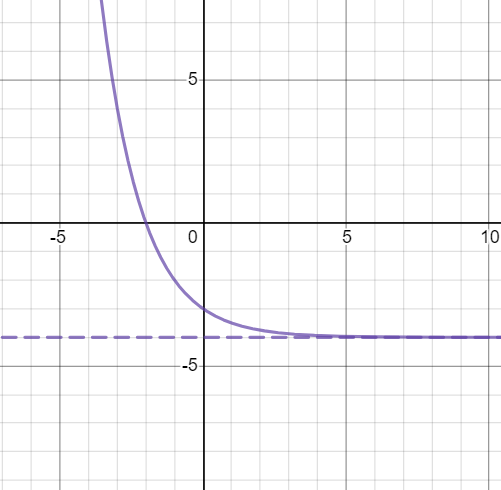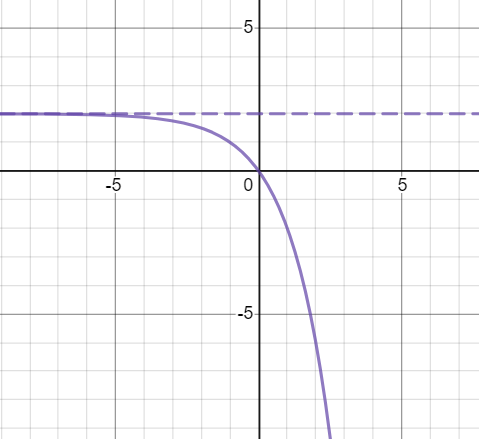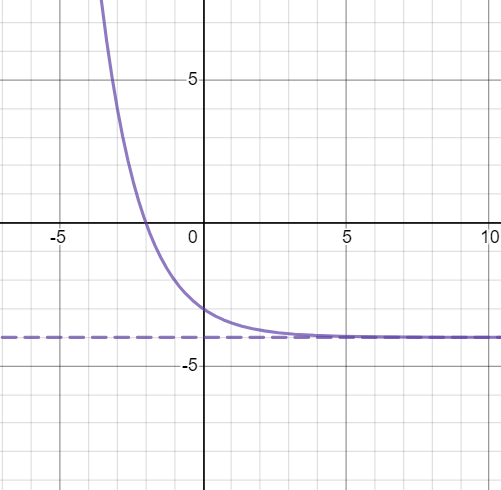
Which of the following is the equation of the function graphed?
Which of the following is the equation of the function graphed?
What is the equation of the asymptote for the graph of:
(give your answer as an equation of a line)
What is the equation of the asymptote for the graph of:
(give your answer as an equation of a line)
Which of the following is the equation of the function graphed?
Given the graph shown, determine the end behavior:
What is the domain of the function
(give your answer in interval notation)
What is the range of the function
(give your answer in interval notation)
What are the domain and range for the exponential function shown below?
all real numbers except 1
domain
range
Write the equation for the function that would transform the graph of
4 units to the right, 3 units down, and reflected in the x-axis
use
in your answer
The equation
transforms the parent function
by shifting it:
Find the inverse of
use
in your answer (show your work for credit)
Drag and drop the appropriate function into the box:
A function that describes exponential decay
A function that describes exponential growth
Find the y-intercept of the following function
give your answer as an ordered pair (x,y)
Given the functions
what is the value of x? (show your work for credit)
A new radioactive element is governed by the following formula
where a is the initial mass, m is the current mass, and t is the number of days that has passed.
If the initial mass is 128g, how many days will it take to lose 1/2 it's mass?
A new radioactive element is governed by the following formula
where a is the initial mass, m is the current mass, and t is the number of days that has passed.
If the initial mass is 128g, how many days will it take for the mass to reach 1g? (show your work for credit)
t represents the number of years since buying a car and V represents the trade value in dollars. If the given data can best be described using the following formula:
What will the value of the car be 10 years after purchase? (round your answer to the nearest hundreths place..like dollars and cents)
t represents the number of years since buying a car and V represents the trade value in dollars. If the given data can best be described using the following formula:
What will be the approximate age (t) of the car when it is worth $1000.00? (show your work for credit)
Round your answer to the nearest WHOLE number.
Condense the expression below into a single logarithm
(show your work for credit)
Expand the expression below
(show your work for credit)
Solve. Round your answer to 4 places beyond the decimal
(show your work for credit)
Solve. Round your answer to 4 places beyond the decimal, if necessary.
(show your work for credit)
Solve
(show your work for credit)
Convert to logarithmic form:
(show your work for credit)
Convert to exponential form:
(show your work for credit)