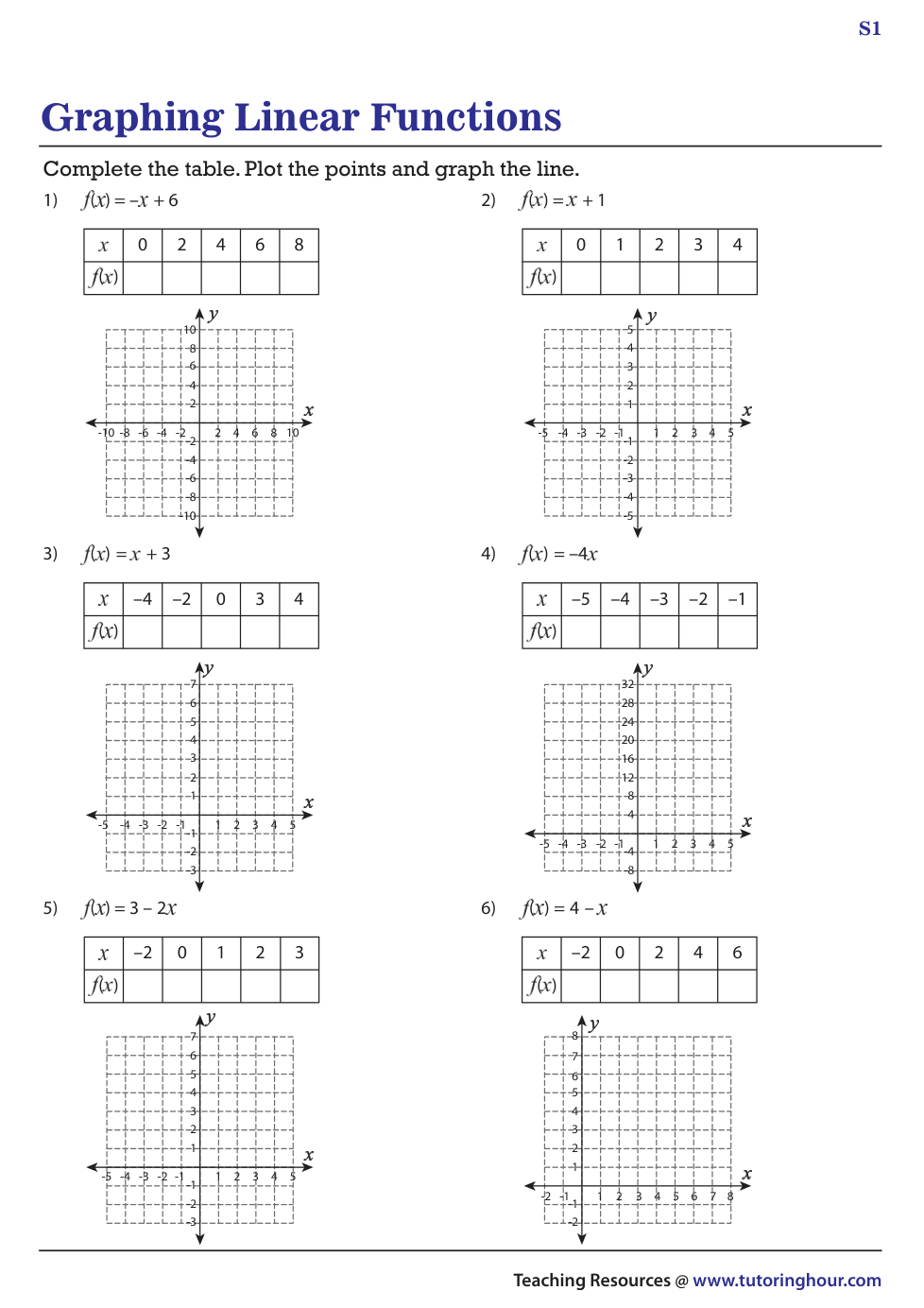
Given the function and domain, find the range values.
y = -4x; domain = {-5, -4, -3, -2, -1}
(Level 3)
Given the function and domain, find the range values.
y = 4 - x; domain = {-2, 0, 2, 4, 6}
(Level 3)

Complete the table by matching the x-value with the correct f(x)-value.
f(x) = -x + 6
(Level 2)
| Draggable item | arrow_right_alt | Corresponding Item |
|---|---|---|
x = 4 | arrow_right_alt | f(x) = 6 |
x = 6 | arrow_right_alt | f(x) = 4 |
x = 8 | arrow_right_alt | f(x) = 2 |
x = 0 | arrow_right_alt | f(x) = 0 |
x = 2 | arrow_right_alt | f(x) = -2 |

What is the domain?
(Level 3)
What is the range?
(Level 3)
Graph the points from Question 1.
(Level 2)
Complete the table by matching the x-value with the correct f(x)-value.
f(x) = 3 - 2x
(Level 2)
| Draggable item | arrow_right_alt | Corresponding Item |
|---|---|---|
x = 1 | arrow_right_alt | f(x) = 7 |
x = 2 | arrow_right_alt | f(x) = 3 |
x = 3 | arrow_right_alt | f(x) = 1 |
x = -2 | arrow_right_alt | f(x) = -1 |
x = 0 | arrow_right_alt | f(x) = -3 |
Graph the points from Question 3.
(Level 2)
What is the domain?
(Level 3)
What is the range?
(Level 3)
What is the domain?
(Level 3)
What is the range?
(Level 3)
Explain why the range is all real numbers, but the domain isn't.
(Level 4)