Log in
Sign up for FREE
arrow_back
Library

Semester 1 Final 2022 (backup)

star
star
star
star
star
Last updated almost 3 years ago
30 questions
1
1
1
1
4
1
1
1
1
4
1
1
1
1
1
1
1
1
1
1
1
1
1
2
4
1
1
1
1
4
Question 1
1.

Question 2
2.

Question 3
3.

Question 4
4.

Question 5
5.

Draggable itemarrow_right_altCorresponding Item
arrow_right_alt
arrow_right_alt
arrow_right_alt
arrow_right_alt
Question 6
6.

Question 7
7.

Question 8
8.

Question 9
9.

Question 10
10.

Draggable itemarrow_right_altCorresponding Item
arrow_right_alt
arrow_right_alt
arrow_right_alt
arrow_right_alt
Question 11
11.

Question 12
12.

Question 13
13.

Question 14
14.

Question 15
15.

Question 16
16.

Question 17
17.

Question 18
18.

Question 19
19.

Question 20
20.

Question 21
21.

Question 22
22.

Question 23
23.

Question 24
24.

Draggable itemarrow_right_altCorresponding Item
arrow_right_alt
arrow_right_alt
Question 25
25.

Draggable itemarrow_right_altCorresponding Item
arrow_right_alt
arrow_right_alt
arrow_right_alt
arrow_right_alt
Question 26
26.

Question 27
27.

Question 28
28.

Question 29
29.

Question 30
30.

Draggable itemarrow_right_altCorresponding Item
arrow_right_alt
arrow_right_alt
arrow_right_alt
arrow_right_alt
What are the three phases of water?
Ice, liquid, water
Solid, ice, water vapor
Water vapor, liquid, gas
Ice, water, water vapor
What is true about macroinvertebrates?
They are animals with no backbone that are visible to the naked eye
They are categorized into three groups by how they react to pollution: very sensitive, somewhat sensitive, and tolerant
You can tell long term health of a stream by looking at them
All of the above
Water can NOT get directly back into the ocean by:
Underground flow
Surface run-off
Precipitation
Infiltration
What happens to the water molecules as they get below 4°C?
The water molecules expand
The water molecules condense and get denser
The water molecules get less dense and float
Both A and C
Match the following types of living organisms with the correct definition.
Nekton
On the bottom sands or in the sands; clam
Benthos
floating on the surface; algae
Neuston
Floating in the water column; phyto or zoo___
Plankton
Free swimming; fish
What is a floodplain?
An area of low-lying ground adjacent to a river, formed mainly of river sediments and subject to flooding
An area on the continental shelf that gets covered with water during low tide.
A reservoir to collect rain water.
A populated area that was devastated by a flood.
Water combines with carbon dioxide in the air or water to produce carbonic acid causing ocean acidification.
True
False
When a polar molecule, like soap or salt, is added to water, the:
Surface organisms will sink
Polar molecules will mix in all the water
Some surface organisms will sink and some will float
Both A and B
Choose the statement that is TRUE.
Sublimation is the process sweat goes through when it is evaporating
Sublimation can be found in aquifers as the rain infiltrates through the soils
Sublimation can occur from snow-covered mountains and glaciers
None of these are true
Match the appropriate word for the amounts of each found on Earth.
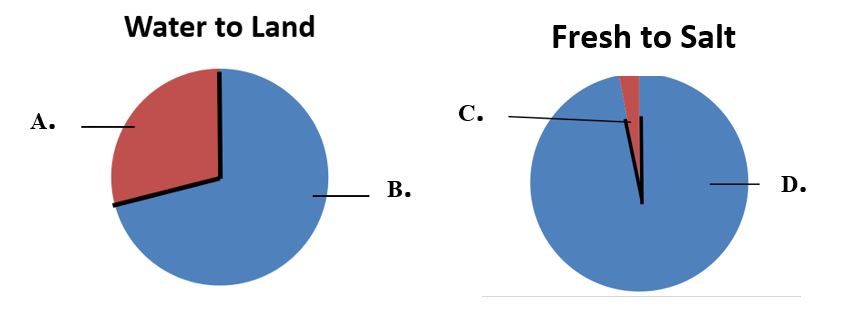
D
Land
A
Water
B
Fresh water
C
Salt water
What divides a watershed or drainage basin?
The watershed or drainage basin is divided by the person who owns the property
The watershed or drainage basin divide is created by where the river flows
The divide is created by the highest points of land surrounding the watershed or drainage basin
The divide is created by the political government in which the watershed or drainage basin is found.
Salinity of seawater increases
As evaporation increases
Around ice as ice melts in spring
Near the mouth of rivers
With an increase in rain
In a natural area/country, what percent of precipitation infiltrates into the ground?
25%
50%
75%
85%
Water molecules are constantly breaking bonds with other water molecules and re-bonding.
True
False
What happens to pollution in a watershed?
It stays in the same place
It washes into the nearest stream
It can pollute things downstream
Both B and C
What makes up a watershed?
Climate and amount of rainfall
Geology of the land (hills, valleys)
Man-made geography
All of the above
Cold water fish have different oxygen requirements than warm water fish. What would happen if you put a cold-water fish into a warm water tank.
Nothing – they are tough enough to survive with the extra oxygen
They would die from too much oxygen
They would die from not enough oxygen.
None of the above
What happens to a non-polar molecule when it is added to water?
It can float on the top
It mixes evenly with the water
It breaks apart into individual atoms and attaches to the water molecules
Both A and C
Water in nature has a neutral pH of 7.
True
False
Salinity of seawater decreases
As evaporation increases
Around ice as it melts in spring
Near the mouth of rivers
Both B and C
Why can water have no net charge but have slight charges in different parts of the molecule?
The oxygen end is slightly negative and the hydrogen end is slightly positive
The hydrogen end is slightly negative and the oxygen end is slightly positive
The hydrogen and oxygen ends change in polarity
Because it is neutrally charged.
What would happen if ice in had a higher density than liquid water?
Nothing, It already does
Ice would sink
Ponds and lakes would freeze solid
Both B and C
Which of the following will NOT help you to conserve water in your watershed?
Turn off water when you brush your teeth of soap your hands
Wash your car on the driveway
Plant native plants that do not require as much water
Wash only full loads of dishes or clothes
Which is a gaining stream and which is a losing stream?

B
Losing stream
A
Gaining stream
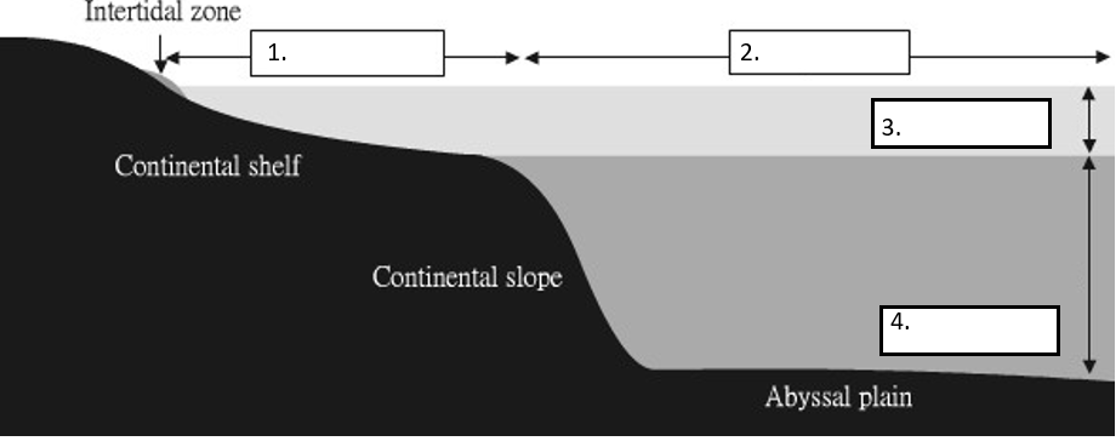
Use the diagram below to lable the ocean zones

4
Neritic
3
Oceanic
1
Photic
2
Aphotic
Which statement is FALSE about the water and density?
Warmer water is less dense and floats; colder water is denser and sinks.
Fresh water is less dense and floats; salt water is denser and sinks.
Water in an 8‰ (salinity) sea is less dense and floats while water in a 40‰ (Salinity) sea is denser and sinks.
None of the above are false
Which statements are true about freezing and boiling points of water?
Water freezes at 32°F and 0°C
Water boils at 212°F and 100°C
Both A and B are true
Both A and B are false
Choose the statement that is FALSE
Groundwater is water stored beneath the surface
Groundwater comes directly from precipitation
Groundwater flows to the ocean in underground rivers
Infiltration refills the groundwater
Water can NOT get into the atmosphere by
Precipitation
Transpiration
Sublimation
Perspiration
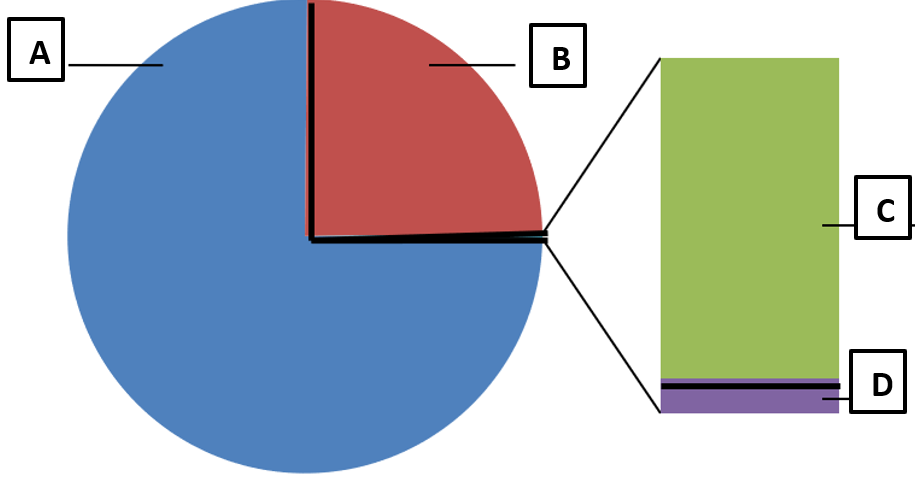
Label the appropriate part for the amounts of each found on Earth.

C
Glaciers
A
Groundwater
D
Rivers and Lakes
B
Atmosphere