Semester 1 Final - 2022 (Aquatic Science)

Last updated over 2 years ago
18 questions
Unit 1: Water and Water Cycle
Required
4

Match the parts of the water cycle to their correct definitions.

Draggable itemCorresponding Item
Condensation
The process of water changing from water vapor into tiny droplets to form clouds.
Sublimation
The process of liquid water changing into water vapor.
Precipitation
The process of ice evaporating into gas.
Evaporation
The process where water droplets are too heavy to stay in clouds and fall as rain, sleet, hail or snow.
Required
4

Match the term to the correct definition.

Draggable itemCorresponding Item
Surface Runoff
The process of water soaking into the soil and in between rock layers.
Groundwater
The process where water flows/runs downhill from land surfaces into rivers and streams and then back to the ocean/
Infiltration
The water stored beneath the surface of the earth.
Floodplain
Floodplain is an area around a waterway that periodically floods with too much water.
Required
4

Match the term to the correct definition.

Draggable itemCorresponding Item
Deposition
Impermeable/impervious surfaces are solid surfaces that don't allow water to penetrate, forcing it to run off. Ex. Concrete
Impermeable
Allows water to sink into the soil to filter out pollutants and recharge the water table adding to the groundwater. Ex. Soil
Erosion
The washing away of material from the bed or outsides curves of the river or stream.
Permeable
The depositing of materials at the inside curve of a river or stream.
Required
4

Look at the pie charts below. Match the letter to correctly label the charts comparing water to land and freshwater o saltwater.
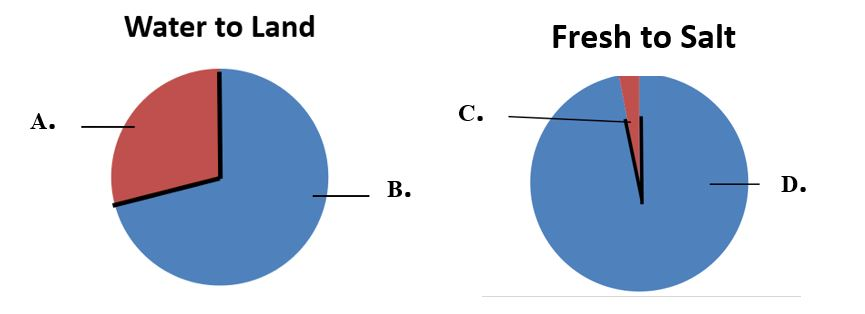
Draggable itemCorresponding Item
A
Land
B
Water
C
Freshwater
D
Saltwater
Required
4

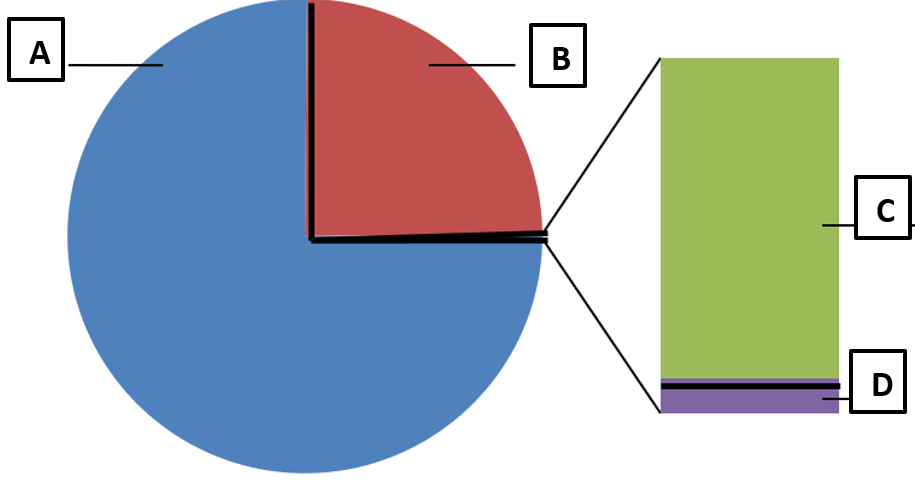
Look at the image below. Match the letters to correctly label the distribution of FRESHWATER.

Draggable itemCorresponding Item
C
Glaciers (Frozen)
A
Groundwater
B
Rivers, Lakes and Streams
D
Atmosphere
Unit 3: Aquatic Life Zones
Required
4

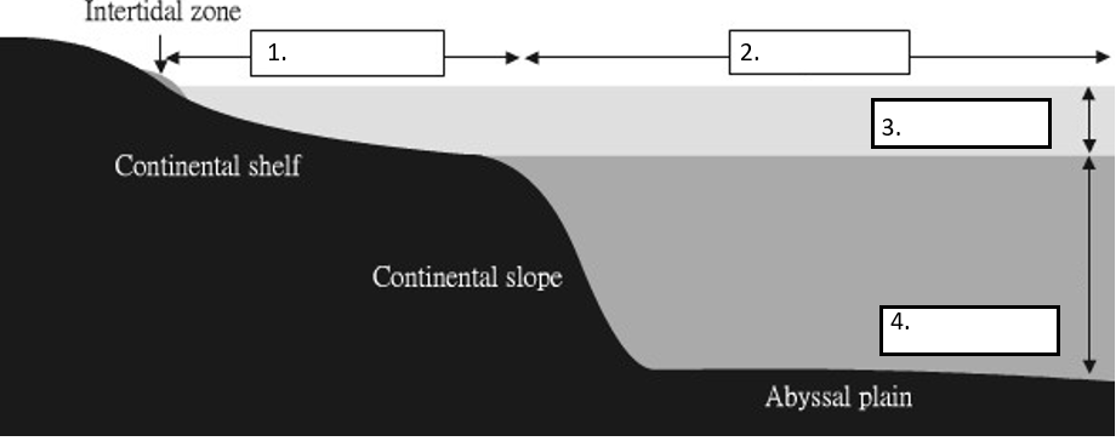
Match the number to the correct label for the ocean zones.

Draggable itemCorresponding Item
2
Neritic
1
Oceanic
4
Photic
3
Aphotic
Required
3

Match the zone of the ocean to the correct definition.

Draggable itemCorresponding Item
Sublittoral Zone
Part of the ocean floor from low tide to
200m down the edge of the continental
shelf; permanently submerged under water.
Littoral/Intertidal Zone
Part of the ocean floor between high and
low tide. Sometimes submerged.
Supralittoral Zone
Past of the ocean floor above the high tide
zone that is regularly splashed, but not
submerged by ocean water.
Required
3

Match the type of water body to the correct definition.

Draggable itemCorresponding Item
Lotic
Bodies of flowing water such as rivers and streams.
Lentic
Bodies of standing water such as lakes, ponds, and wetlands.
Brackish
Slightly salty, as is the mixture of river water and seawater in estuaries.
Required
4

Match the zones of lentic water bodies to the correct definition.

Draggable itemCorresponding Item
Littoral zone
Open water too deep for rooted plants but has light.
Limnetic zone
Shallow area with rooted plants and waves – light through to bottom
Benthic zone
Deep part of lake with no light
Profundal zone
The bottom/floor of the water body
Unit 2: Water Properties
Required
3

Match the term to the correct definition.

Draggable itemCorresponding Item
Surface tension
The surface film or "Skin" of a liquid caused by the attraction of the particles in the surface layer.
Cohesion
Water molecules are attracted to water molecules
Adhesion
Water molecules are attracted to other substances.
Required
3

Match the term to the correct definition.

Draggable itemCorresponding Item
Dissolved oxygen
A reduction in the pH of the ocean over an extended period time, caused primarily by uptake of carbon dioxide
Salinity
The amount of free oxygen that is present in water.
Ocean Acidification
The saltiness or amount of salt dissolved in a body of water
Required
4

Match the term to the correct definition.

Draggable itemCorresponding Item
Density
How much space an object or substance takes up (its volume) in relation to the amount of matter in that object or substance (its mass).
Capillary Action
The ability or tendency to float in water or air or some other fluid.
Buoyancy
The uneven distribution of electrons causing water to have a slightly negative charge near the oxygen atom and a slightly positive charge near the hydrogen atoms.
Polarity
The process of a liquid flowing in a narrow space without the assistance of any external forces.
Unit 4: Aquariums
Required
4

Match the term with the correct description.

Draggable itemCorresponding Item
Ammonia
Is toxic --> Causes frayed fins, cloudy eyes, lack of appetite, laying on the bottom
Nitrate
Not Toxic --> Can be absorbed by live plants and cause fish stress. Gets into tank through bacteria.
Nitrite
Is Toxic --> Causes Gulping of air, Lethargy, staying near the top, and brown gills
Phosphate
Not Toxic --> Can Cause algae and plant growth
Required
1

All fish can eat the same type of fish food.

Required
1

I will be responsible for purchasing ALL aquarium equipment AND fish by myself.

Required
1

I must check for fish compatibility before buying fish for my tank so that they do not fight with each other.

Required
1

I can have as many fish as I want in my tank.

Required
1

Freshwater tanks allow 1 inch of fish per each gallon of water.