Get out ALL your notes! Work together with your partner. I will give you time updates to keep you on track.
Required
1 point
1
Question 1
1.
Chapter 1:
There were 40 students that took a statistics exam having a maximum of 50 points.
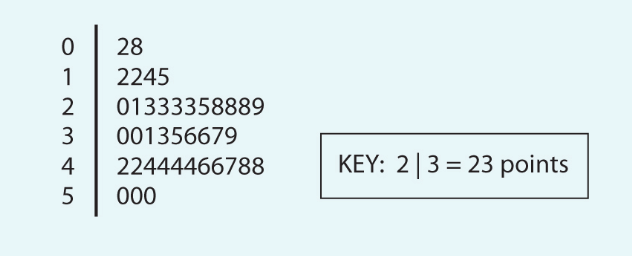
The distribution of score is given in the stem-and-leaf plot.
Which of the following are the correct median and interquartile range of this distribution?
Hint: you should not need to use statsmedic.com/applets, think about where the median is in the list of data values.
Required
1 point
1
Question 2
2.
Chapter 1:
Interpret the median from #1 for the scores data.
What does the median mean? What does it tell you?
A notes page was filled out that gave the interpretation of all the chapter 1 terms.
Required
1 point
1
Question 3
3.
Chapter 1:
Using the information from #1, we have a standard deviation of 12.994 points and mean of 32.15.
Interpret the Standard Deviation for the scores data.
What does it mean? Check the notes page with the interpretations on it.
Required
1 point
1
Question 4
4.
Chapter 1:
Forty students took a statistics exam having a maximum of 50 points.
The distribution of score is given in the stem-and-leaf plot.
Tess’s score was 25. What was her percentile?
Hint: find her score in the data set, think about the meaning of percentile.
Required
2 points
2
Question 5
5.
Chapter 1:
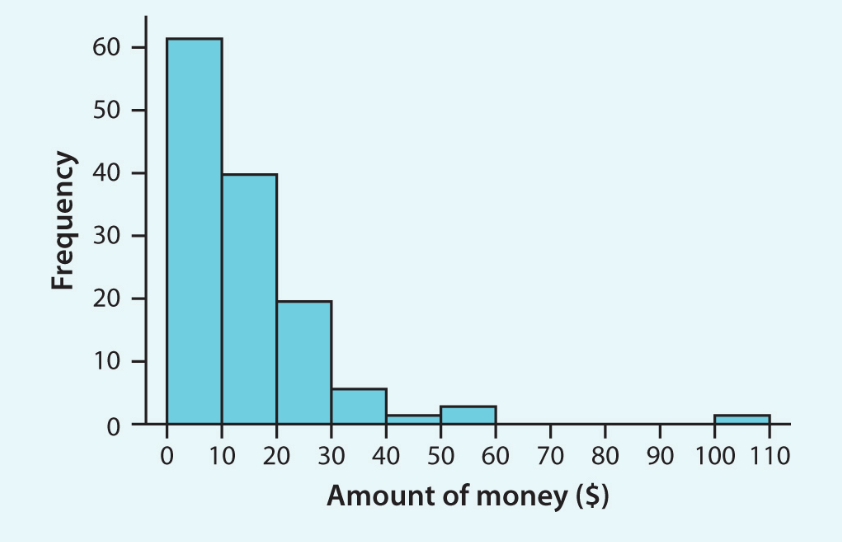
In a statistics class with 136 students, the professor records how much money (in dollars) each student has in his or her possession during the first class of the semester.
The histogram shows the data that were collected.
Describe the data distribution, use D.O.F.S. Find four answers.
Required
1 point
1
Question 6
6.
Chapter 1:
Using the histogram in #5, describe the relationship between the median and the mean.
Required
1 point
1
Question 7
7.
Based on the histogram in #5, what is the appropriate measures of center and spread to use with the data.
Required
0 points
0
Question 8
8.
Chapter 1:
Which of the following distributions has the smallest standard deviation?
Required
2 points
2
Question 9
9.
Chapter 1:
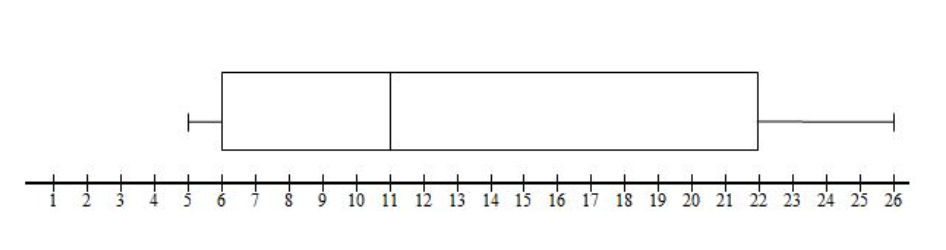
Use the boxplot below:
Calculate the IQR and tell what it represents: select two answers.
Required
1 point
1
Question 10
10.
Chapter 2:
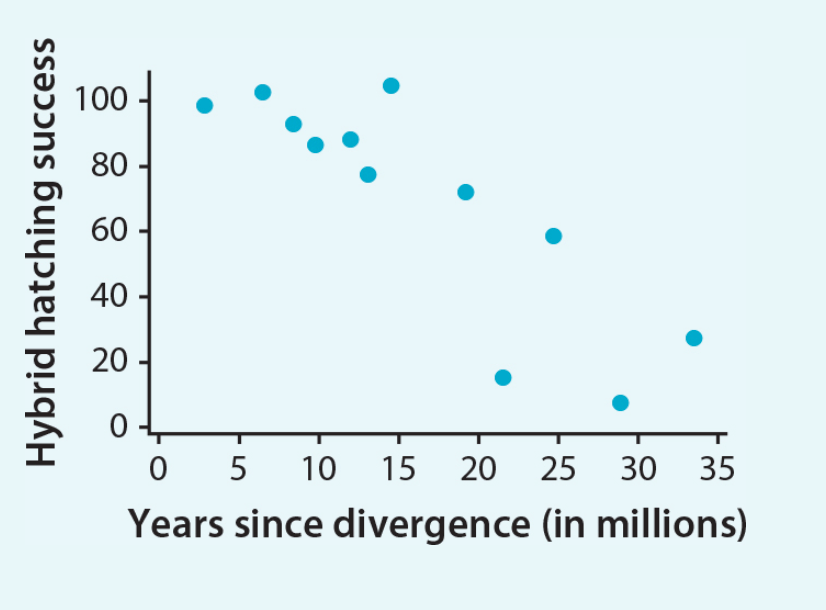
Biologists assess how closely related similar species are by measuring the number of years since the two species diverged from a common ancestor. Researchers Daniel Bolnick and Thomas Near compared the years since divergence for 12 different pairs of sunfish species to the hatching success of eggs produced by a “cross” between the two species. A scatterplot of their results is shown.
A hatching success of 100 means the hybrid eggs hatched as often as single-species eggs hatched.
A number below 100 means the hybrid eggs hatch less often.
Which of the following is closest to the correlation between these two variables?
Required
1 point
1
Question 11
11.
Chapter 2
A statistics student wonders if tall women tend to date taller men than do short women. She measures herself, her dormitory roommate, and the women in the adjoining rooms. Then, she measures the next man each woman dates.
Here are the data (height in inches).
Women: 66 64 66 65 70 65
Men: 72 68 70 68 71 65
Use statsmedic.com/applets , 2 quantitative variables, to make a scatterplot for these data, using women’s height as the explanatory variable. Copy and paste into the applet.
Calculate the correlation for these data. Include all the numbers past the decimal.
Required
1 point
1
Question 12
12.
Chapter 2
A statistics student wonders if tall women tend to date taller men than do short women. She measures herself, her dormitory roommate, and the women in the adjoining rooms. Then, she measures the next man each woman dates.
Here are the data (height in inches).
Use statsmedic.com/applets to make a scatterplot for these data, using women’s height as the explanatory variable.
What does the correlation tell about this data?
Select the 2 correct answers.
Required
2 points
2
Question 13
13.
Chapter 2
A statistics student wonders if tall women tend to date taller men than do short women. She measures herself, her dormitory roommate, and the women in the adjoining rooms. Then, she measures the next man each woman dates.
Here are the data (height in inches).
Look at the scatterplot.
What effect does the pair (70, 71) have on the correlation? Explain.
1. What does it do to the correlation coefficient value?
2. What does it do to the line of best fit?
Select 2 correct answers.
Required
2 points
2
Question 14
14.
Chapter 2
A statistics student wonders if tall women tend to date taller men than do short women. She measures herself, her dormitory roommate, and the women in the adjoining rooms. Then, she measures the next man each woman dates.
Here are the data (height in inches).
What is the correct linear regression model for predicting the men's height based on the women's height?
Required
2 points
2
Question 15
15.
Chapter 2
A statistics student wonders if tall women tend to date taller men than do short women. She measures herself, her dormitory roommate, and the women in the adjoining rooms. Then, she measures the next man each woman dates.
Here are the data (height in inches).
A.Use the linear regression equation from statsmedic.com/applets to calculate the predicted man's height for a woman who is 64 inches tall. _______Round to 2 places past the decimal point. Do not use units.
B. Find the actual height of the man the 64 in tall women will date. Calculate the residual using your answer from A. _______
Required
1 point
1
Question 16
16.
Chapter 2
Which of the following statements is not true of the correlation r (in general) between the height of women and the height of the men they date?
BE CAREFUL! Look for three answers that ARE true and then check the fourth answer, it should be the one that IS NOT true.
Required
1 point
1
Question 17
17.
Chapter 2
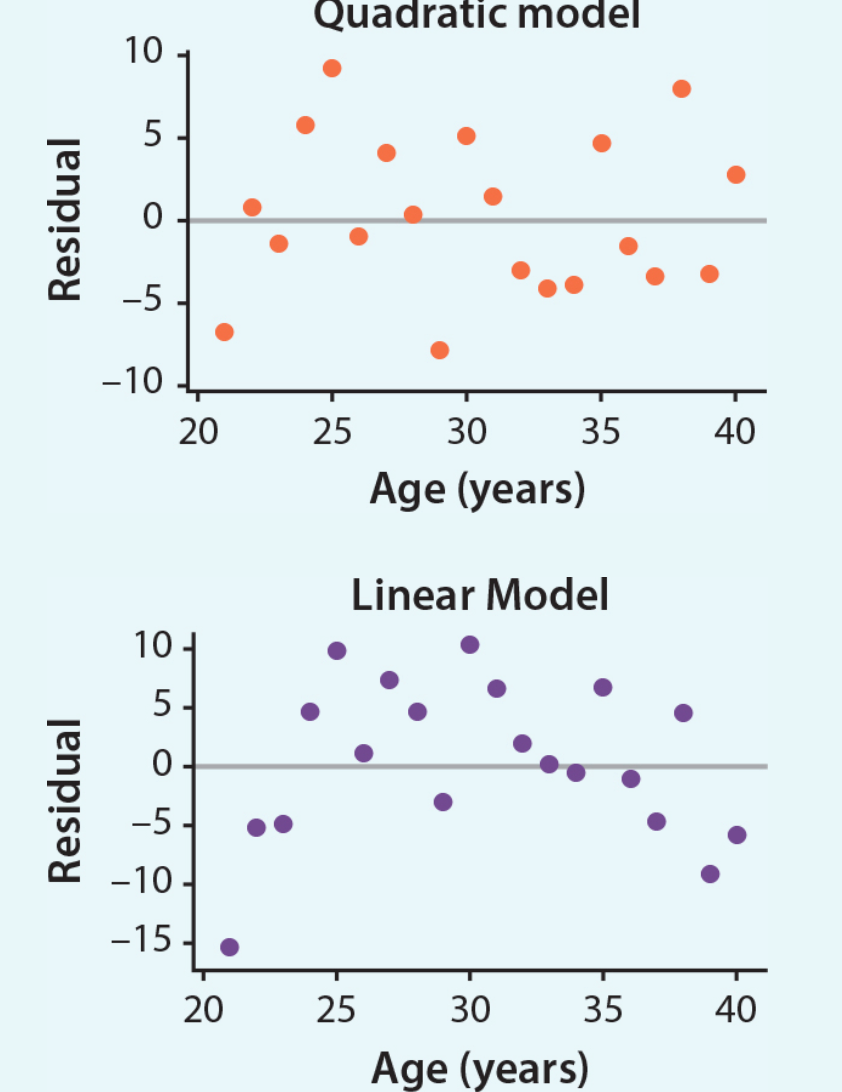
Derek Jeter, the New York Yankees’ star shortstop, retired after the 2014 season. A linear regression model and quadratic regression model were calculated to predict y = the number of home runs Jeter hit in a given year from x = his age that year.
Here are the residual plots for each model.
Which of the following statements is supported by these residual plots?
Required
1 point
1
Question 18
18.
Chapter 3:
Which one of the following is a valid statistical question?
Required
1 point
1
Question 19
19.
Chapter 3
A sportswriter wants to know how strongly Albuquerque residents support the local minor league baseball team, the Isotopes. She stands outside the stadium before a game and interviews the first 20 people who enter the stadium, asking them to rate their enthusiasm for the team on a 1 (lowest) to 5 (highest) scale.
Which of the following best describes the type of sample and the results of this survey?
Required
1 point
1
Question 20
20.
Chapter 3
A local news agency conducted a survey about unemployment by randomly dialing phone numbers until it had gathered responses from 1000 adults in the state.
In the survey, 19% of those who responded said they were not currently employed.
In reality, only 6% of the adults in the state were not currently employed at the time of the survey.
Which of the following best explains the difference in the two percentages?
Required
2 points
2
Question 21
21.
Chapter 3
A study of treatments for angina (pain due to low blood supply to the heart) compared bypass surgery, angioplasty, and use of drugs.
The study looked at the medical records of thousands of angina patients whose doctors had chosen one of these treatments.
It found that the average survival time of patients given drugs was the highest.
What do you conclude about cause and effect?
Think statistically about the ideas we covered in class, check notes from Lesson 3.9
Select two correct answers.
Required
1 point
1
Question 22
22.
Chapter 3
One hundred volunteers who suffer from attention deficit hyperactivity disorder (ADHD) are available for a study.
Fifty are randomly assigned to receive a new drug that is thought to be particularly effective in treating ADHD.
The other 50 are given a commonly used drug. A psychiatrist evaluates the symptoms of all volunteers after four weeks to determine if there has been substantial improvement in symptoms.
The study would be double-blind if
Required
2 points
2
Question 23
23.
Chapter 3
Consider an experiment to investigate the effectiveness of different insecticides in controlling pests and their impact on the productivity of tomato plants.
What kind of inference is possible if the researchers randomly assigned treatments (spraying or not spraying) to the farms?
Hint: where is the randomization in this study? This determines what conclusion(inference) can be made.
Select 2 correct answers.
Required
2 points
2
Question 24
24.
Chapter 4
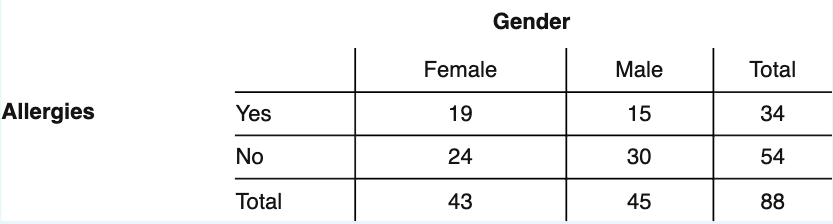
A random sample of 88 U.S. 11th- and 12th-graders was selected. The two-way table summarizes the gender of the students and their response to the question “Do you have allergies?” Suppose we choose a student from this group at random.
Create a Venn Diagram in the 'show your work' section based on the information in the table:
Required
1 point
1
Question 25
25.
Chapter 4
A random sample of 88 U.S. 11th- and 12th-graders was selected. The two-way table summarizes the gender of the students and their response to the question “Do you have allergies?” Suppose we choose a student from this group at random.
What is the probability that the student has allergies?
Required
1 point
1
Question 26
26.
Chapter 4
A random sample of 88 U.S. 11th- and 12th-graders was selected. The two-way table summarizes the gender of the students and their response to the question “Do you have allergies?” Suppose we choose a student from this group at random.
What is the probability that the student is female or has allergies?
Required
1 point
1
Question 27
27.
Chapter 4
A random sample of 88 U.S. 11th- and 12th-graders was selected. The two-way table summarizes the gender of the students and their response to the question “Do you have allergies?” Suppose we choose a student from this group at random.
What is the probability that the student is female and has allergies?
Required
2 points
2
Question 28
28.
Chapter 4
A random sample of 88 U.S. 11th- and 12th-graders was selected. The two-way table summarizes the gender of the students and their response to the question “Do you have allergies?” Suppose we choose a student from this group at random.
Given the student is a female, what is the probability that the student has allergies?
Required
2 points
2
Question 29
29.
Chapter 4
A random sample of 88 U.S. 11th- and 12th-graders was selected. The two-way table summarizes the gender of the students and their response to the question “Do you have allergies?” Suppose we choose a student from this group at random.
Given the student is not a female, what is the probability that the student has allergies?
Required
0 points
0
Question 30
30.
BONUS:
Use the information from above to answer: Are gender and having allergies independent?