Log in
Sign up for FREE
arrow_back
Library

Protein synthesis and mutations

star
star
star
star
star
Last updated over 3 years ago
13 questions
Required
1
BIO.6.C
Required
2
BIO.6.E
Required
1
BIO.6.E
Required
2
BIO.6.E
Required
1
BIO.6.A
Required
1
BIO.6.C
Required
1
BIO.5.A
Required
1
BIO.5.C
Required
1
BIO.6.A
Required
1
BIO.6.B
Required
1
BIO.6.C
Required
1
BIO.6.C
Required
1
BIO.6.C
Question 1
1.

Question 2
2.
Sickle cell anemia is a genetic disorder in which the hemoglobin responsible for transporting oxygen is mis- formed. The disease begins with a mutation in a __________________ _______, which results in a structural difference in a ______________ ___.
Other Answer Choices:
protein
carbohydrate
nucleic acid
lipid
Question 3
3.

Question 4
4.

Question 5
5.

Question 6
6.

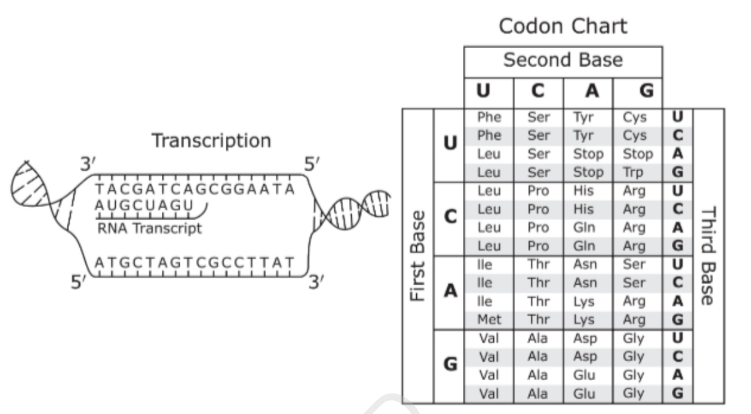
A models of transcription and a codon chart are shown.

Which amino acid would be coded first from the DNA strand being transcribed?

Question 7
7.

Question 8
8.

Question 9
9.

Question 10
10.

Question 11
11.

Question 12
12.

Question 13
13.

Part of an important cellular process involving a DNA strand is modeled below.
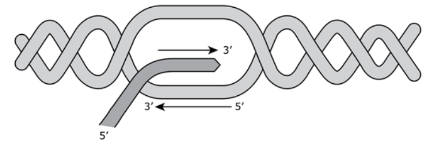
What is the purpose of this cellular process?
Deleting the information in the sequence produced from the DNA template
Preserving genetic information for future generations
Producing more nucleotides for the DNA sequence.
Transcribing information in the DNA sequence for the use by the cell.
Sickle-shaped red blood cells result from a mutation in the gene that codes or hemoglobin. This mutation results in sickle-cell anemia. A partial sequence of bases from a normal hemoglobin gene and a sequence that results in sickle-cell anemia are shown below.
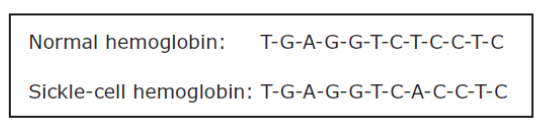
What type of mutation is depicted in this sequence?
deletion
frameshift
insertion
substitution
An illustration of how a particular DNA mutation will most likely affect the polypeptide produced is shown.
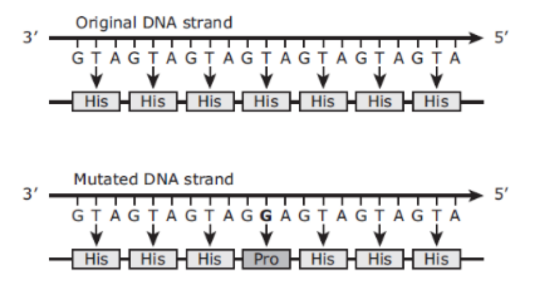
What type of mutation is illustrated? Select 2 answers.
insertion
silent
missense
deletion
nonsense
substitution
What components make up the backbone of a DNA molecule?
nitrogen bases and phosphate groups
Purines and pyrimidines
deoxyribose and nitrogen bases
deoxyribose and phosphate groups
Scientists determine the total mass of DNA from a sample of animal cells. The masses of equal numbers of cells were taken during three different stages of the cell cycle. Stage I contains cells massed during G1 of the cell cycle.
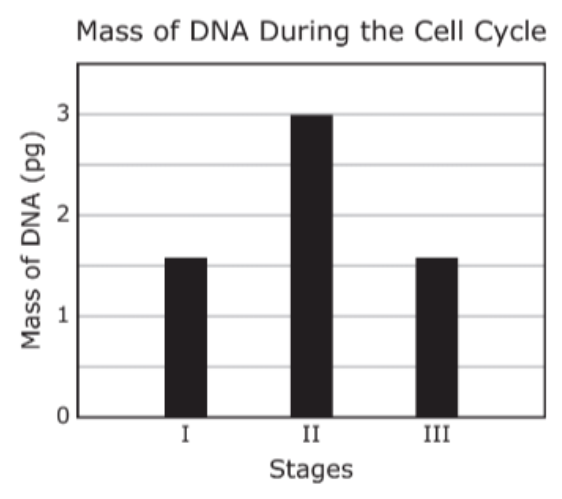
Which statement best describes the cells during Stage II?
The cells have temporarily exited the cell cycle without replicating their DNA
The cells have replicated their DNA and completed mitosis and cytokinesis.
The cells have replicated their DNA, but not completed mitosis and cytokinesis.
The cells have completed mitosis and cytokinesis without replicating their DNA.
When cells lose their ability to regulate the cell cycle, they can divide at an accelerated rate and form a mass of cells. This mass of cells is referred to as -
an organ
an embryo
a gland
a tumor
Differences in traits such as hair texture are determined by differences in -
the location of sugar groups in DNA
the number of nitrogenous bases in DNA
the sequence of nucleotides in DNA
the molecules attached to the phosphate in DNA
Which property is shared by the cells in all living things?
The cells contain DNA composed of adenine, thymine, guanine, and cytosine.
The cells are surrounded by a phospholipid bilayer and a cell wall made of cellulose.
The cells have chromosomes that are located inside a membrane-bound nucleus.
The cells rely on mitochondria to carry out aerobic cellular respiration.
A section of nucleic acid is shown below.
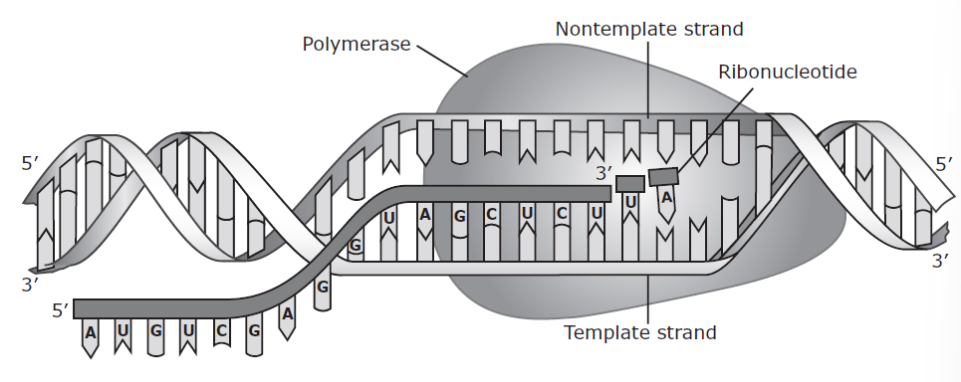
The process represented in the diagram produces a molecule that is complementary to the template strand of DNA. What type of molecule is produced?
Messenger RNA
New DNA
Polypeptide
Carbohydrate
A partial DNA segment and an mRNA codon chart are shown.

3' T C A T G C A T G 5'
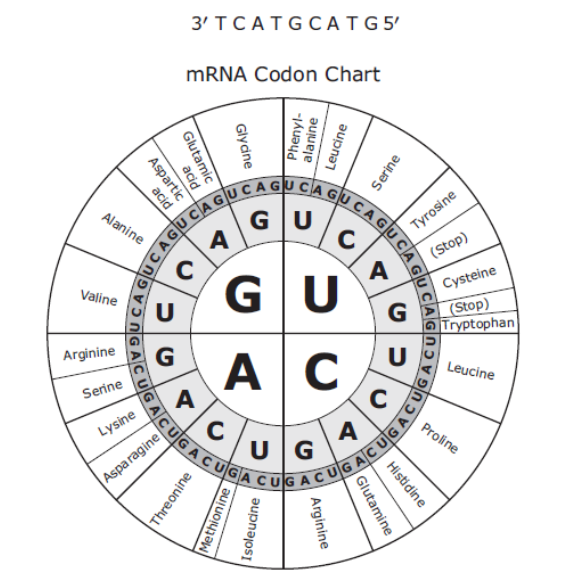


What amino acid sequence is encoded in the partial DNA segment?
Serine - Threonine - Methionine
Serine - Threonine - Tyrosine
Serine - Serine - Tyrosine
Serine - Alanine - Methionine
Students are modeling mRNA during the process of protein synthesis. Which answer choice correctly describes the model of the mRNA strand being transcribed?
The mRNA strand is an exact copy of the DNA template strand; however, uracil instead of thymine is paired with adenine.
The mRNA strand is an exact copy of the DNA template strand; however, uracil instead of adenine is paired with thymine.
The mRNA stand is complementary to the DNA template strand; however, uracil instead of adenine is paired with thymine.
The mRNA stand is complementary to the DNA template strand; however, uracil instead of thymine is paired with adenine.