Summative Investigation: Roots of a Quadratic Equation

Last updated over 2 years ago
7 questions
Note from the author:
You will be using DESMOS extensively in this summative, so keep your DESMOS Graphing Calculator open throughout.
You will be given a little paper to do your work, you will not submit this.
Duration: 1 Hour
You will be using DESMOS extensively in this summative, so keep your DESMOS Graphing Calculator open throughout.
You will be given a little paper to do your work, you will not submit this.
Duration: 1 Hour
A quadratic equation in its standard form is an equation of degree 2 and is equated to 0. Example,


is an example of a quadratic equation in standard form.

The roots of this equation are essentially the values x can take when you solve the equation.

In this task, you will try to figure out a method to find the values of x, or the roots of the equation and figure out some special properties of quadratic equations.
1
Level 1 - 2
Fill in the blanks with the factorized forms of these quadratic expressions, if they are factorable:
(Write only the final answer or not factorable)

_______


_______


_______


_______
1

Levels 3 - 4
Figure out which of these are factorizable, that is, it can be written in the form of (x+a)(x+b). Then put the various expressions on DESMOS. You can attach your screenshots in the show-your-work space.

Factorizable
Not Factorizable
1

Levels 5 - 6
From the data above and their corresponding graphs, can you tell just from the graphs if an expression is factorable? Use an expression of you own to verify your rule.

1

Levels 1 - 2
Fill in the following table. Attach screenshots from DESMOS in the graph column
Now, observe the points of intersection of the graph and your factor form carefully before answering the next question.

1

Levels 3 - 4
The points of intersection of the curve with the x-axis are called 'the roots of an equation'. In other words, they are the values of x in a quadratic equation.

Eg, the solution to the equation:


is
x = 4 or x = -3. (You can substitute either value and the equation will be satisfied.)
I got this answer from the x-intercept points on the graph of the equation:
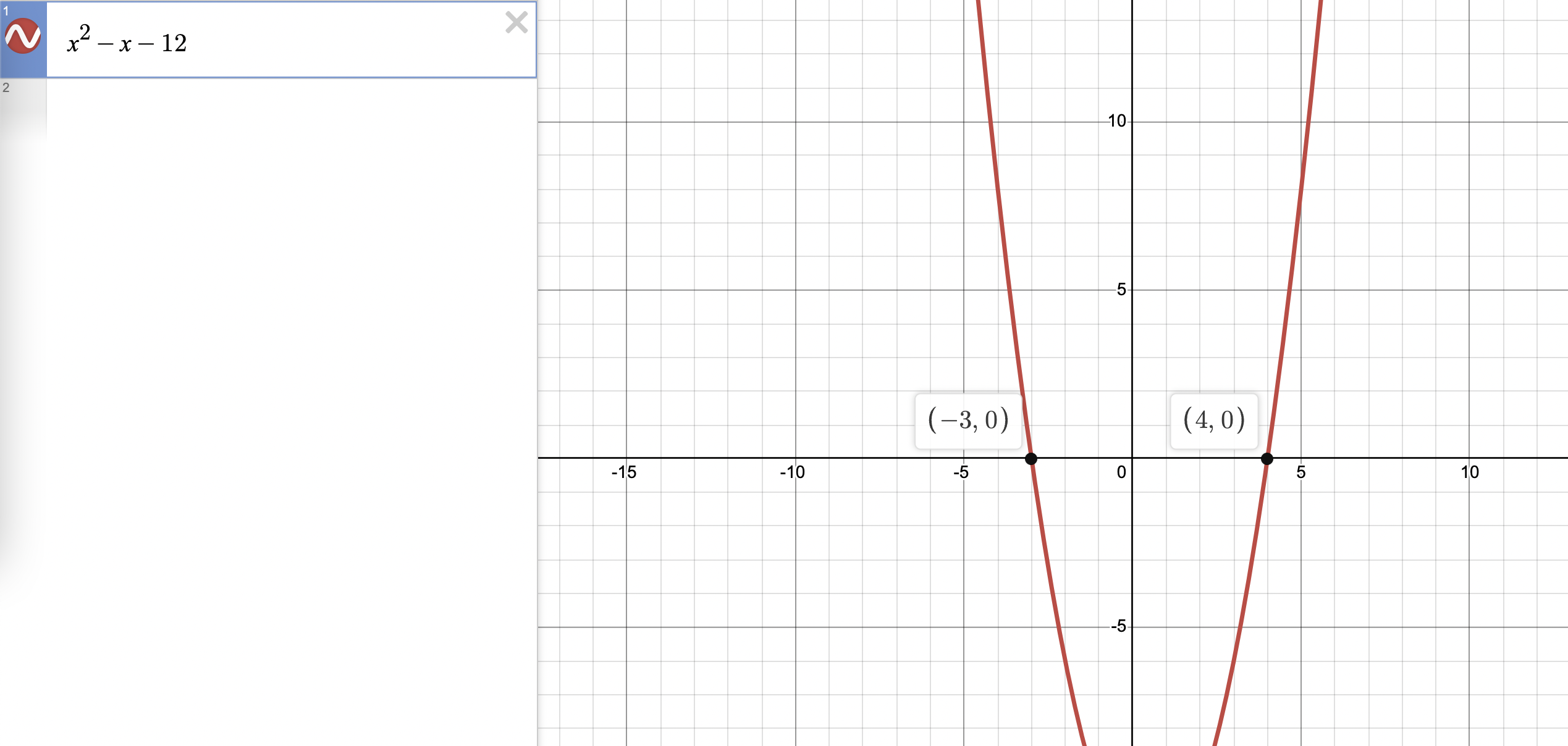

What connection/ pattern do you see between the roots of an equation and the factorized form of the expression?

Levels 7 - 8
Justify why this pattern occurs.

1

Levels 5 - 6
Using the pattern you observed, can you outline a method for finding the solutions of the quadratic equation:
Explain your work.

1

Levels 7 - 8
What kind of quadratic equations has positive roots? Justify with an example. Combine all the information you have learnt from the beginning of this assessment to answer this question.