Lesson 4.4 Content Check
star
star
star
star
star
Last updated over 1 year ago
22 questions
Required
1
Consider the following table with information about some of the students taking Statistics at Davenport High School.
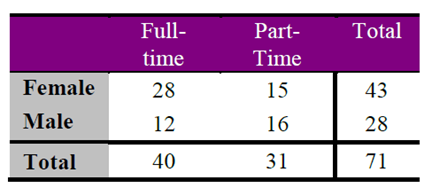
Given that the student is a male what is the probability that the student works full time? Give your answer as a decimal proportion, round to three places.P(Full Time|MALE) =
Consider the following table with information about some of the students taking Statistics at Davenport High School.
Given that the student is a male what is the probability that the student works full time?
Give your answer as a decimal proportion, round to three places.
P(Full Time|MALE) =
Required
1
Consider the following table with information about all of the students taking Statistics at Davenport High School.
What is the probability that the student is a female, given that the student is FULL-TIME? Give your answer as a decimal proportion, keep all decimal places.P(Female|Full Time) =
Consider the following table with information about all of the students taking Statistics at Davenport High School.
What is the probability that the student is a female, given that the student is FULL-TIME?
Give your answer as a decimal proportion, keep all decimal places.
P(Female|Full Time) =
Required
1
Consider the following table with information about all of the students taking Statistics at Davenport High School.
What is the probability that the student is full- time, given that the student is part-time?Give your answer as a decimal proportion, keep all decimal places.P(Full-time|Part -time) =
Consider the following table with information about all of the students taking Statistics at Davenport High School.
What is the probability that the student is full- time, given that the student is part-time?
Give your answer as a decimal proportion, keep all decimal places.
P(Full-time|Part -time) =
Required
1
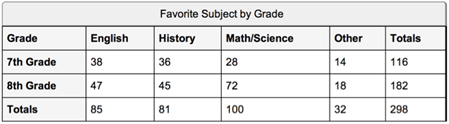
What is the probability that a randomly-selected person will prefer history, given that the person is an 8th grader?Give your answer as a decimal proportion, round to three decimal places.
What is the probability that a randomly-selected person will prefer history, given that the person is an 8th grader?
Give your answer as a decimal proportion, round to three decimal places.
Required
1
What is the probability that a randomly-selected person will be a 7th grader, given that the person prefers English?Give your answer as a decimal proportion, round to three decimal places.
What is the probability that a randomly-selected person will be a 7th grader, given that the person prefers English?
Give your answer as a decimal proportion, round to three decimal places.
Required
10
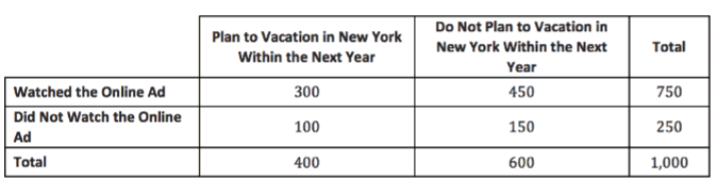
Use the following hypothetical 1000 two-way table to compare watching an online ad and planning a vacation to New York:
Record the probabilities as a decimal proportion, round to three places past the decimal point if necessary.
P(Plan to Vacation to NY | Watched Ad): _______
P(Plan to Vacation to NY | Did Not Watch Add): _______
P(Plan to Vacation to NY): _______
Required
1
Are watching the ad online and planning a vacation to New York City independent?Select the answer and the reason why below:
Are watching the ad online and planning a vacation to New York City independent?
Select the answer and the reason why below:
Required
1
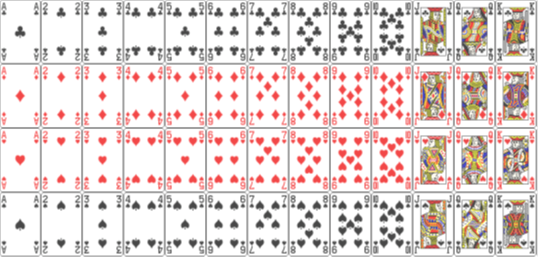
Determine the following conditional probabilities.Consider drawing 1 card from a standard deck of shuffled cards:
Given it is a face card, what is the probability of picking a RED card? P(RED |FACE CARD) =Give your answer as a decimal proportion, keep all decimal places.
Determine the following conditional probabilities.
Consider drawing 1 card from a standard deck of shuffled cards:
Given it is a face card, what is the probability of picking a RED card?
P(RED |FACE CARD) =
Give your answer as a decimal proportion, keep all decimal places.
Required
1
Determine the following conditional probabilities.Consider drawing 1 card from a standard deck of shuffled cards:
Given it is a red card, what is the probability of picking a FACE card? P(FACE |RED CARD) =Give your answer as a decimal proportion, round to three decimal places.
Determine the following conditional probabilities.
Consider drawing 1 card from a standard deck of shuffled cards:
Given it is a red card, what is the probability of picking a FACE card?
P(FACE |RED CARD) =
Give your answer as a decimal proportion, round to three decimal places.
Required
1
Determine the following conditional probabilities.Consider drawing 1 card from a standard deck of shuffled cards:
Hint: Spades are the upside down black hearts, there are 13 of each suit.P(ODD|SPADE) =For finding the # of odd cards: Use only cards with numbers on them (A, K, Q, J do not have numbers on them).Give your answer as a decimal proportion, round to three decimal places.
Determine the following conditional probabilities.
Consider drawing 1 card from a standard deck of shuffled cards:
Hint: Spades are the upside down black hearts, there are 13 of each suit.
P(ODD|SPADE) =
For finding the # of odd cards: Use only cards with numbers on them (A, K, Q, J do not have numbers on them).
Give your answer as a decimal proportion, round to three decimal places.
Required
1
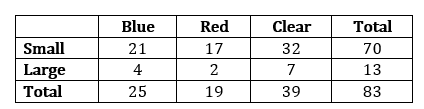
Jenna made the following two-way table about the color and size of the marbles in a bag.
What is the probability that one of Jenna’s marbles is red, given that it is small?Give your answer as a decimal proportion, round to three decimal places.
Jenna made the following two-way table about the color and size of the marbles in a bag.
What is the probability that one of Jenna’s marbles is red, given that it is small?
Give your answer as a decimal proportion, round to three decimal places.
Required
2
Jenna made the following two-way table about the color and size of the marbles in a bag.
Give your answer as a decimal proportion, round to three decimal places if necessary.
What is the probability that one of Jenna’s marbles is Blue, given that it is small? _______
What is the probability that one of Jenna's marbles is Blue, given that it is large? _______
Required
3
Use the information from above to answer: Are marble color and size independent?Select the answer and the reason why below:
Use the information from above to answer: Are marble color and size independent?
Select the answer and the reason why below:
Required
1
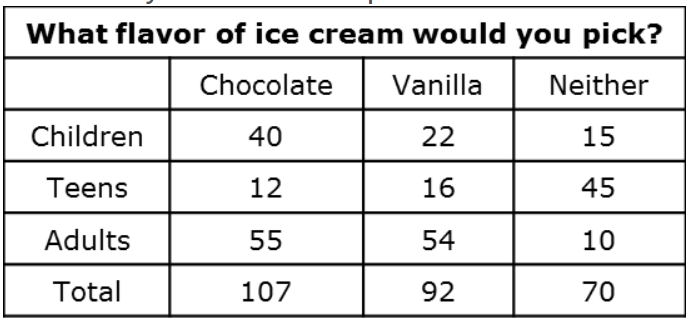
Use the table to answer the question.
Given the person is picking Chocolate, what is the probability the person is a teen?
Use the table to answer the question.
Given the person is picking Chocolate, what is the probability the person is a teen?
Required
1
Use the table to answer the question.
Given the person is picking Vanilla, what is the probability the person is a teen?
Use the table to answer the question.
Given the person is picking Vanilla, what is the probability the person is a teen?
Required
1
Use the table to answer the question.
Given the person is not picking either Chocolate or Vanilla, what is the probability the person is a teen?
Use the table to answer the question.
Given the person is not picking either Chocolate or Vanilla, what is the probability the person is a teen?
Required
1
Based on your answers to #14, 15 & 16, are being a teen and ice cream flavor preference independent?Explain why or why not and the relationship if there is one.
Based on your answers to #14, 15 & 16, are being a teen and ice cream flavor preference independent?
Explain why or why not and the relationship if there is one.
Required
3
In our school there are 1,208 students. 47% of the students are involved in Fine Arts, 62% are on a sports team and 21% do both.Fill in the Venn Diagram to answer the question below. This is part of your points.Hint: you will NOT enter 47 or 62 into the Venn diagram but you will use them to calculate the numbers.If you are still confused, try setting up the two-way table in #19 first, then fill in the Venn Diagram.
What is the probability a student is in the arts but not sports?Answer as a percent.
In our school there are 1,208 students. 47% of the students are involved in Fine Arts, 62% are on a sports team and 21% do both.
Fill in the Venn Diagram to answer the question below. This is part of your points.
Hint: you will NOT enter 47 or 62 into the Venn diagram but you will use them to calculate the numbers.
If you are still confused, try setting up the two-way table in #19 first, then fill in the Venn Diagram.
What is the probability a student is in the arts but not sports?
Answer as a percent.
Required
3
In our school there are 1,208 students. 47% of the students are involved in Fine Arts, 62% are on a sports team and 21% do both.Use the 'show your work' section to set up the table using the numbers from the Venn Diagram. This is part of your points.
What is the probability a student plays sports given that he/she is in Arts?Round your answer to three places past the decimal.
In our school there are 1,208 students. 47% of the students are involved in Fine Arts, 62% are on a sports team and 21% do both.
Use the 'show your work' section to set up the table using the numbers from the Venn Diagram. This is part of your points.
What is the probability a student plays sports given that he/she is in Arts?
Round your answer to three places past the decimal.
Required
1
Using the table from #19...What is the probability a student is in the arts given that he/she is in sports?Round your answer to three places past the decimal.
Using the table from #19...
What is the probability a student is in the arts given that he/she is in sports?
Round your answer to three places past the decimal.
Required
1
What is the probability of a student being in fine arts OR sports?Answer as a percent.Hint: look back at the Venn Diagram.
What is the probability of a student being in fine arts OR sports?
Answer as a percent.
Hint: look back at the Venn Diagram.
Required
1
What is the probability of a student NOT being in sports or fine arts?Hint: check your Venn Diagram
What is the probability of a student NOT being in sports or fine arts?
Hint: check your Venn Diagram