Is the graph below a function? (Use the vertical line test)

Is the graph below a function? (Use the vertical line test)
Watch the Lesson Ch 3.1 Relations and Functions EdPuzzle.
Then complete this assignment.
Is the graph below a function? (Use the vertical line test)
Is the graph below a function? (Use the vertical line test)

Is the graph below a function?
(Use the vertical line test) (Hint: if the vertical line overlaps everywhere then x would have many y-values) Below you can see that 'x=6' has infinite 'y-values' so it would not be a function!

Is the graph below a function? (Use the vertical line test)

Is the graph below a function? (Use the vertical line test)

Is the graph below a function? (Use the vertical line test)

Is the graph below a function? (Use the vertical line test)

Is the graph below a function? (Use the vertical line test)

Is the graph below a function? (Use the vertical line test)

Is the graph below a function? (Use the vertical line test)

Does the set of ordered pairs represent a function? (If 1 x-value has more than 1 corresponding y-value then it is not a function; If this is the case then it would also fail the vertical line test)

Does the set of ordered pairs represent a function?

Does the set of ordered pairs represent a function? (If 1 x-value has only 1 corresponding y-value then it is a function; If this is the case then it would Pass the vertical line test)

Does the set of ordered pairs represent a function?

Does the set of ordered pairs represent a function?

Does the graph represent a function? (Remember open circles do not include the point and closed (solid) circles do include the point. So, if no solid circles touch the same vertical line then it is a function)

Does the graph represent a function?

Does the graph represent a function? (Remember open circles do not include the point and closed (solid) circles do include the point. So, if Solid circles do touch the same vertical line then it is Not a function)

Does the graph represent a function?

Does the graph represent a function?

Does the graph represent a function?

Does the set of ordered pairs represent a function? (Remember you can't have the same x-value with more than 1 y-value. In other words, Functions do not have repeating x-values!) It's ok to have the same y-values but not the same x-values!

Does the set of ordered pairs represent a function? (Remember you can't have the same x-value with more than 1 y-value. In other words, Functions do not have repeating x-values! It's ok to have the same y-values but not the same x-values!)

Does the set of ordered pairs represent a function? (Remember you can't have the same x-value with more than 1 y-value. In other words, Functions do not have repeating x-values! It's ok to have the same y-values but not the same x-values!)

Does the set of ordered pairs represent a function? (Remember you can't have the same x-value with more than 1 y-value. In other words, Functions do not have repeating x-values! It's ok to have the same y-values but not the same x-values!)

Does the set of ordered pairs represent a function? (Remember you can't have the same x-value with more than 1 y-value. In other words, Functions do not have repeating x-values! It's ok to have the same y-values but not the same x-values!)

Does the set of ordered pairs represent a function? (Remember you can't have the same x-value with more than 1 y-value. In other words, Functions do not have repeating x-values! It's ok to have the same y-values but not the same x-values!)

Which of the following sets Do NOT represent a function?
It's kinda obvious! Just make sure you see why! :) Notice that a function can have the same y-values like in Set B, just not the same x-values!

Does the table of values below represent a function?
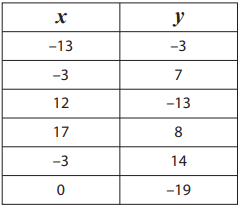
Does the table of values below represent a function?

Does the table of values below represent a function?

Does the table of values below represent a function?

Does the relation below represent a function? (Remember each x-values may only be pointing or 'mapped' to 1 y-value to be considered a Function! Functions may have different x-values pointing or 'mapping' to the same y-values.
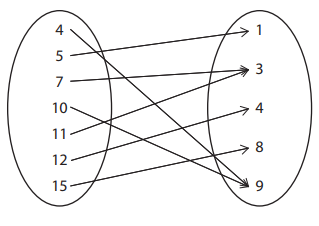
Does the relation below represent a function? (Remember each x-values may only be pointing or 'mapped' to 1 y-value to be considered a Function! Functions may have different x-values pointing or 'mapping' to the same y-values.

Does the relation below represent a function? (Remember each x-values may only be pointing or 'mapped' to 1 y-value to be considered a Function!
Functions may NOT have one x-value pointing or 'mapping' to DIFFERENT y-values.

Does the relation below represent a function? (Remember each x-values may only be pointing or 'mapped' to 1 y-value to be considered a Function!
Functions may NOT have one x-value (INPUT) pointing or 'mapping' to DIFFERENT y-values (OUTPUTS).

Does the relation below represent a function?

Does the relation below represent a function?

Does the relation below represent a function?

Does the relation below represent a function?

Does the relation below represent a function?
