Enter all answers as decimals or percents, please do not use fractions.
You have a connection to an infinite supply of Skittles.
The company that manufactures these delicious sugary treats claims that:
35% are purple,
15% are yellow,
25% are red,
15% are green,
the remaining are orange.
Required
4 points
4
Question 1
1.
Find the probability that you pick one orange skittle.
P(orange)=
HINT: What do all the probabilities need to add up to in a sample space? Use this to find your answer.
Required
4 points
4
Question 2
2.
What is the complement of picking a purple Skittle?
Select the best answer choice:
Required
4 points
4
Question 3
3.
Find the probability that you will pick a red or a green skittle.
P(red or green)=
Required
4 points
4
Question 4
4.
What needs to be true about choosing a Skittle in order to do the calculations for #3?
Required
4 points
4
Question 5
5.
Find the probability that you will pick a pink skittle.
P(pink)=
Required
4 points
4
Question 6
6.
A company is testing a newly developed coin to be used in the Super Bowl, they are trying to determine if the coin is fair and can be used to start the game.
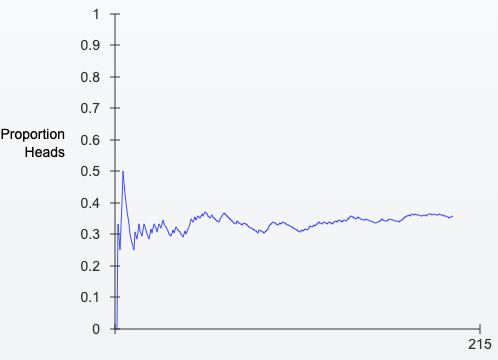
Estimate the probability that a flip of the coin will give heads. __________
Explain your reasoning.
Required
4 points
4
Question 7
7.
What Statistical law is being illustrated in the previous question?
Required
4 points
4
Question 8
8.
The coach of the football team needs to choose a kicker for a critical field goal in the championship game. These are his choices and strategies.
Choose Lonnie because he missed his last five shots over the last several games.
He’s due to make this field goal.
Choose Ronnie because he has made his last three kicks earlier in the game so he’s “on a roll” tonight.
Choose Donnie because he has the highest overall season percentage of making field goals.
Based on your understanding of probability, which is the best strategy _____ and why?
Answer both questions for full credit.
Who should he choose and why.
Use the following information for problems #8-13.
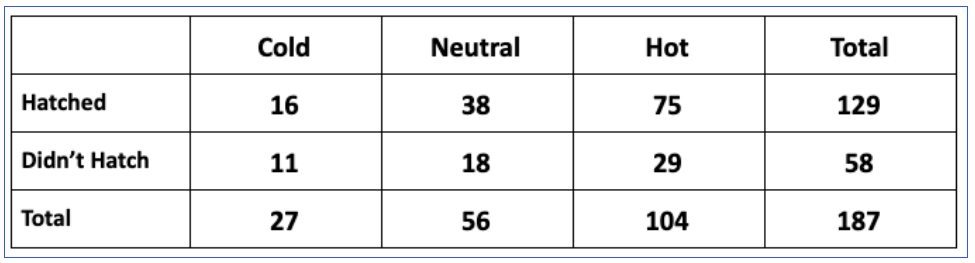
How is the hatching of water python eggs influenced by the temperature of the snake's nest?
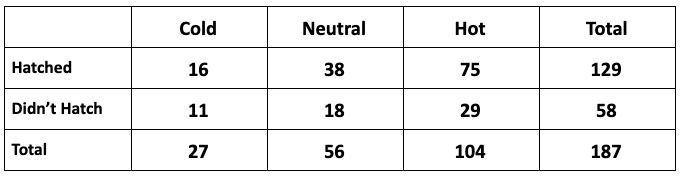
Researchers randomly assigned newly laid eggs to one of three water temperatures: hot, neutral, or cold.
Hot duplicates the extra warmth provided by the mother python, and cold duplicates the absence of the mother.
The results are shown in the two-way table below.
Required
4 points
4
Question 9
9.
Suppose we select one of the eggs at random.
Define event C as cold water, event H= hot water, event N= neutral water, and events hatched or not hatched.
If we randomly select an egg, find P(didn't hatch):
Hint: (you will use the totals/marginal distribution)
Required
4 points
4
Question 10
10.
Suppose we select one of the eggs at random.
Define event C as cold water, event H= hot water, event N= neutral water, and events hatched or not hatched.
If we randomly select an egg, find the probability that the egg didn't hatch given that it was in cold temperature: P(didn't hatch|Cold)=
Hint: (double check the total you will use)
Enter your answer as a decimal rounded to three places or percent, if it is a percent make sure to use %.
Required
4 points
4
Question 11
11.
Suppose we select one of the eggs at random.
Define event C as cold water, event H= hot water, event N= neutral water, and events hatched or not hatched.
If we randomly select an egg, find the probability that the egg didn't hatch given that it was in neutral temperature: P(didn't hatch|Neutral)=
Hint: (double check the total you will use)
Required
4 points
4
Question 12
12.
Suppose we select one of the eggs at random.
Define event C as cold water, event H= hot water, event N= neutral water, and events hatched or not hatched.
If we randomly select an egg, find the probability that the egg didn't hatch given that it was in hot temperature: P(didn't hatch|Hot)=
Hint: (double check the total you will use)
Required
4 points
4
Question 13
13.
Suppose we select one of the eggs at random.
Define event C as cold water, event H= hot water, event N= neutral water, and events hatched or not hatched.
Compare the probabilities in #10-12, are nest temperature and hatched status independent?
Check all that apply, choose three answers.
Required
4 points
4
Question 14
14.
A recent census at a major university revealed that:
65% of its students used Macintosh computers (Macs) in total.
80% of its students used PCs in total.
In the census, 52% used both types of computers.
Using the information, fill in the Venn Diagram in the 'show your work' area using a textbox.
This information will be helpful for the following questions, so when you are finished please ask me to check it.
Required
4 points
4
Question 15
15.
Are using a Mac and/or a PC mutually exclusive?
How do you know?
Check all that apply, choose two answers.
Required
6 points
6
Question 16
16.
A recent census at a major university revealed that:
65% of its students used Macintosh computers (Macs) in total.
80% of its students used PCs in total.
In the census, 52% used both types of computers.
Refer to #14 for the 2-way table.
What percent of the students used a Mac or a PC at the campus?
Enter your answer as a percent.
Required
6 points
6
Question 17
17.
A recent census at a major university revealed that:
65% of its students used Macintosh computers (Macs) in total.
80% of its students used PCs in total.
In the census, 52% used both types of computers.
Refer to #14 for the 2-way table.
What percent of the students used a Mac but not a PC at the campus?
Enter your answer as a percent.
Required
2 points
2
Question 18
18.
A recent census at a major university revealed that:
65% of its students used Macintosh computers (Macs) in total.
80% of its students used PCs in total.
In the census, 52% used both types of computers.
Refer to #14 for the 2-way table.
What percent of the students did not use a Mac or a PC?