7.4A Rate of Change in Mathematical and Real World Problems
star
star
star
star
star
Last updated about 3 years ago
12 questions
1
1
1
1
1
1
1
1
1
1
1
1
Question 1
1.
Frank and his family drove 6 hours every day during a road trip. Which graph best represents y, the total number of hours driven in x days?
Question 2
2.
During migration, a butterfly can trael 30 miles in 1 hour. Which graph best represents y, the number of miles a butterfly can travel in x hours?
Question 3
3.
An artist is making a scale model of a statue. On the model 2 inches represents 1 foot on the actual statue. Which graph best represents this relationship?
Question 4
4.
How did you identify which graph matches the situation for question 3?
Question 5
5.
Which of these does NOT represent the distance a car travels when going 55 miles per hour?
Question 6
6.
The graph represents the linear relationship between the number of books Layla has read and the number of months she has been a member of a book club.
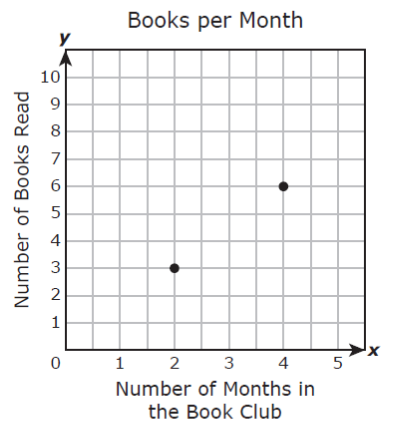
Which of these statements is supported by the rate of change in this relationship?
Question 7
7.
Which answer choice represents a person burning 90 calories by climbing 18 flights of stairs?
Question 8
8.
Pamela rode her bike at a constant rate of 0.1 kilometer per minute. Which table represents y, the number of kilometers Pamela roder her bike in x minutes?
Question 9
9.
Natasha has a job putting letters in envelopes to be mailed. In 1 hour she put 42 letters in envelopes.
Which equation best represents y, the total number of letters Natasha puts in envelopes in x hours if she continues at this rate?
Question 10
10.
How did you identify which equation matches the situation for question 9?
Question 11
11.
An online game increases in number of users at a rate of 500 users each day. Which graph best represents the relationship between y, the number of users, and x, the number of days?
Question 12
12.
A dog eats 1.25 cups of dog food twice a day. Which graph best represents this relationship?
Completed early? Continue practicing with IXL Lesson J.16 Constant Rate of Change (TWW)