Retest Summative Criterion B and D

Last updated over 2 years ago
8 questions
Note from the author:
You have 105 minutes to complete this test.
Criterion B Rubrics

Achievement level
Level descriptor
0
The student does not reach a standard described by any of the descriptors below.
1-2
The student is able to:
[ ] apply, with teacher support, mathematical problem-solving techniques 
to discover simple patterns
[ ] state predictions consistent with patterns.
3-4
The student is able to:
[ ] apply mathematical problem-solving techniques to discover simple patterns
[ ] suggest general rules consistent with findings.
5-6
The student is able to:
[ ] select and apply mathematical problem-solving techniques to discover 
complex patterns
[ ] describe patterns as general rules consistent with findings
[ ] verify the validity of these general rules.
7-8
The student is able to:
[ ] select and apply mathematical problem-solving techniques to discover 
complex patterns
[ ] describe patterns as general rules consistent with correct findings
[ ] prove, or verify and justify, these general rules.
1

Consider the following Sequence,
-7, -3, 1, 5, 9...
1. What would the next two terms of the sequence be?
2. What is the general rule of the sequence?

1

Consider the sequence 2(8-7), 4(10-8), 6(12-9), 8(14-10), …
1. What are the next 2 terms of the sequence?
2. What would the general rule of this sequence be? Write it in the form a(b-c).
3. What would the 10th term of the sequence be?

1

Building a house of cards is a tricky job, it is essential to find a proper balance and also requires very steady hands. Card stacking looks like the image given below.
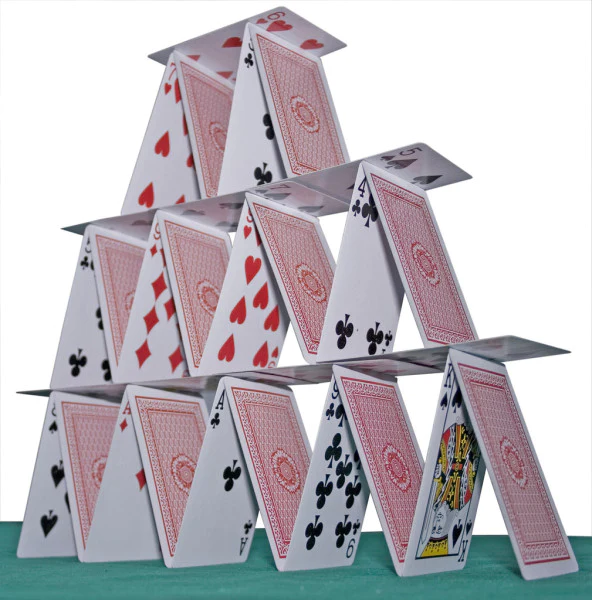
With each storey, the number of cards required to build the house increases and you are going to find out exactly how.

Observe the table below. (A diagram is attached after that to help you visualize how the cards are stacked.)




1. Fill in the rest of the table and use diagrams to find the pattern and support your answer. Attach you can show the diagram in the show-your-work space given below.

2. Find a general rule for the pattern given above.

3. Verify your general rule is valid by applying it to the 4th pattern.

4. If you have a deck of 100 cards, how many storeys do you think you'd be able to make from it?

5. Justify why your rule works. Support your answer with mathematical reasoning.

Criterion D Rubrics

Achievement level
Level descriptor
0
The student does not reach a standard described by any of the descriptors below.
1-2
The student is able to:
[ ] identify some of the elements of the authentic real-life situation
[ ] apply mathematical strategies to find a solution to the authentic real-life situation, with limited success.
3-4
The student is able to:
[ ] identify the relevant elements of the authentic real-life situation
[ ] select, with some success, adequate mathematical strategies to model the authentic real-life situation
[ ] apply mathematical strategies to reach a solution to the authentic real-life situation
[ ] discuss whether the solution makes sense in the context of the authentic real-life situation.
5-6
The student is able to:
[ ] identify the relevant elements of the authentic real-life situation
[ ] select adequate mathematical strategies to model the authentic real- life situation
[ ] apply the selected mathematical strategies to reach a valid solution to the authentic real-life situation
[ ] explain the degree of accuracy of the solution
[ ] explain whether the solution makes sense in the context of the authentic real-life situation.
7-8
The student is able to:
[ ] identify the relevant elements of the authentic real-life situation
[ ] select appropriate mathematical strategies to model the authentic real-life situation
[ ] apply the selected mathematical strategies to reach a correct solution to the authentic real-life situation
[ ] justify the degree of accuracy of the solution
[ ] justify whether the solution makes sense in the context of the authentic real-life situation.
A band is performing for charity at an auditorium with a seating capacity of 500. It seeks to raise an amount of $12,000 from this performance.


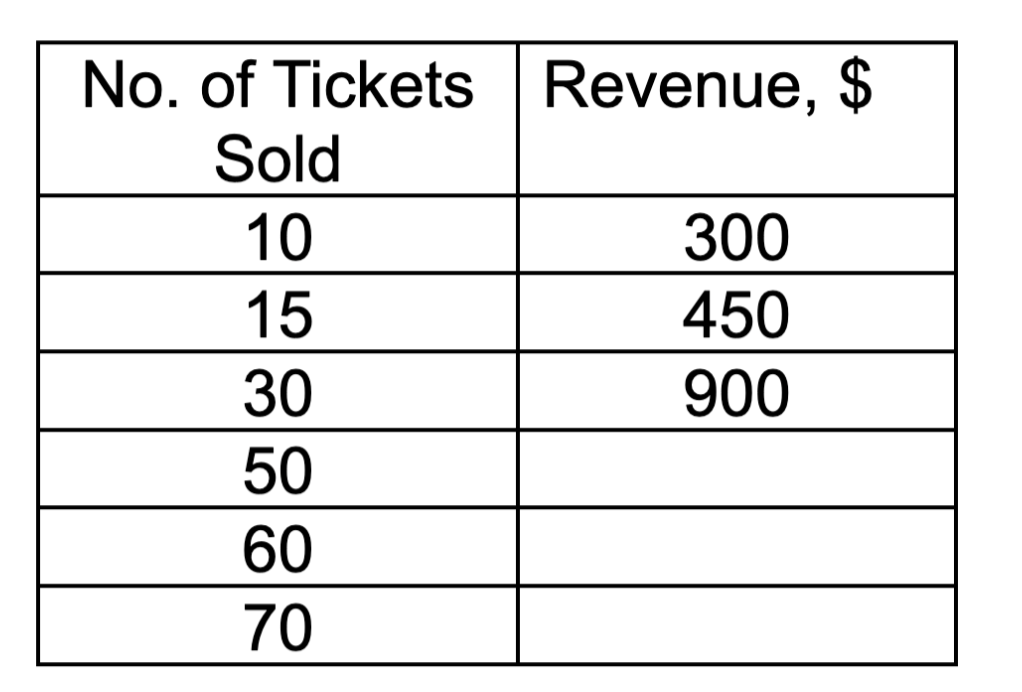
The revenue of the band is shown in the table below:


The band, however, is required to pay a rental to the auditorium. It wants to make a mathematical model (Equation) for the profit it makes at the performance. That way they can calculate how many tickets they need to sell to raise the amount.
1

What are some factors that affect the final profit they make, P, and the number of tickets they sell, n?

1

Since the relationship between P and n is linear, the model could be represented as:
P = an + b
What quantities do you think a and b represent in this equation? As in, n represents the no of tickets sold and P the profits made from the performance. So what could a and b be? What units will you use to measure a and b?

1

The band negotiates a rental of $ 2100 for the event. Calculate the values of ‘a’ and ‘b’

1

Rewrite the model from earlier for the profits made using the values of a and b that you have just calculated.

1

Justify whether your solution (the model) makes sense in the given context of calculating profits. What other problems could you apply this model to?