Asemmisa {{asɛmmisaAhyɛnsode}}
1.
You have one try. Use your notes and the anchor charts around the room to answer all of the questions.
A student is drinking a cup of hot chocolate as they sit by a campfire on a chilly evening. They know that the cup of hot chocolate transfers thermal energy to the surrounding air. The heated air over their cup of hot chocolate expands and rises and is replaced by cooler, denser air. This method of energy transfer is —
A convection
B condensation
C conduction
D radiation
A student is standing with their back facing a campfire. The student notices that their back is much warmer than their chest. They know that thermal energy is being transferred from the fire and that this method of energy transfer can happen even if no air is present. This method of energy transfer is —
How does transfer of thermal energy by radiation differ from convection and conduction?
A Convection and conduction transfer thermal energy through solids, liquids, or gases.
B Radiation can transfer thermal energy through space in addition to solids, liquids, or gases.
C Radiation requires direct contact between particles for thermal energy transfer.
D Convection and conduction use currents to transfer thermal energy in solids, liquids, or gases
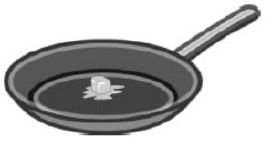
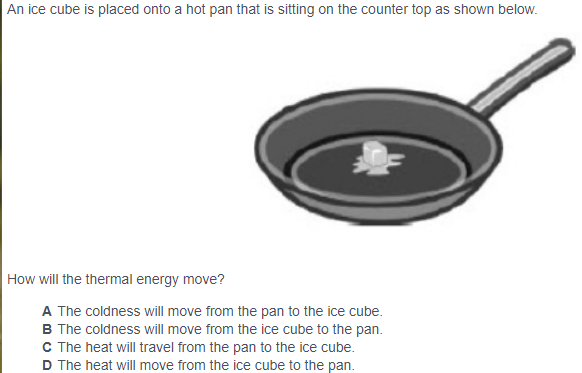
The diagram below shows an ice cube placed in a hot pan.
Thermal energy is being transferred to the ice cube from the pan shown above by —
A convection
B conduction
C radiation
D conservation
What type of heat transfer occurs when you touch a metal seat with your hand and the seat feels cold?
A Radiation
B Convection
C Conduction
D Transpiration
What is an example of thermal energy transfer by radiation?
A A metal spoon becoming hot in a bowl of soup
B Water boiling in a pot on a burner on the stove
C The Sun heating the surface of the Earth
D A hot air balloon releasing gas and rising
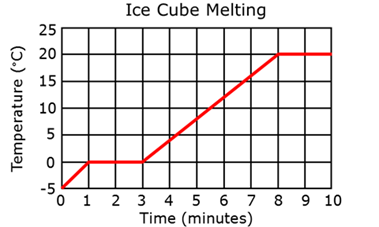
The graph below shows the temperature change that occurs when an ice cube in a beaker (-2 C) melts to form water until the water reaches room temperature (20 C).
Which statement correctly describes thermal energy movement?
A Thermal energy in the room absorbs the cold from the ice cube.
B The ice cube absorbs thermal energy from the room.
C Thermal energy moves back and forth from the ice cube and the room.
D The ice cube gives thermal energy to the room
A bottle of water at a room temperature of 21.0 C is placed into a refrigerator with an air temperature of 4.5 C. The thermal energy will move —
A from the cooler air to lower the temperature of the water to 4.5oC
B in both directions until the temperature is equal in the water and the air
C from the water to the air until the water temperature is zero degrees Celsius
D from the water to the air until the temperature is equal in both
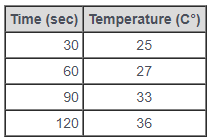
Students conducted an investigation of thermal energy transfer. Students placed a thermometer under a heat lamp and recorded the change of temperature every thirty seconds for two minutes in the data table.
Based on the data, how was thermal energy transferred in this investigation?
A Thermal energy moved from a warmer object to a cooler object through conduction.
B Thermal energy moved from a cooler object to a warmer object through conduction.
C Thermal energy moved from a cooler object to a warmer object through radiation.
D Thermal energy moved from a warmer object to a cooler object through radiation.
Which action in the science laboratory transforms chemical energy to thermal energy?
A Using a hot plate to boil a beaker of water
B Using a candle to melt sulfur in a test tube
C Growing potted plants near a window
D Flipping the light switch to turn on classroom lights
Which scenario describes a transformation of thermal energy into chemical energy?
A You turn on the heater in your car.
B The UV light from the Sun causes a sunburn.
C The Sun’s energy causes you to sweat.
D The oven bakes dough into bread.
A hydroelectric power plant works by using flowing water to turn a turbine. The turbine is connected to a magnet inside of a generator. When the magnet turns inside of the generator, the coiled wire surrounding the magnet will generate the type of energy that is sent along power lines to your home. What energy transformation occurs in a hydroelectric power plant?
A Mechanical to electrical
B Electrical to mechanical
C Chemical to mechanical
D Chemical to electrical