B2 GRAMMAR PERFECT TENSES
star
star
star
star
star
Last updated almost 3 years ago
10 questions
Note from the author:
English B2 Grammar
PRESENT PERFECT SIMPLE
I/you/we/they + have + V3 (-ed/ 3rd form)
he/she/it + has + V3 (-ed/ 3rd form)
PRESENT PERFECT CONTINUOUS
I/you/we/they + have + BEEN +V-ing
he/she/it + has + BEEN + V-ing
PAST PERFECT SIMPLE
ALL pronouns + had +V3 (-ed/ 3rd form)
PAST PERFECT CONTINUOUS
ALL pronouns + had + BEEN + V-ing
Present perfect simple and present perfect continuous
- We use the present perfect simple with past finished actions or experiences when we don’t mention or we don’t know when they happened.
COMPARE:
I've been to Paris few times. (Present Perfect Simple)
I was in Paris 4 years ago. (Past Simple)
- And we also use the present perfect simple to ask or talk about situations that started in the past and have not finished.
I've had English lessons since May.
- We use the present perfect simple to focus on the result of an action, and we use the present perfect continuous to focus on the doing of the action itself.
I've been practising this piece for weeks, but still haven't learned it.
- We use the present perfect simple to talk about how much or how many. When we focus on how long something has taken, we use the present perfect continuous.
I've done three tests this term.
We've seen that show three times.
I've been working on this project for a month now. I need to finish it by the end of the week.
- We use the present perfect simple to talk about how many times.
- But we use the present perfect continuous for repeated actions when we don't say specifically how many times they have happened. We often use phrases such as all day and recently in these sentences.
I've been trying to contact him all morning.
I've tried to call him 10 times this morning.
- We usually use the present perfect simple, not the present perfect continuous, to talk about states rather than actions with state verbs such as: be, have, know, seem, think, love, believe...
We've known each other since university.
❌NOT We've been knowing each other
She's had that laptop for over ten years!
❌NOT She's been having that laptop for over ten years!
We use the present perfect continuous with action verbs (dynamic verbs) to talk about situations that started in the past and have not finished or have just finished.
- Have you been crying?
- Sorry I am so dirty, but I‘ve been painting.
There is often a present result from doing these actions.
- You‘ve been crying. (Your eyes are red.)
- I am dirty because I‘ve been painting.
We can use the present perfect continuous to talk about continuous or repeated actions or situations from the past till now.
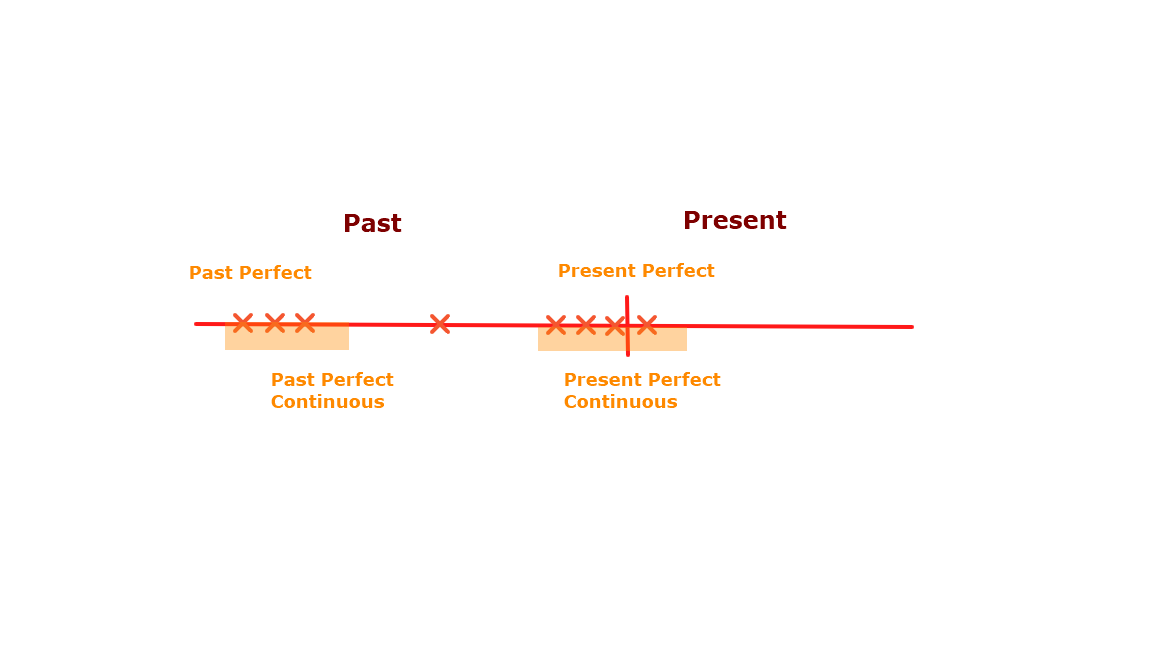
- She‘s been calling you for days. (=She has repeated this action for several days.)
- I‘ve been studying since you left. (=I have done this action continuously without stopping.)
Required
12
Choose the present perfect simple or present perfect continuous to complete the sentences below. If both tenses are possible, use the present perfect continuous.
1. I __________ and my legs are really tired now.
2. I'm sorry I'm late, __________ for a long time?
3. How long __________ Peter?
4. Somebody __________ my cookies. There are none left.
5. Somebody __________ my cookies. There are very few left.
6. How many books __________?
7. She must be tired. She __________ all afternoon.
8. I __________ all afternoon. I __________5 chapters.
9. I think I __________ chocolate since I was born.
10. They __________ for months, and they __________ three countries so far.
Required
13
Choose the present perfect simple or present perfect continuous for each gap below.
1. I __________ the book you lent me and it's great. I'll give it back to you when I finish it.
2. Bruce __________ tennis since he was a child. He __________ many trophies.
3. You __________ too much time playing that stupid game!
4. You __________ tennis since 10 o'clock. How many sets __________?
5. He __________ to me since we met last summer. He __________ over 100 emails.
6. __________ any fish today?
7. A: He __________ hundreds of job applications, but he's got no answers yet. B: How long __________ for a job?
8. Now that I __________ tidying the house, I'm going to clean it.
9. We __________ this TV for ages. I think it's time to buy a new one.
Required
20
Complete the dialogues below with the present perfect simple or present perfect continuous of the verbs in brackets. If both tenses are possible, use the present perfect continuous.
1. A: I'm very tired. We _______ (walk) too fast.
B: Maybe you are right, we _______ (walk) 10 kilometres in only one hour and a half.
2. A: You _______ (drink). You can't take the car.
B: But I _______ (only/drink) a couple of beers!
A: That isn't true; you _______ (drink) four beers.
3. I _______ (wait) for you all morning! Where _______ (you/be) all this time?
4. I _______ (teach) in this school for 20 years, and I _______ (meet) thousands of students from hundreds of different countries.
5. A: It smells fantastic!
B: Yeah, I _______ (make) cookies all afternoon.
A: Let me see. Wow! You _______ (make) a lot of cookies!
6. A: Someone _______ (call) all morning. They _______ (call) at least ten times.
B: Well, you _______ (sit) next to the phone all this time. You could have picked it up.
7. I _______ (work) here for over a month and I _______ (not meet) the manager yet.
8. I _______ (lose) my keys and I _______ (try) to contact my wife all morning, but she isn't answering her phone.
9. What's the matter with you? You _______ (say) anything since this morning.
10. Look, I _______ (wash) my car. Doesn't it look new now?
Past perfect simple and past perfect continuous
- We use the past perfect simple to describe completed events that happened before another event in the past, often with time expressions, such as: by the time, when, before, after and until.
She had already learned how to read and write by the time she started school.
We use the past perfect continuous:
- to describe ongoing activities leading up to a past event.
They had been walking for hours when they saw the house in the distance.
- to give background information about an event.
She was concerned because he hadn't been sleeping well recently.
Required
10
1) We _______ (eat) all the ice cream by the time Susan got to the party.
2) Matthew needed a holiday because he _______ (work) hard for several months.
3) I could tell my daughter _______ (cry) because her eyes were red.
4) He _______ (get) up at four o'clock all week, so on Saturday he was completely exhausted.
5) The Alvarezes _______ (never/be) to the theatre before last Friday.
6) _______ (Amanda/ever/study) Japanese before she moved to Japan?
7) If he _______ (know) about the consequences, he wouldn't have done that.
8) The car _______ (belong) to Mark for years before Sara bought it.
9) The police officer asked whether everybody _______ (leave) the building.
10) I wish I _______ (go) fishing that day. Everybody else did.
Required
8
Complete the sentences with the correct form of the verbs in brackets. Use contractions where possible.
- Peter was Sally's best friend. She _______ (know) him all her life.
- The children were wet because they _______ (play) football in the rain.
- We were very hungry because we _______ (not / eat).
- I was delighted when I found my keys. I _______ (look) for them for hours.
- She was exhausted because she _______ (work) since eight o'clock that morning.
- Everything was white because it _______ (snow).
- The passengers were cross because the airline_______ (lose) everyone's bags.
- I _______ (not / see) Jacob for several years, but I recognised him immediately.
Required
6
Match the sentence beginnings (1-6) with their correct endings (a or b).
1. By the time he reached the prison gates, __________
2. When the visitors arrived at the island __________
3. His head ached and his eyes were sore because. __________
4. Until I read Mandela's autobiography. __________
5. We heard about the riot __________
6. How much studying had you done __________
Required
6
Complete the sentences using the past perfect simple or past perfect continuous form of the verbs.
climb | look for | not expect | not finish | swim | work
1. She _______ for thirty minutes before she realized that she couldn't see the shore.
2. He _______ the speech before the crowd began to cheer.
3. By the time we reached the top of the mountain,
we _______ over 300 metres.
4. She was surprised to see the room so full - she _______ so many people to come.
5. He was extremely tired because he _______ hard all day.
6 How long _______ the book before you found it?
Required
10
Match the sentence beginnings (1-5) with their correct endings.
1. I'd been cutting ...______________________
I'd cut ..._______________
2. I've been thinking about you ...____________________
I've thought about you_____________________________
3. I've seen a lot of good films ...________________
I saw a lot of good films..._______________
4. You've been wearing the same socks ... ___________________
You're wearing the same socks _________________
5. How long have you been ___________________________________
How many times have you been _______________
Other Answer Choices:
going to Spain for the winter?
wood all morning.
a lot recently.
last year.
as me! Look!
this year.
my finger.
several times this week.
since Monday!
to Spain?
Required
10
Complete the text with the correct form of the verbs from the box. Use the past simple, present perfect simple, present perfect continuous or past perfect simple.
be (x2) | get | improve | introduce | kill | not cook | not live | result | rise
Who wants to live for ever? In wealthy countries, the number of years people can expect to live _______ over the last 200 years. Most babies born in 1900 _______ past the age of 50, but many babies born these days will live to over 80. There are three main reasons why people are living longer these days.
Firstly, public health _______ dramatically. In the 20th century, thanks to developments in medical science, a large proportion of the population were protected against diseases which _______ many people, such as smallpox, polio and measles. In addition, medical research _______ in cures being found for many other illnesses.
Secondly, there is a much greater understanding of the importance of good hygiene than there _______ in the past. People wash their hands more often than they used to and are much more aware of food hygiene. In the past, for example, people often _______ ill because they ate food that they _______ properly.
Awareness of the importance of keeping people safe and well at school and at work has grown, too, and laws for ensuring health and safety at work _______ in place for several decades now.
Finally, people generally lead more healthy lifestyles these days. Fewer people smoke
and in many countries governments _______ smoking bans in public places.
Required
12
Complete the text with the correct form of the verbs in brackets. More than one option may be possible.
My life _______ (change) dramatically in 2010, when I _______ (lose) my job as an accountant. My father _______ (die) the year before, and he _______ (leave) me some money. I _______ (look) at some travel magazines and I _______ (think) about spending the money on an exotic holiday, when I _______ (hear) a programme on the radio about orphanages in India. 'I _______ (want) to make a difference,' thought to myself. 'Why _______ (I/dream) about holidays when I can help other people?' Since then, I _______ (travel) several times to India and I _______ (help) to rebuild an orphanage in Calcutta. It _______ (be) an amazing experience.