Log in
Sign up for FREE
arrow_back
Library

Lesson 7 Wrap Up

star
star
star
star
star
Last updated over 1 year ago
31 questions
2
2
2
2
1
1
1
3
1
1
1
1
1
1
1
1
1
1
1
2
2
1
1
1
1
1
1
Question 1
1.

Explain how age relates to cancer?

Question 2
2.

Explain how height relates to cancer?

Question 3
3.

State two differences between normal and cancer cells.

Question 4
4.

Explain how tumors form using your knowledge of the cell cycle.

Question 5
5.

The stage of the cell cycle where the cell grows in size, replicates DNA, and develops.

Question 6
6.

The stage of the cell cycle where the chromosomes of the cell separate and two identical cells are made.

Question 7
7.

The stage of the cell cycle where the cell membranes form to divide a cell into two cells

Question 8
8.

The stage of interphase with the definition

  • DNA replicates
  • Cell grows in size
  • Cell checks to make sure the DNA replicated correctly and cell has the proper supplies
  • G2
  • G1
  • S
Question 9
9.

People who have leukemia, a cancer that affects white blood cells, are often given Cytarabine. This drug inhibits the synthesis of DNA. Which phase of the cell cycle is most affected by Cytarabine?

Question 10
10.

The diagram below represents the cell cycle.
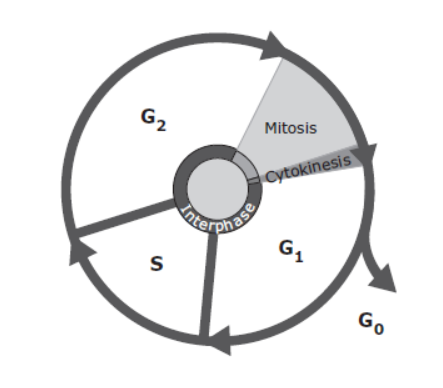
​When cells leave the cell cycle, they exit during G1 phase and then enter G0 phase, a resting period. Most normal cells can leave G0 phase and reenter the cell cycle at G1 phase before entering S phase. Cancer cells are different because they cannot enter G0 phase and are likely to do which of the following?

Question 11
11.

Which statement describes what would most likely happen if p53 mutated and could not perform its task?

Question 12
12.
As cell division increases the rate of mutation __________
Question 13
13.

DNA replication results in

Question 14
14.
The base pair C pairs with __________ during DNA replication.
Question 15
15.
The base pair T pairs with __________ during DNA replication.
Question 16
16.

DNA replication results in two DNA molecules

Question 17
17.

When does DNA replication occur?

Question 18
18.

A mistake in the DNA sequence is called

Question 19
19.

The model shows a mutation to a partial sequence of bases in a gene. Which type of mutation does the model represent?

Question 20
20.
A gene on chromosome 17 codes for the p53 protein.

Select from the drop-down menus to correctly complete the sentence.

After the gene is __________ into mRNA the mRNA is __________ to produce the p53 protein.
Question 21
21.
A student created a model of a DNA sequence and its mRNA transcript, as shown.

DNA 3'- AGC CGT ATC - 5'
RNA 5'- TCG GCA TAG- 3'

Another student found a mistake in the model
Select from the drop-down menus to complete the sentence describing the correction that should be made to the model.

The __________ nucleotides in the mRNA transcript should be replaced with __________ nucleotides
Question 22
22.

In cancer cells, mutations in the DNA cause the cells to reproduce uncontrollably, forming a tumor. Cancer directly affects which cellular process?

Question 23
23.

Which of the following is a primary reason for cancer cells developing in an organism?

Question 24
24.
__________ plays an important role in preventing cancer by telling cells to die when they are damaged. But this process is not always successful.
Question 25
25.

What does transcription produce?

Question 26
26.

Which of these is the direct result of an error in the transcription of a DNA nucleotide?

1
1
1
1
Question 31
31.

Which of the following is the correct sequence of events in the creation of a protein?

Question 27
27.

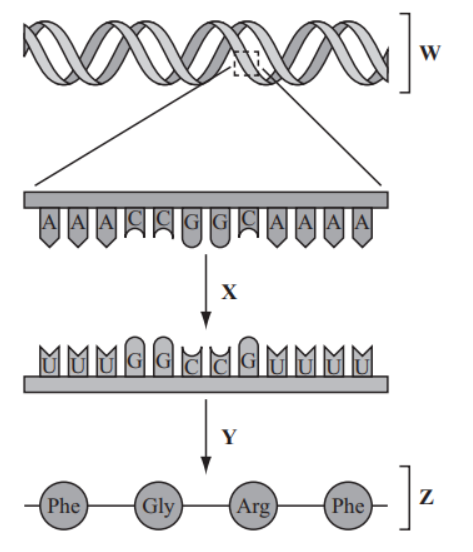
Image W is a molecule that is a double helix. Image W is

Question 28
28.

The arrow labeled X represents a process where DNA is read, copied, and made into a single strand of mRNA. This process called

Question 29
29.

The arrow labeled Y represents the step in the process when mRNA and tRNA work together in the ribosome. This process is called

Question 30
30.

The structure labeled Z is what is created as a result of protein synthesis. Structure Z is a long strand of what