Log in
Sign up for FREE
arrow_back
Library

12/19 Study Gde_Phys Final Exam_adv - ETM

star
star
star
star
star
Last updated over 3 years ago
30 questions
Required
1
Required
1
Required
1
Required
1
Required
1
Required
1
Required
1
Required
1
Required
1
Required
1
Required
1
Required
1
Required
1
Required
1
Required
1
Required
1
Required
1
Required
1
Required
1
1
Required
1
Required
1
Required
1
Required
1
Required
1
Required
1
Required
1
Required
1
Required
1
Required
1

REVIEW: SCIENTIFIC METHOD

Goal: I can identify the five general steps of the scientific method.

Recommendation: Review these notes. Then answer the questions below.

Question 1
1.


Question 2
2.


Question 3
3.


Question 4
4.


Question 5
5.


Review: Experiment Variables & Hypothesis

Goal: I can recognize a scientific hypothesis, independent variable, dependent variable, and control variable(s) given an experiment.

Recommendation: Review these notes. Then answer the questions below.

Question 6
6.

Question 7
7.

Question 8
8.

Question 9
9.

Question 10
10.


Review: Calculate Average Speed

Goal: I can use the average speed equation (spd = distance/time) to solve problems and make predictions.

Recommendation: Review these notes. Then answer the questions below.


Question 11
11.

Question 12
12.

Question 13
13.


Review: Solve for Travel Distance or Time

Goal: I can use the equations (d = spd*t; t = d/spd) to solve for travel distance or travel time.


Question 14
14.

Question 15
15.

Question 16
16.

Question 17
17.

At the start of your trip to San Diego, your family's car travels at a rate of 260 miles over four hours. If you continue at the same rate for the entire trip and reach San Diego in a total of 32 hours then how far would you have driven in total?

Show all math calculations. If not, assignment is considered incomplete.


Question 18
18.


Review: Graph Trends & Values

Goal - I can identify the values of a given X-Y graph by answering questions.

Recommendation: Review these notes. Then answer the questions below.


Question 19
19.

Question 20
20.

Question 21
21.

Question 22
22.

Question 23
23.


Review: Converting Units (1-step)

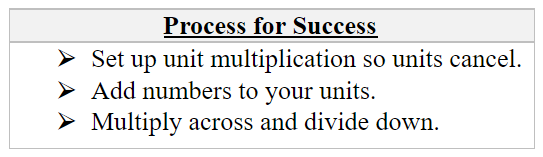
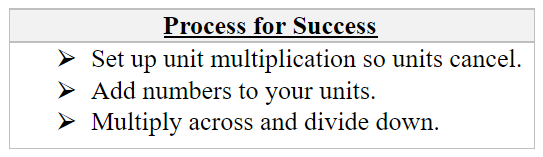
Goal - I can convert units using a unit cancelling process (called dimensional analysis).

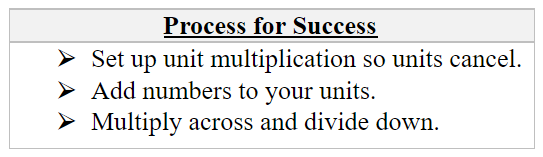
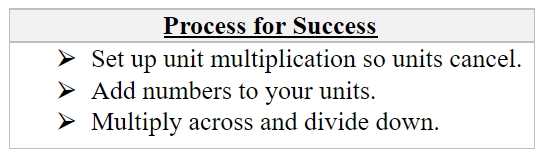
Recommendation: Watch the video HERE, pause it, try to solve a question on your own using scratch paper, and then press play to see how you did. Next, try the question below.

Question 24
24.

Question 25
25.

Question 26
26.

Question 27
27.

If the winter break lasts for 14 days then how long is the winter break in minutes?
(1 day = 24 hours, 1 hour = 60 minutes)

Question 28
28.

Question 29
29.

Question 30
30.


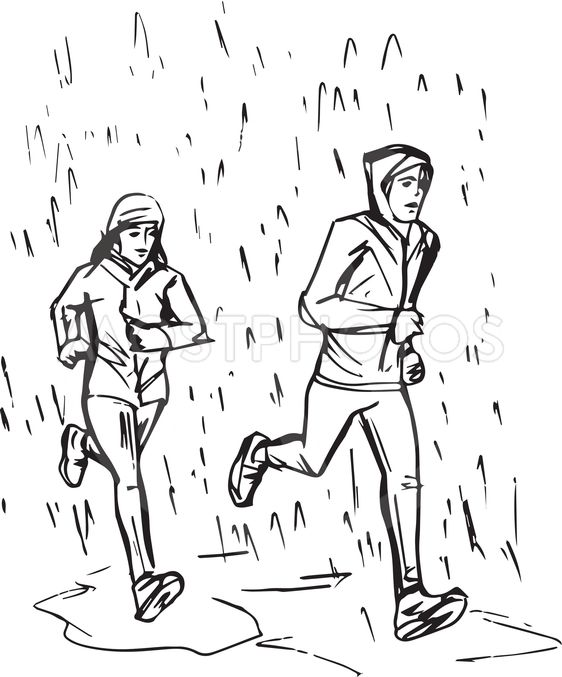
A student notices some people run in the rain and some people walk. They wonder if the walking person always gets more rain. They test this using a sponge. In one situation they walk in the rain with a sponge and measure the water squeezed out afterwards.
In a different situation they run in the rain and measure the water squeezed out. They compare the amounts of water and find that in both situations the sponge absorbed about 1 ounce of rain. Later that day they explain what they did and how it turned out to their parents.

Which sentence represents step #2 (define a question)?
A student notices some people run in the rain and some people walk.
They wonder if the walking person always gets more rain.
They test this using a sponge. In one situation they walk in the rain with a sponge and measure the water squeezed out afterwards.
In a different situation they run in the rain and measure the water squeezed out.
They compare the amounts of water and find that in both situations the sponge absorbed about 1 ounce of rain.
Later that day that explain what they did and how it turned out to their parents.
Which sentence represents step #5 (share results)?
A student notices some people run in the rain and some people walk.
They wonder if person walking always gets more rain.
They test this using a sponge. In one situation they walk in the rain with a sponge and measure the water squeezed out afterwards.
In a different situation they run in the rain and measure the water squeezed out.
They compare the amounts of water and find that in both situations the sponge absorbed about 1 ounce of rain.
Later that day they explain what they did and how it turned out to their parents.
Which sentence represents step #3 (set up and collect data)? Mark all that apply.
Later that day they explain what they did and how it turned out to their parents.
They compare the amounts of water and find that in both situations the sponge absorbed about 1 ounce of rain.
In a different situation they run in the rain and measure the water squeezed out.
They test this using a sponge. In one situation they walk in the rain with a sponge and measure the water squeezed out afterwards.
They wonder if person walking always gets more rain.
A student notices some people run in the rain and some people walk.
Which sentence represents step #1 (observe a phenomenon)?
A student notices some people run in the rain and some people walk.
They wonder if person walking always gets more rain.
They test this using a sponge. In one situation they walk in the rain with a sponge and measure the water squeezed out afterwards.
In a different situation they run in the rain and measure the water squeezed out.
They compare the amounts of water and find that in both situations the sponge absorbed about 1 ounce of rain.
Later that day they explain what they did and how it turned out to their parents.
Which sentence represents step #4 (analyze data)?
A student notices some people run in the rain and some people walk.
They wonder if person walking always gets more rain.
They test this using a sponge. In one situation they walk in the rain with a sponge and measure the water squeezed out afterwards.
In a different situation they run in the rain and measure the water squeezed out.
They compare the amounts of water and find that in both situations the sponge absorbed about 1 ounce of rain.
Later that day they explain what they did and how it turned out to their parents.
Select all the things that can changed in this experiment below. Remember to select ALL that apply.
Experiment: Students drop a ball from different heights and record the falling time.
type of ball used
height of the ramp
drop height of ball
falling time of ball
Identify the independent variable given the experiment below.

Experiment: Students drop a ball from different heights and record the falling time.
type of ball used
falling time of ball
drop height of ball
Identify the dependent variable given the experiment below.

Experiment: Students drop a ball from different heights and record the falling time.
type of ball used
falling time of ball
drop height of ball
Identify a control variable given the experiment below.

Experiment: Students drop a ball from different heights and record the falling time.
type of ball used
falling time of ball used
drop height of ball used
Identify a scientific hypothesis that can be tested by the experiment below.

Experiment: Students drop a ball from different heights and record the falling time.
Scientific hypothesis: If the weight of the ball increases then the falling time will decrease.
Scientific hypothesis: If the drop height of the ball increases then the falling time will increase.
Scientific hypothesis: If the temperature of the oven air increases then the baking time for the cake will decrease.
A toy car is turned on for 8 seconds and then turned off. During that time the toy car travels 2.7 meters. Determine the average speed of the toy car in units of meters per second.

21.6 miles per second
2.96 miles per second
0.34 meters per second
A person is walking to their friend's place. It takes them 21 minutes to walk the 1.5 miles. What was their average walking speed in miles per minute?

0.07 miles per minute
14 miles per minute
31.5 miles per minute
A toy car is turned on and travels 120 inches before being turned off. The time between it being turned and off was 15 seconds. Determine the average speed of the toy car in units of feet per second. Remember to convert inches to feet first. (1 foot = 12 inches)

8 feet per second
0.67 feet per second
0.125 feet per second
You and a friend go sledding at a hill next to Soldier Field. If your average speed down the hill is 6 feet per second then how long will it take you to reach the bottom of the 230-foot-long hill?


Yesterday you walked 25 minutes from Pritzker to your friend’s place. If you walked with an average speed of 70 meters per minute then how far does your friend live from Pritzker?


---------------------------------------------------------------------------------------------
---------------------------------------------------------------------------------------------
You and a friend decide to take the Pulaski bus 15 blocks to your aunt's house. If the bus averages a speed of 0.625 blocks per minute then how long will it take you to reach your aunts?

------------------------------------------------------------------------------------------------------------------
-------------------------------------------------------------------------------------------------------------------
A toy car is turned on and then turned off. During that time the toy car travels 2.9 meters.
If the average speed was 0.15 meters per second then how much time was it turned on for?


--------------------------------------------------------------------------------------------------------------
-------------------------------------------------------------------------------------------------------------
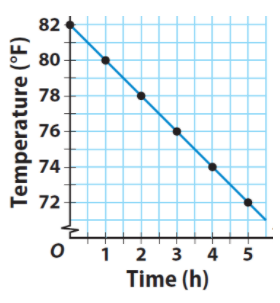
Which description below correctly describes the trend shown in the graph.

Temperature versus Time
positive linear correlation
negative linear correlation
exponential correlation
no correlation
Which description below correctly describes the trend shown in the graph.

positive linear correlation
negative linear correlation
exponential correlation
no correlation
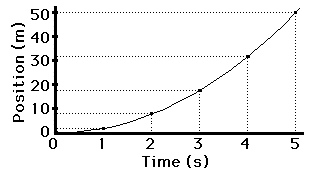
Which description below correctly describes the trend shown in the graph.

Position versus Time
positive linear correlation
negative linear correlation
exponential correlation
no correlation
Six flags Amusement park offers different ticket prices. The graph below shows the cost for each ticket based on group size. Which set of values below comes from this graph?

(20, 0); (24, 2);
(1, 20); (2, 24);
(0, 20); (2, 24);
You mail a gift to a cousin in another country. The graph below shows the cost based on the weight of the package. Which set of values below comes from this graph?

(1, 0); (2, 2 );
(0,1); (2, 2);
(0, 0); (2, 2);
In September you spent 1,452 minutes on snapchat. How many hours were you on snapchat?

Organize: (1 hour = 60 minutes)
87,120 hours
24.2 hours
0.041 hours
Yesterday you spent 27 minutes watching tiktok videos. How many seconds did you watch tiktok videos yesterday?

Organize: (1 minute = 60 seconds)
1620 seconds
0.45 seconds
2.22 seconds
You spent 170 seconds texting your mom this morning. How many minutes were you texting your mom this morning?

Organize: (1 minute = 60 seconds)
Yesterday you walked 4,100 feet to your friend’s place after school. How many yards was that?

Organize: (1 yard = 3 feet)
1,366.67 yards
12,300 yards
12,300 feet
Each day you walk 14.5 feet from the door to your seat in Physics. How many inches is that?

Organize: (1 foot = 12 inches)
You and a friend walk 20 blocks to the phone store to look at new phones. How many miles did you walk? ( 1 mile = 8 blocks )
120 miles
0.533 miles
1.875 miles