Log in
Sign up for FREE
arrow_back
Library

TEST_DE_Chem_2.3_ElectronRepresntations

star
star
star
star
star
Last updated almost 3 years ago
18 questions
1
1
1
1
1
1
1
1
1
1
1
1
1
1
1
1
1
1
Question 1
1.

Question 2
2.

Question 3
3.

Question 4
4.

Question 5
5.

Question 6
6.

Question 7
7.

Question 8
8.

Question 9
9.

Question 10
10.

Question 11
11.

Question 12
12.

Question 13
13.

Question 14
14.

Question 15
15.
The _______ exclusion principle is an important rule in quantum mechanics that states that no two electrons may have the same set of quantum numbers
Question 16
16.
The _______ dot structure is used to represent the number of electrons in the valence shell of an atom. Bonding between compounds can also be represented using these structures.
Question 17
17.
The _______ number is a unique set of numbers that describes the location of each electron in an atom or ion.
Question 18
18.

For the element oxygen, which of the following orbitals will be involved in bonding?
1s
2s
2p
3p
Using the orbital diagram below, which of the following elements does it describe?
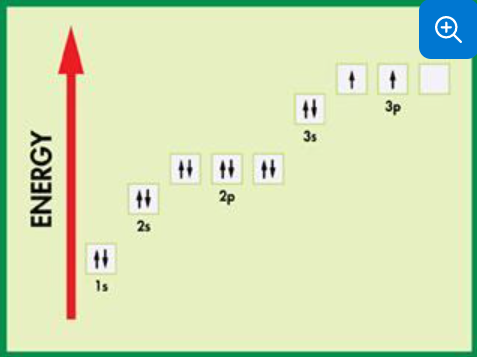
Si
O
F
Xe
What word is used to describe electrons in the outermost energy level?
ionic
orbital
covalent
valence
With the given orbital diagram, which of the following is true?
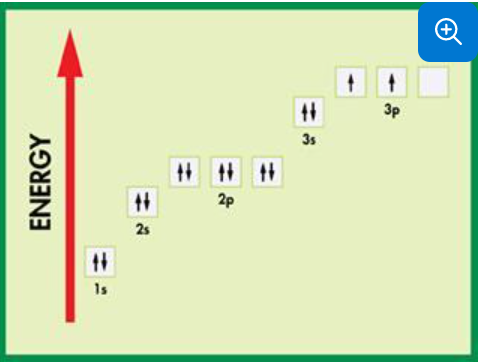
The orbital diagram violates Hund's rule
The 3p orbitals are filled
none of the above
The 2s orbitals are filled
What does an orbital diagram tell about a given element?
the number of electrons in a given atom
the relative energetic position of each electron
the number of occupied orbitals in an atom
Which of the following four letters does NOT represent an orbital?
s
g
d
p
The given orbital diagram is written incorrectly. Why?T
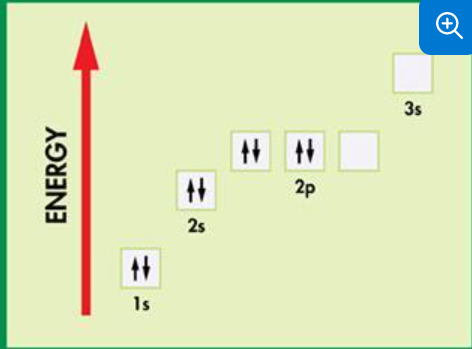
The number of electrons used is incorrect
The orbital diagram violates Hund's rule
The orbitals are not in the correct sequence
none of the above
Which of the following four choices best describes the octet rule?
Elements will typically react if they have less than eight electrons in their valence shell
Orbitals fill one electron at a time
Elements always have eight electrons in their valence shell
No more than two electrons can share an orbital
Generally, as one goes across the periodic table from left to right, which of the following is true about electron configurations.
The number of valence electrons in the last orbital increases
The electron configuration remains the same.
The energy level of the orbitals decreases
The types of orbitals in an atom remain the same
Which of the following Lewis structures for sulfur is written correctly?
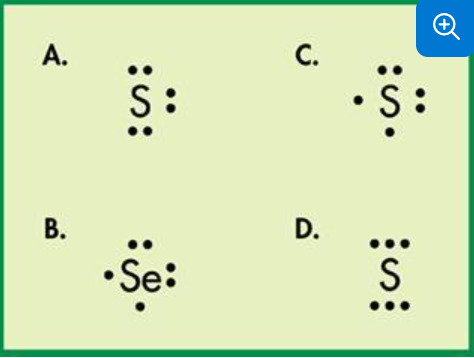
A
B
C
D
Which of the following Lewis structures describes an element in Group 1 of the periodic table?
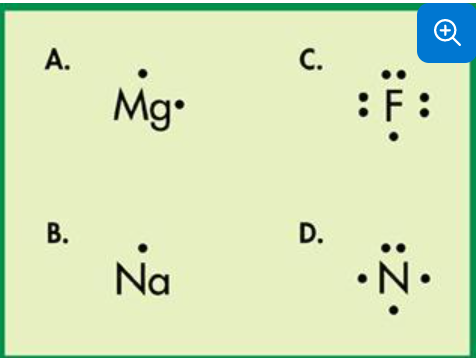
A
B
C
D
What does the superscript number in the electron configuration describe?
the number of electrons in the orbital
the shape of the orbital
all of the above
the energy level of the orbital
Why are noble gases non-reactive?
they have atoms which are bonded to one another
they are ionic in nature
none of the above
their valence orbitals are completely occupied
How is the direction of the electron's spin described in an orbital diagram?
none of the above
a plus or minus sign
an arrow pointing horizontally
an arrow pointing vertically
Electrons fill the orbitals in the following order:
1s, 2s, 2p, 3s, 3p, 3d, 4s, 4p, 4d, 4f, 5s, 5p, 5d, 5f, 6s, 6d, 6p,7s,7p.
1s, 2s, 2p, 3s, 3p, 4s, 3d, 4p, 5s, 4d, 5p, 6s, 4f, 5d, 6p, 7s, 5f, 6d, 7p.