Log in
Sign up for FREE
arrow_back
Library

TEST_DE_Phys_2.3-2.5

star
star
star
star
star
Last updated almost 3 years ago
23 questions
2.3 Electric Forces
1
1
1
1
1
2.4 Gravity
3
2
1
1
1
1
1
1
1
2.5 Movements in Space
8
1
1
1
1
1
1
1
1
Question 1
1.
The principle that states that the electric force between two electrically charged objects is directly proportional to the charges of the two objects and inversely proportional to the square of the distance between them is known as _______ law.
Question 2
2.

Question 3
3.

Question 4
4.

Question 5
5.

Two metal conducting spheres are fixed in place and have charges of 0.00025 C and 0.00015 C. They are separated by a distance of 0.85 meters. What is the electric force between them?

Question 6
6.
Draggable itemarrow_right_altCorresponding Item
arrow_right_alt
arrow_right_alt
arrow_right_alt
Question 7
7.
Newton's law of universal gravitation states that the magnitude of the gravitational force __________as the mass of the two objects increases and __________as the distance between the objects increases.
Question 8
8.
Gravitational force is an interaction between any two objects with mass that __________them to one another.
Question 9
9.
Gravitational __________ energy is the energy stored due to position in a gravitational field, commonly due to Earth's gravity.
Question 10
10.

Question 11
11.

Question 12
12.

A 9900-kg object feels a gravitational force of 12.0 N due to a 52,000-kg object. What is the distance between the two objects?

Question 13
13.

Question 14
14.

Question 15
15.
Draggable itemarrow_right_altCorresponding Item
arrow_right_alt
arrow_right_alt
arrow_right_alt
arrow_right_alt
arrow_right_alt
arrow_right_alt
arrow_right_alt
arrow_right_alt
Question 16
16.

Question 17
17.

Question 18
18.

Question 19
19.

Question 20
20.

Question 21
21.

Question 22
22.

Question 23
23.

As the distance between two charged particles increases, the force between them ___________.
decreases
increases
initially increases, then decreases
remains constant
When an electron is near a proton, which of the following is true?
There is no electric force between the two.
There is a repulsive force between the two.
There is an attractive force between the two
The force can be either attractive or repulsive depending on the distance between the two.
Common forces often known as 'contact forces' (such as a person's hand pushing a chair) are actually not caused by contact but rather are primarily the result of _________ acting at a distance.
the strong nuclear force
the electric force
the gravitational force
a combination of the gravitational, electric and strong nuclear forces
Newton's 2nd law
An object in motion stays in motion, unless acted on by a force and an object at rest stays at rest unless acted on by a force
Newton's 3rd law
Force is the product of mass and acceleration
Newton's 1st law
For every action force, there is an equal but opposite reaction force
Which of the following is a unit of mass?
newton
kilogram
tesla
meter
At the top of Willis tower (110 stories high) in Chicago, you weigh ________.
slightly less than you do at the bottom of the Grand Canyon
twice as much as you do at the bottom of the Grand Canyon
the same as you do at the bottom of the Grand Canyon
slightly more than you do at the bottom of the Grand Canyon
If your mass on Earth is 100.0 kg, what is your mass on Jupiter, where the force of gravity is approximately 2.5 that of Earth?
100.0 kg
40 kg
25 kg
2500 kg
Seesaws use the concept of center of gravity to work. If your mass is 100 kg and your friend has a mass of 80 kg, where is the center of gravity located?

closer to you
closer to your friend
an equal distance between you and your friend
cannot be determined based on the information provided
perihelion
the point in the orbit of a planet or other orbiting body where it is farthest from the Sun or the body around which it revolves
orbit
A date of the year when daylight and nighttime each last 12 hours everywhere on Earth and neither hemisphere is tilted toward or away from the sun; occurs twice per year
satellite
the circular or elliptical path of an object as it revolves around another object
solar eclipse
the point in the orbit of a solar system body when it is closest to the Sun
tide
any object that orbits another object
solstice
the temporary blockage of sunlight by the moon as it travels between Earth and the Sun
equinox
the twice-a-year occurrence during which the Sun appears at the highest point in the sky as seen from the North or South pole
aphelion
the regular fluctuation of sea water driven by the gravitational pull of the Moon and Sun on Earth's oceans and other large bodies of water
What event occurs when one celestial object or that object’s shadow obscures the view from Earth?
equinox
tide
solstice
ecllipse
The spin of a body on its axis is called ________.
revolution
orbital period
axial tilt
rotation
The International Space Station is an example of ________.
an artificial satellite
a tidally locked satellite
a lunar satellite
a natural satellite
According to Kepler's third law of planetary motion, ________.
the cube of a planet's orbital period is inversely proportional to the square of its average distance from the sun
the cube of a planet's orbital period is directly proportional to the square of its average distance from the sun
the square of a planet's orbital period is directly proportional to the cube of its average distance from the sun
the square of a planet's orbital period is inversely proportional to the cube of its average distance from the sun
Which of the following is the primary cause of tides on Earth?
Earth's position between Venus, which is more massive, and Mars, which is less massive
the moon's revolution around Earth
Earth's revolution around the sun
Earth's rotation on its axis
According to Kepler's first law of planetary motion, ________.
a planet's orbit is elliptical, with the sun at one focus of the ellipse.
a planet's orbit is elliptical, with the sun at the center of the ellipse.
a planet's orbit is circular, with the sun at the center of the circle.
a planet's orbit is elliptical, with the sun moving back and forth between the ellipse's two foci.
Which of the following is not a phase of the moon?
first quarter
waxing gibbous
waxing crescent
waning quarter
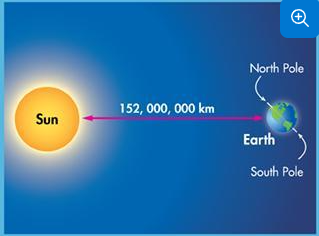
The following diagram shows Earth at the point in its orbit farthest from the sun.
Based on this diagram, which of these statements is correct?
It is summer in the Northern Hemisphere because that hemisphere is tilted toward the sun.
It is summer at the North Pole only and winter everywhere else on the planet.
It is winter in the Northern Hemisphere because Earth is farther from the sun than at any other point it its orbit.
It is winter at the South Pole only and summer everywhere else on the planet