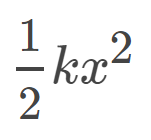
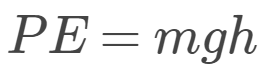
Match the type of potential energy with the matching equation.
PEelastic =
PEgrav =
PEelec =
Mmuae Afoforo a Wobɛpaw:
What do you already know about types of energy?
Categorize the following examples on if they represent kinetic or potential energy.
running a race
lying on a table
chemical energy in food
spinning in a dance
a compressed spring
Kinetic Energy
Potential Energy
A converts electrical energy into thermal energy.
A converts rotational energy into electrical energy.
A converts gravitational energy into mechanical energy.
A converts rotational energy into mechanical energy.
Kinetic Energy is the energy of motion. The kinetic energy of an object is proportional to its mass and the square of its velocity. What is the equation to calculate kinetic energy?
Match the type of potential energy with the matching description.
| Draggable item | arrow_right_alt | Corresponding Item |
|---|---|---|
Gravitational Potential Energy | arrow_right_alt | Stored in the bonds between atoms and molecules. |
Elastic Potential Energy | arrow_right_alt | Stored in electric fields between charged particles. |
Electric Potential Energy | arrow_right_alt | Stored in the object when the object is lifted against the force of gravity |
Chemical Potential Energy | arrow_right_alt | Stored in a material is stretched or compressed |
Match the type of potential energy with the matching equation.
PEelastic =
PEgrav =
PEelec =
Name each section of the electromagnetic spectrum
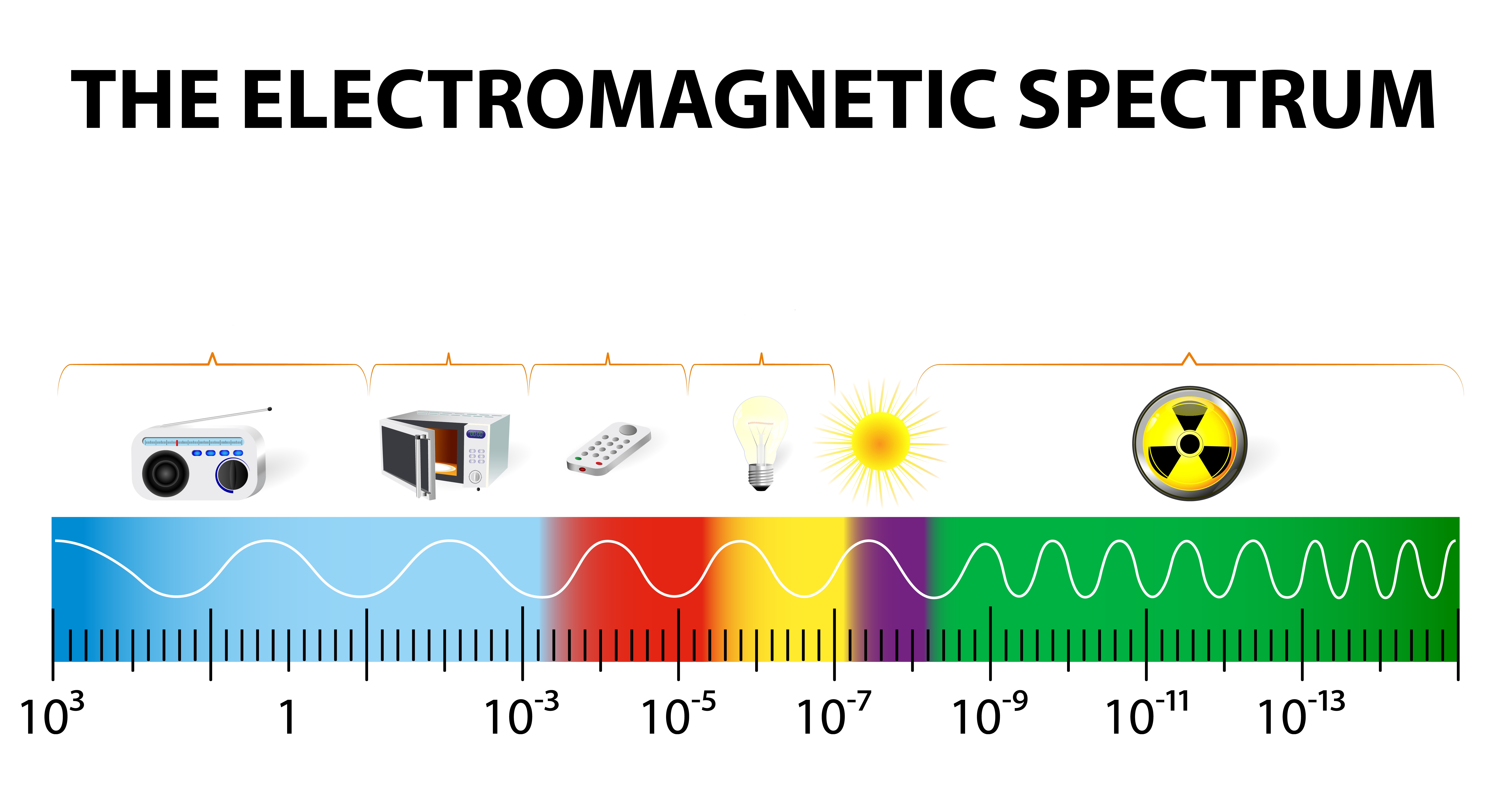
All electromagnetic waves, including visible light waves, are made up of
What are the three ways heat energy can be transferred?
It is possible to rearrange the equation for kinetic energy to solve for different variables such as velocity. This will be helpful in cases where the total kinetic energy and the mass are known but the velocity is unknown.
What is the equation to find velocity using kinetic energy?
A 2,300-kg truck is traveling down a highway at 32 m/s. What is the kinetic energy of the truck in Joules (J)?
A 35-kg boy is riding an 18-kg bicycle down a path. The bicycle is moving at 11 m/s.
Calculate the kinetic energy of the boy and the bicycle in Kilojoules (KJ). (rounding your answer to the nearest tenth).
A 0.450 kg soccer ball has a kinetic energy of 119 J.
Calculate the velocity of the soccer ball (rounding your answer to the integer). Include units.
A 0.041 kg bullet has a kinetic energy of 660 J. What is the velocity of the bullet?
As an object falls, it loses
If an object of mass m at rest falls from a height h1 to a height h2, the magnitude of its velocity increases to v.
How is this described in an equation?
The first hill of a roller coaster is 42.0 meters high. The roller coaster drops to a height of 4.2 meters above the ground at the bottom of this first hill.
If the mass of the roller coaster is 34,500 kg, what is the velocity at the bottom of the first hill? Ignore friction and assume the velocity at the top of the first hill is 0 m/s.
The first hill of a roller coaster is 42 meters high. The top of the second hill of the roller coaster is 33 meters high. The mass of the roller coaster is 34,500 kg.
Calculate the velocity of the roller coaster at the top of the second hill (rounding your answer to the integer). Ignore friction and assume the velocity at the top of the first hill is 0 m/s.