Log in
Sign up for FREE
arrow_back
Library

Formative_DE_LE_Unit2

star
star
star
star
star
Last updated over 2 years ago
16 questions
2.1 Energy of Life
2
1
2
1
2
2
1
2
1
1
1
2.2 Photosynthesis
1
1
2
3
2.3 Cellular Respiration
2.4 Nutrient Cycles
2.5 Mechanical and Chemical Weathering
2.6 Erosion and Deposition
Question 1
1.

Classify the following as either carbohydrates or other organic molecules by dragging them to the correct box.

  • glucose
  • starch
  • albumin
  • cholesterol
  • glycogen
  • fructose
  • testosterone
  • Carbohydrates
  • Other organic molecules
Question 2
2.

If a female lion runs a distance of 469.2 meters while chasing an antelope, how many millimeters did she run?

Question 3
3.

The two main processes organisms use to make energy are photosynthesis and cellular respiration. Match the following terms or processes with the best definition.

Draggable itemarrow_right_altCorresponding Item
oxygen is absent
arrow_right_alt
where cellular respiration takes place
chloroplasts
arrow_right_alt
where photosynthesis takes place
mitochondria
arrow_right_alt
the first stage of respiration
oxygen released
arrow_right_alt
taken in through leaves
carbon dioxide
arrow_right_alt
lactic acid or alcohol from pyruvate
glycolysis
arrow_right_alt
by product of water breakdown
Question 4
4.

The conversions of energy involve many chemical reactions taking place within an organism or the environment. What is the term for the energy needed to begin one of these reactions?

Question 5
5.

Life requires energy to exist. Connect the life processes to the reasons they consume energy.

Draggable itemarrow_right_altCorresponding Item
Breathing
arrow_right_alt
Polymerization of nucleic acids require energy to break chemical bonds
Dreaming
arrow_right_alt
Production of digestive enzymes requires energy to break bonds in proteinst
Replication of DNA
arrow_right_alt
Contraction of the diaphragm uses energy to move muscle fibers
Digesting food
arrow_right_alt
Active transport uses energy to produce chemical gradients across neurons
Question 6
6.
A rollercoaster car moves from left to right as shown. The car starts out with high velocity as it is launched at the gate and no additional energy is provided during the part of the roller coaster shown. Determine whether the car is gaining or losing kinetic and potential energy at each part of the rollercoaster.
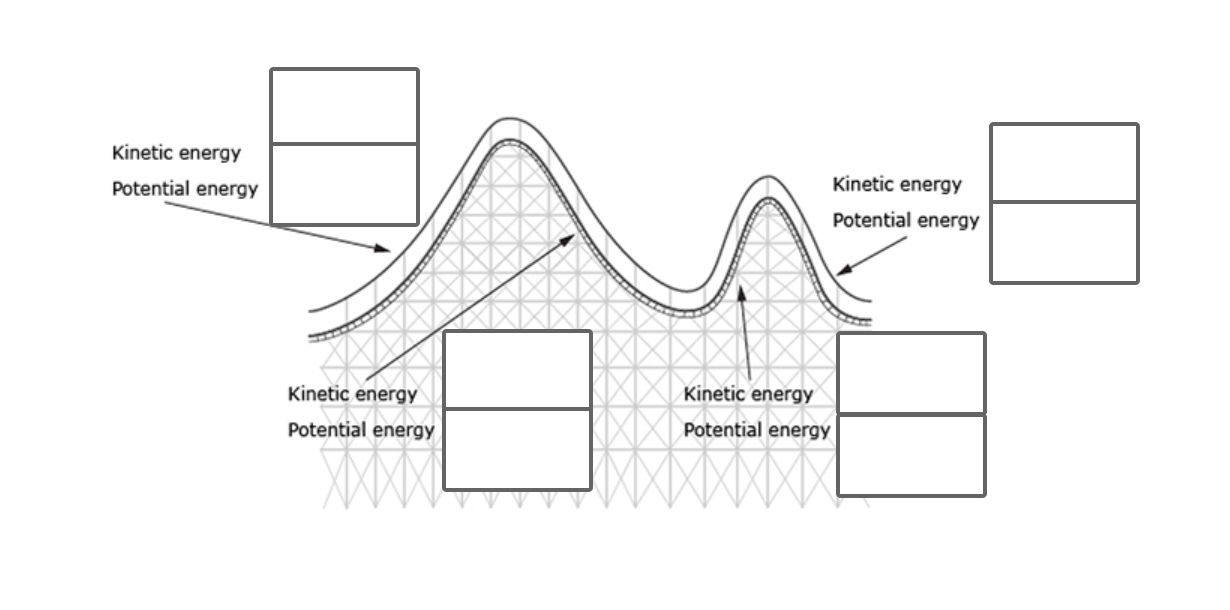
Other Answer Choices:
decreases
increases
increases
increases
decreases
decreases
decreases
increases
Question 7
7.
Draggable itemarrow_right_altCorresponding Item
First Law of Thermodynamics
arrow_right_alt
Energy cannot be created nor destroyed
Second Law of Thermodynamics
arrow_right_alt
Entropy of a system cannot decrease
Third Law of Thermodynamics
arrow_right_alt
The point at which the thermal energy of molecules is zero is when atoms have ceased moving.
Question 8
8.

Classify the following statements for if they best fit an endergonic reaction or an exergonic reaction.

  • Require a net input of energy
  • Release energy into the surroundings
  • Change in free energy is positive
  • Change in free energy is negative
  • Breakdown of food molecules
  • Building ATP
  • Endergonic Reaction
  • Exergonic Reaction
Question 9
9.
Electrons can be moved from a lower energy state in one atom to a higher energy state in another atom; this serves to _______ energy. Electrons can also move from higher energy states in one atom to lower energy states in another, thus _______ energy. The movement of electrons from one atom to another changes the _______ number of both atoms. Any chemical reaction that changes the oxidation number of atoms is called a _______ reaction.
Question 10
10.
The term redox is a combination of the terms reduction and oxidation. _______ is the gain of electrons, which decreases the _______ state of the atom or ion.
Question 11
11.

Determine whether each change in the fast carbon cycle would increase or decrease atmospheric carbon. Drag each change into the correct row.

  • less solar energy
  • more green plants
  • less water
  • fewer decomposers
  • more animals
  • Increase Atmospheric Carbon
  • Decrease Atmospheric Carbon
Question 12
12.

Classify some of the following as a product or a reactant in the process of photosynthesis.

  • carbon dioxide
  • oxygen
  • glucose
  • water
  • Reactants
  • Products
Question 13
13.
_______ in a plant absorbs and transfers energy from most visible waves of light from the _______, except green and yellow.
Question 14
14.

Read the terms below. Read the possible definitions and separate the incorrect definitions from ones that correctly relate to the terms. Connect the definition to its correct term.

Draggable itemarrow_right_altCorresponding Item
autotroph
arrow_right_alt
a substance essential for the growth and maintenance of life
carbon dioxide
arrow_right_alt
primary pigments responsible for the absoption of light energy in the process of photosynthesis
cellular respiration
arrow_right_alt
a conversion of light energy into chemical energy
chlorophyll
arrow_right_alt
a reactant in the process of photosynthesis
nutrients
arrow_right_alt
a series of metabolic processes where chemical energy is released to produce ATP
photosynthesis
arrow_right_alt
an organism capable of synthesizing its own food from inorganic sources
chloroplasts
arrow_right_alt
the location in plants that holds chlorophyll and where photosynthesis takes place
Question 15
15.

Determine whether each statement describes photosynthesis or cellular respiration or both.

  • Reactions include C6H12O6 (glucose) and H2O (water)
  • Requires oxygen as a reactant
  • Requires carbohydrates as a reactant
  • Requires carbon dioxide as a reactant
  • Produces oxygen as an end product
  • Produces carbohydrates as an end product
  • Produces carbon dioxide as an end product
  • Involves ATP
  • Releases energy
  • Uses energy
  • Photosynthesis
  • Both Photosynthesis and Cellular Respiration
  • Cellular Respiration
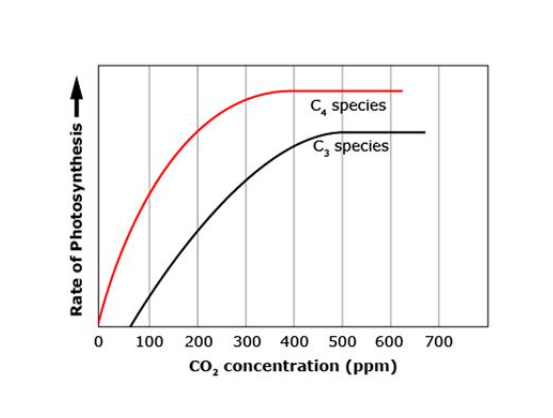
Scientists categorize plants into two groups: C3 and C4 species. The C3 species are temperate or cool-season plants. The C4 species are tropical or warm-season plants. Based on the graph below, choose the best words or phrases to complete the summary comparing the data about the two types of plants.
1
Question 16
16.
In comparing these two species, photosynthesis increases more rapidly in the presence of carbon dioxide for __________ plants. The C4 species reaches a peak rate of photosynthesis at __________and the C3 species reaches a peak rate of photosynthesis at __________. This means that carbon dioxide concentrations in excess of __________ will not increase the rate of plant growth or carbohydrate production for either species. The tropical C4 species grows more quickly. Since the photosynthesis reaction requires an equal number of CO2 and __________, this is adaptive for tropical environments.