Log in
Sign up for FREE
arrow_back
Library

TEST: Unit 2_Energy, Matter and Life

star
star
star
star
star
Last updated almost 3 years ago
23 questions
Energy for Life
1
4
3
1
1
Photosynthesis
4
1
1
Cellular Respiration
1
1
1
Nutrient Cycles
1
1
1
2
1
1
Mechanical and Chemical Weathering
1
1
1
Erosion and Deposition
1
1
1
Question 1
1.
_______ is the ability to do work or cause change.
Question 2
2.
__________energy is often referred to as energy of motion. __________, or stored energy, is based on position. __________measures the kinetic energy of atoms and molecules in matter.__________energy is the used to bond ions and atoms together.
Question 3
3.

Question 4
4.
An __________reaction is a chemical reaction that is not spontaneous and requires the input of energy. An __________reaction is a chemical reaction that is spontaneous and releases energy.
Question 5
5.

Question 6
6.
Question 7
7.

Question 8
8.
Plants and other photosynthesizing organisms contain_______ which is a green pigment molecule that absorbs the energy contained in light.
Question 9
9.

Question 10
10.

Question 11
11.

Question 12
12.

Question 13
13.

Question 14
14.

Question 15
15.
The water cycle includes three major processes. __________is the process of water falling from the atmosphere toward Earth's surface i.e. rain. __________is the process of water transforming from a liquid to a gas called water vapor. __________is the process of water cooling and changing into a liquid.
Question 16
16.

Question 17
17.

Question 18
18.

Question 19
19.

Question 20
20.

Question 21
21.

Question 22
22.

Question 23
23.

Which of the following are included in the laws of thermodynamics?
absolute zero (0K or -273 degrees Celsius) is the point where all thermal motion is removed from molecules (stops)
For every action, there is an equal and opposite reaction
An object at rest tends to stay at rest and an object in motion tends to stay in motion
Energy can be transferred from one system to another, or transformed from one form to another.
thermal energy cannot be transferred from a colder body to a hotter body
Which of the following will be reduced in this reaction?

Cu2+
Fe
Cu
Fe2+
Requires carbon dioxide as a reactant
Requires oxygen as a reactant
Requires carbohydrates as a reactant
Produces carbohydrates as an end product
Produces carbon dioxide as an end product
Uses energy
Releases energy
Produces oxygen as an end product
Photosynthesis
Cellular Respiration
In the first stage of photosynthesis, _______________ molecules accumulate to form a gradient in the thylakoid.
oxygen
carbon
nitrogen
hydrogen
Cellular respiration has three main stages: place the following into the correct order.
glycolysis
Krebs Cycle
electron transport chain
During the electron transport chain (cellular respiration), what form of energy is produced in the largest quantity?
FADH2
GTP
ATP
NADH
2 molecules of pyruvate are produced in which stage of cellular respiration?
citric acid cycle
electron transport chain
glycolysis
Which of the following processes does not contribute to carbon cycling?
combustion
respiration
photosynthesis
condensation
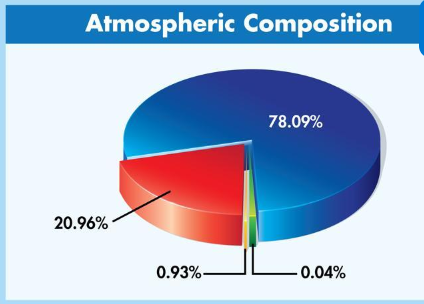
The pie chart shows the gases that make up Earth's atmosphere. Which gas is represented by the section labeled 78.09%?
oxygen
nitrogen
argon
carbon dioxide
Which of the following is true of the phosphorus cycle but NOT the water cycle?
It involves multiple processes.
It is not a major contributor to living things.
It does not include a gaseous form.
It involves the ocean.
Phosphorous is an important component in which of the following?
neither A nor B
DNA
ATP
both A and B
Nitrogen is a primary elemental component of which of the following?
sugars and DNA
fats and amino acids
DNA and amino acids
sugars and amino acids
Which is an example of chemical weathering?
Water that has become ionized reacts with silicate minerals in a rock, producing new minerals.
Tree roots extending into cracks in a rock thicken as they grow, splitting the rock into fragments
all of the above
Glaciers scrape away bits of rock as they advance across Earth's surface.
Mechanical weathering is
the radioactive breakdown of rock
all of the above
the chemical breakdown of rock
the physical breakdown of rock
What is weathering?
the process by which sediment is compacted into rock
the process by which rocks are broken down into sediment
the process by which sediment is transported from one place to another
the process by which sediment is deposited and built up into landforms
What is deposition?
the physical breakdown of rock by natural forces, including the actions of organisms
the removal of rock or soil by the action of gravity, water, ice, or wind
the accumulation of sediment in a low-lying area due to the action of gravity, water, ice, wind, or organisms
the decomposition of rock by natural forces, which change the rock's chemical composition
What is erosion?
the removal of rock or soil by the action of gravity, water, ice, or wind
the accumulation of sediment in a low-lying area due to the action of gravity, water, ice, wind, or organisms
the physical breakdown of rock by natural forces, including the actions of organisms
the decomposition of rock by natural forces, which change the rock's chemical composition
Which answer choice correctly lists sediment by increasing grain size?
gravel, boulder, silt, sand, clay
clay, sand, silt, boulder, gravel
boulder, gravel, sand, silt, clay
clay, silt, sand, gravel, boulder