Log in
Sign up for FREE
arrow_back
Library

TEST_DE_Chem_5.6_OceanWater

star
star
star
star
star
Last updated almost 3 years ago
22 questions
1
1
1
1
1
1
1
1
1
1
1
1
1
7
1
5
1
4
1
Question 1
1.

Question 2
2.

Question 3
3.

Question 4
4.

Question 5
5.

Question 6
6.

Question 7
7.

Question 8
8.

Question 9
9.

Question 10
10.

Question 11
11.

Question 12
12.

Question 13
13.

Question 14
14.

Question 15
15.

Question 16
16.
Imagine that you have a small pool in your backyard that contains a chlorine-containing salt to disinfect the water. Based on what you know about the changes in salinity of ocean water, complete the passage to describe what happens to concentration of chlorine in your pool in different types of weather.
On a hot , clear day, water __________, which causes the concentration of chlorine in your pool to __________ On a rainy day, the concentration of chlorine __________because water __________ Your neighbors have a much deeper pool- about four times the depth as yours. The concentration of chlorine in their pool follows the same trend as the weather changes, but the amount of change is __________ significant.
Question 17
17.

Question 18
18.

Question 19
19.

1
Question 20
20.
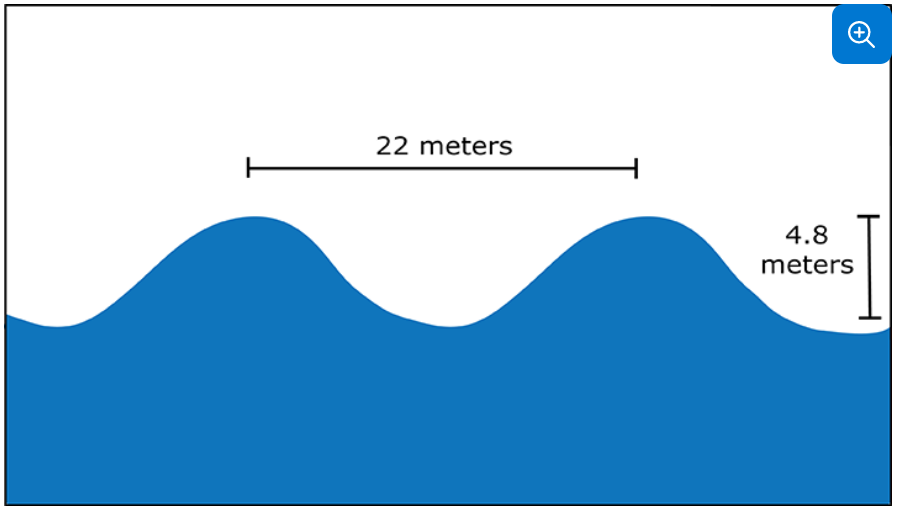
Supposing you are sitting on a dock observing uniform waves that hit shore every 5.5s, the wavelength would be____________________.
1
1
How do water molecules move as part of deep ocean waves?
in circles
in ovals
in straight lines with the wave
in curving lines with the wave
The water in upwellings is ________.
cold
nutrient-rich
oxygen rich
all of the above
What is the most abundant gas found in ocean water?
oxygen
carbon dioxide
carbon monoxide
nitrogen
During neap tides, the sun, the moon, and Earth form a ___________.
straight line
45 degree angle
90 degree angle
135 degree angle
Wavelength is a measure of the horizontal distance between ________.
two wave crests
a wave's crest and trough
a wave's crest and the ocean surface
any two water molecules in the same wave
Wave speed is calculated by dividing ________.
wave height by wavelength
wavelength by wave height
wave period by wavelength
wavelength by wave period
Phytoplankton can increase the amount of dissolved oxygen in water through photosynthesis. What else is necessary for photosynthesis to occur?
sunlight
nutrients
carbon dioxide
all of the above
What is the primary cause of surface currents in the ocean?
gravity
density differences in ocean water
temperature differences in water
winds
What is the primary cause of deep currents in the ocean?
the Coriolis effect
winds
density differences in ocean water
upwellings
Where does most of the heat in ocean water come from?
marine organisms
solar energy
tides
collisions between dissolved solids
Why are phytoplankton usually not found in deep water?
The amount of dissolved gas is too low.
The salinity is too high.
The temperature is too low.
There is not enough sunlight.
How is the density of ocean water calculated?
volume/mass
salinity/volume
mass/volume
salinity/mass
Based solely on its location, which ocean likely contains the highest percentage of dissolved gases?
Indian Ocean, because it is located mostely around the equator
Pacific Ocean, because it covers the largest area
Atlantic Ocean, because it covers a long mid-ocean ridge system
Arctic Ocean, because it is located mostly around the North Pole
Decide which of the following characteristics describe surface currents, deep currents, or both, and drag each tile to the correct category.
relatively slow-moving currents
pathway changed by continents
relatively fast-moving currents
distribute thermal energy around the globe
mainly caused by differences in density of water
pathway deflected by the Coriolis Effect
mainly caused by winds
Only Surface Currents
Only Deep Currents
Both
Which of the following describes factors that may contribute to annual variations in phytoplankton population in the Siberian Seas? Use what you know of the properties of ocean water, as well as the Plankton Distribution graph below.
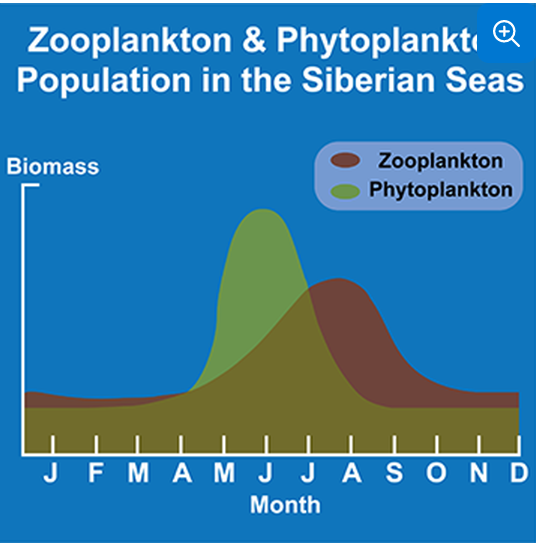
There are more nutrients in the water during the summer months because of the warmer water
There is more sunlight during the summer, which is necessary for the phytoplankton to photosynthesize
There is a lower population of zooplankton for phytoplankton to feed on in the winter
In the summer, ocean currents bring phytoplankton from all over the Atlantic and Pacific Oceans.
In the winter, there is a maximum amount of zooplankton to feed on phytoplankton.
How does the temperature of ocean water change in the thermocline?
Temperature decreases rapidly with depth.
Temperature increases rapidly with depth
Temperature decreases slowly with depth.
Temperature increases slowly with depth.
Coral reefs require very specific conditions to survive, and climate change is having an impact on their habitats. Determine whether each of the following statements is true or false.
Like other plants, coral reefs thrive with an increasing amount of carbon dioxide in the atmosphere.
The burning of fossil fuels is responsible for increasing the amount of carbonic acid in ocean water, which harms coral reefs.
The increase in the greenhouse effect caused by human activity is causing a change in water temperature that leads to bleaching.
The amount of carbon dioxide in the atmosphere can be tracked by examining the thickness of corallites.
True
False
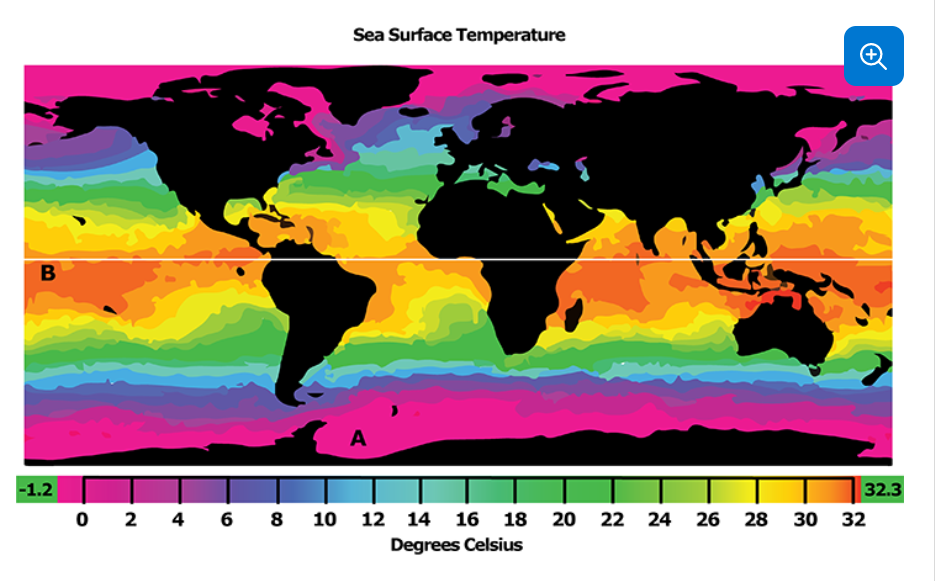
The properties of ocean water vary greatly with latitude, partly because of differences in water temperature. Compare Regions A and B in the figure by connecting each description of the sea surface to the appropriate area.
Has a higher temperature
Has a higher density
Contains a higher amount of dissolved solids
Receives a greater amount of solar radiation
Contains a higher amount of dissolved oxygen
Region A
Region B
Question 21
21.
Supposing you are sitting on a dock observing uniform waves that hit shore every 5.5s, the wave height would be____________________.
Question 22
22.
Supposing you are sitting on a dock observing uniform waves that hit shore every 5.5s, the wave speed would be____________________.