An isotope of platinum is shown. Which of the following changes would result in the isotope osmium-186?
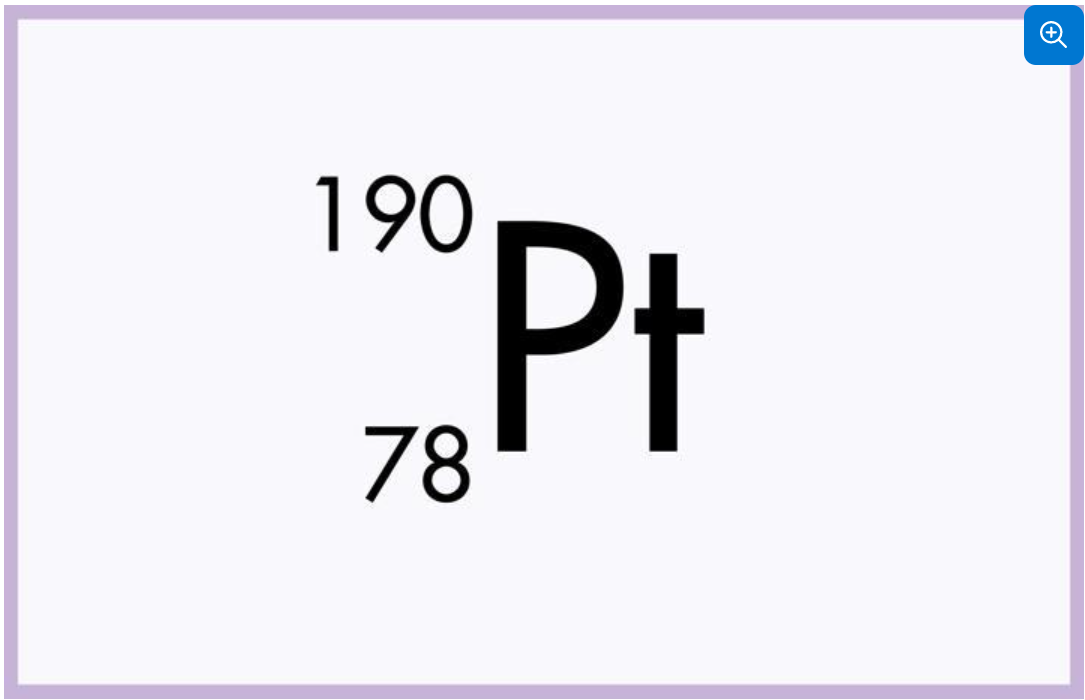
An isotope of platinum is shown. Which of the following changes would result in the isotope osmium-186?
An isotope of platinum is shown. Which of the following changes would result in the isotope osmium-186?
A scientist wants to date rocks that were formed over a billion years ago. Which of the following isotopes could be used to date the rocks accurately?
In the following nuclear reaction, what is the missing product and what type of reaction is this?

A sample initially has 10,000 atoms of carbon-14. After a certain amount of time, only 1,250 atoms of carbon-14 remain. How many half-lives have occurred?
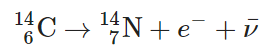
The reaction below is an example of what type of process?

An atom contains 18 protons, 19 neutrons, and 18 electrons. What change would need to occur for the atom to become carbon-13?
In certain beta decay processes, a neutron in a parent nucleus decays into a proton, an electron, and an antineutrino. What is the result of this process in the daughter nucleus?
In the following radioactive decay process, why did the atomic number change while the number of nucleons did not?
Four mystery atoms (Q, R, S, and T) are shown below. Which of the four atoms are the same element, and how many neutrons do they have?

Uranium-238 (U-238) has a half-life of 4.47 × 10 years. Which of the following is a likely application of U-238?
Assume that a substance contains a parent isotope with a half-life of 600 years. The parent-daughter ratio is 6.25% parent isotope to 93.75% daughter isotope. Calculate the age of this substance.
Why are some of the rocks on the moon older than the oldest known rocks on Earth?
The most common absolute dating technique scientists use to study Earth’s history is called ________.
Why are radiometric dating techniques not commonly applied to sedimentary rocks?
Hydrogen has an atomic number of 1. How many neutrons and/or protons are in a hydrogen-3 isotope?
Why is an index fossil valuable if its absolute age is known?
In which way is carbon-14 similar to nitrogen-14?
Assume that a substance has 32 atoms of parent isotope at the end of its third half-life. Predict how many atoms of that isotope the substance would have at the end of its fifth half-life.
Isotopes of the same element have the same number of inside the nucleus. However, they have different numbers of . Certain isotopes of most elements are and will stay intact indefinitely. Certain isotopes of most elements are and will decay radioactively at some time in the future. Protons and neutrons are collectively known as .
In the process of radioactive decay, atoms can change from one element to another element or from one isotope of an element to a different isotope of the same element. The nucleus of atoms is held together by the force. In certain cases the force can overcome the strength of the nuclear force. This causes particles to be emitted from the nucleus of an atom. The three natural types of radioactive decay are alpha decay, , and gamma decay. occurs when an atom decays radioactively and becomes a different element. The isotope is the original element and the isotope is the new element in the nuclear reaction.
Scientists can use a process known as radiometric to determine the age of a sample of material that contains radioactive isotopes. This process measures the proportion of a radioactive isotope remaining in a sample and compares the proportion to the half-life for that particular isotope. is the time required for one half of a particular radioactive isotope to decay. Radiocarbon dating, which makes use of the carbon-14 isotope, is used for samples believed to be than about 50,000 years old.
Nuclear breaks apart a large atom such as uranium or plutonium into smaller fission fragments and other particles. Nuclear combines two smaller atoms such as hydrogen or helium into a larger atom. Both release large amounts of .