Analyzing Pedigrees (Lesson 8.3)
star
star
star
star
star
Last updated over 2 years ago
10 Nsɛmmisa
1
1
1
1
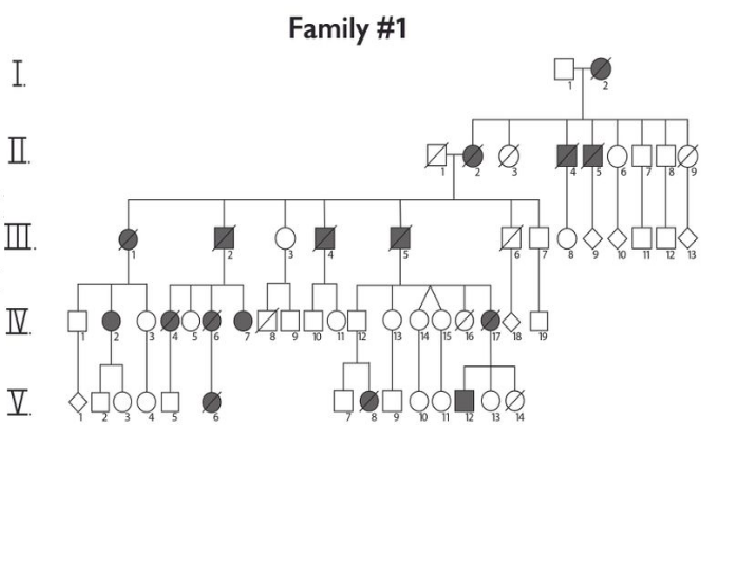
In Family 1, the father did not have cancer and the mother did. What versions of the p53 gene do you think person 1 (the father)?
Remember p53 version A is normal butterfly shape. P53 version C is missing a piece and does not work properly.
In Family 1, the father did not have cancer and the mother did. What versions of the p53 gene do you think person 2 (the mother)?
Remember p53 version A is normal butterfly shape. P53 version C is missing a piece and does not work properly.
In Family 1, they had 8 offspring, and 3 of them had cancer. Explain how it happened that more than half of their offspring were cancer free.
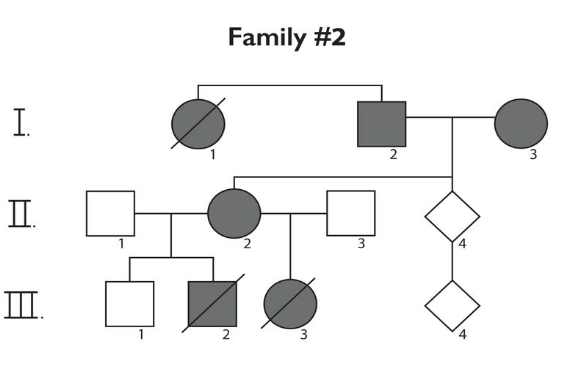
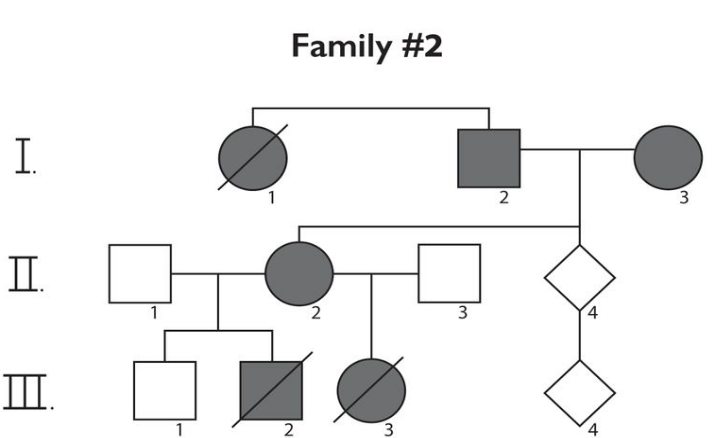
In Family 2, both parents 2 and 3 in generation I had cancer related to p53 mutations. They had two children in generation II, individuals 2 and 4. Scientists did not have detailed information about offspring 4 in generation 2. Which version of p53 do you think this person had?
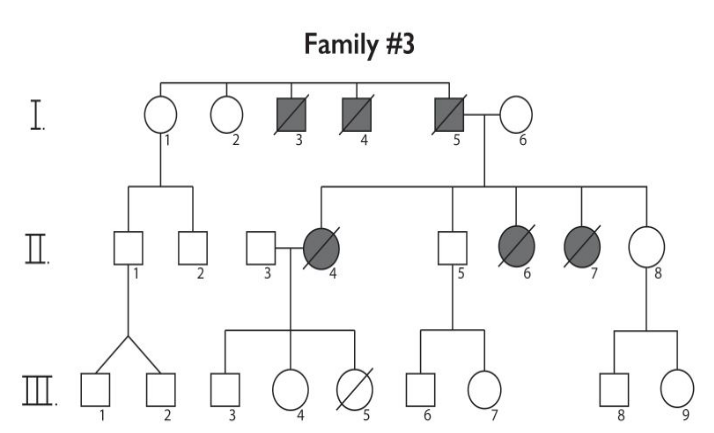
In Family 3, where would you predict cancer caused by germline p53 mutations to occur in generation III? Explain your prediction.
An English scientist named Reignald Crundall Punnett developed a useful model called the Punnett square that can be used to predict the probability of parents passing on their allele to their offspring. The square below shows an example from Family 2 parents 1 and 2, the father or sperm parent on the top and the mother or egg parent on the left side.
We know that the father does not have a p53 mutation, so both of his alleles are version A. The mother does have cancer caused by a p53 mutation, so we know she has at least one version of p53C. Since we are not sure what her second allele is, we mark it with a question mark.
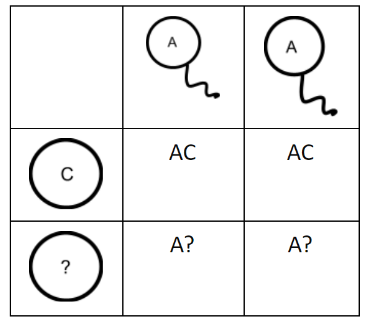
What can you determine about the probability of their offspring having the p53 mutation?
For the offspring in the Punnett square that have one A and one C version of p53, describe the kind and amount of p53 proteins they make. How does this compare to people with 2 A versions or 2 C versions?
In Family 2, generation II, person 1 does not have a p53 mutation. Is it possible he could accumulate a mutation in his lifetime? Explain your answer.
Could someone with two versions of p53A (normal version) ever end up with a mutated p53C?
What patterns did you identify related to how the p53 mutations were inherited?