[AP Statistics] 7.1a Intro to Sampling Distributions

Last updated 5 months ago
31 questions
1

(a) A high school student was interested in finding the mean annual tuition at a 4-year U.S. college. The student randomly selected 23 4-year U.S. colleges and found a mean annual tuition of $19,800.

Identify the population:

1

(a) A high school student was interested in finding the mean annual tuition at a 4-year U.S. college. The student randomly selected 23 4-year U.S. colleges and found a mean annual tuition of $19,800.

Identify the parameter:

1

(a) A high school student was interested in finding the mean annual tuition at a 4-year U.S. college. The student randomly selected 23 4-year U.S. colleges and found a mean annual tuition of $19,800.

Identify the sample:

1

(a) A high school student was interested in finding the mean annual tuition at a 4-year U.S. college. The student randomly selected 23 4-year U.S. colleges and found a mean annual tuition of $19,800.

Identify the statistic:

1

John and Carol have four grown sons. Their heights (in inches) are 71, 75, 72, and 68.
(c) Calculate the range of each possible sample of size 2 and display the sampling distribution of the sample range using a dotplot.

1

A teacher complained that only half of all students turn in “quality” homework. To test his claim, his principal randomly selected 10 students to hand in their assignments one day. She determined that 9 of the 10 assignments could be considered “quality.”

What is the evidence that more than half of students turn in quality homework?

1

A teacher complained that only half of all students turn in “quality” homework. To test his claim, his principal randomly selected 10 students to hand in their assignments one day. She determined that 9 of the 10 assignments could be considered “quality.”

Provide two possible explanations for the evidence above.

1

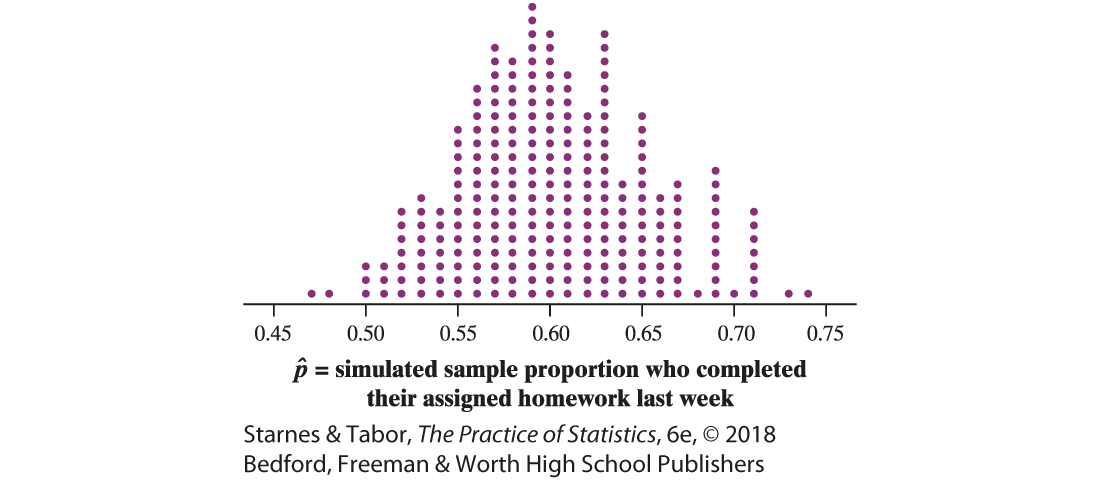
We used technology to simulate choosing 100 SRSs of size n = 10 from a population of 120 students, where half produce “quality” assignments and half do not. The dotplot shows the sample proportion of “quality” assignments for each of the 100 samples.
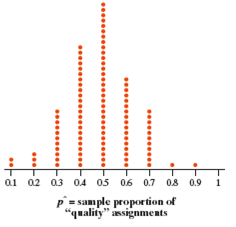


There is one dot on the graph at 0.90. Explain what this value represents.
1

We used technology to simulate choosing 100 SRSs of size n = 10 from a population of 120 students, where half produce “quality” assignments and half do not. The dotplot shows the sample proportion of “quality” assignments for each of the 100 samples.


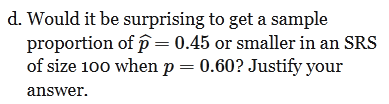
Would it be surprising to get a sample proportion of .9 or greater in an SRS of size 10 when p = 0.5? Justify your answer.

1

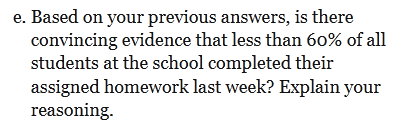
Based on your previous answers, is there convincing evidence that more than half of students are turning in “quality” homework?

1

Most of the following questions are from the book (pg. 482). You can check your answers in the back of the book


Identify the population

1

Identify the parameter

1

Identify the sample

1

Identify the statistic

1


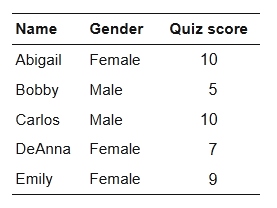
List all possible SRS of size n=2. Feel free to abbreviate with letters.

1

Calculate the mean quiz score for each of those 10 samples. Display on a dotplot.

1

Calculate the proportion of females for each of those 10 samples. Display on a dotplot.

1


1

1


1

1

Explain

1

1

Explain

1

1

Explain

1

1

Explain

1

1

Explain

1

Are there any problems above that you would like to go over in class? Indicate the question numbers below (Numbers refer to the Formative question number). I'll try to cover anything that is highly requested.