Log in
Sign up for FREE
arrow_back
Library
Grade 06 Reading Assessment (RI.6.1 - 6.8)
By Amber Groff
star
star
star
star
star
Share
share
Last updated about 3 years ago
14 questions
Add this activity
Instructions
Read the Passage "From Horse to Electricity." Then answer the questions.
zoom_in
Required
1
RI.6.4
RL.6.4
Required
1
RI.6.1
zoom_in
Required
1
RI.6.6
RI.6.8
Required
1
RI.6.1
Required
1
L.6.4.a
RI.6.4
Required
1
RI.6.1
Required
1
RI.6.7
Required
1
RI.6.1
zoom_in
Required
1
RI.6.5
Required
1
RI.6.1
zoom_in
Required
1
RI.6.2
Required
1
RI.6.1
zoom_in
Required
1
RI.6.6
Required
1
RI.6.1
Question 1
1.
Part A: What is the meaning of congested as it is used in Paragraph 1?
crowded
excited
varied
populated
Question 2
2.
Part B: Select
two
pieces of evidence from paragraph 1 that support the answer to Part A:
When the Erie Canal opened in 1825,
things really began moving in New York.
The canal allowed the transportation of goods and people
to and from the city to the state's and the nation's agricultural interior.
It sparked a commercial business boom
in the port of New York (present-day Manhattan).
In the mid-1800s,
most New Yorkers lived in the lower third of the nearly 13.5-mile-long island,
where access to shipping and the Atlantic Ocean were the greatest.
In the decades that followed,
the southern tip of the island city grew
Question 3
3.
Part A: In paragraph 2, why does the author include the fact that most immigrants coming to America came through the Ellis Island Immigration Station?
to support a claim about how popular New York was at the time
to support a claim about how quickly New York's population increased
to support a claim about how superior New York's transportation system was at the time
to support a claim about how important it was for New York to have quick transportation out of the city
Question 4
4.
Part B: Which other paragraph develops the claim described in the answer to Part A?
paragraph 1
paragraph 3
paragraph 5
paragraph 7
Question 5
5.
Part A: What does the word
vying
mean as it is used in paragraph 2?
moving
growing
competing
developing
Question 6
6.
Part B: Which sentence from paragraph 2 of the passage
best
supports the answer to Part A?
"Then, in the second half of the 19th century, a flood of immigrants began to arrive in America."
"Most of these newcomers came through Ellis Island Immigration Station located in New York Harbor."
"Lacking the means or desire to move any farther, many of these immigrants settled where they landed - in New York City."
"Their large numbers overwhelmed an already crowded city."
Question 7
7.
Part A: Which idea from the passage does the second photograph
best
support?
Streets became very busy with all of the carriages being pulled by horses.
Horses became tired after pulling carriages with large numbers of people in them.
Horse-drawn carriages were uncomfortable to travel in because of street conditions.
Many people still had to walk because there was limited room in a horse-drawn carriage.
Question 8
8.
Part B: Which sentence from paragraph 4 supports the answer to Part A?
"Introduced in New York City in 1827, omnibuses were essentially stagecoaches drawn by horses."
"While stagecoaches had generally been used to carry passengers between major cities, omnibuses picked up and discharged riders along an established route within a locale."
"Designed to carry about 12 to 15 people comfortably, omnibuses were often packed with more people than that, who endured a bumpy - and not exactly swift - ride through the city's mostly cobblestone streets."
"Within about 20 years, nearly 600 omnibuses were in use on Manhattan's city streets."
Question 9
9.
Part A: Read the sentence from Paragraph 3:
They were mostly private enterprises that were largely unregulated by any single overseeing body.
How does this sentence contribute to the development of an idea in the passage?
It shows that there was no group that monitored vehicle production, which led to too many different types of transportation on the roads.
It shows that there were too many transportation businesses using the crowded streets, which made it difficult for the businesses to succeed.
It shows that there were too many small businesses competing in a busy market, which made transportation less profitable than it is today.
It shows that there was no group established to control traffic flow, which made transportation more hazardous than it is today.
Question 10
10.
Part B: Which other sentence from paragraph 3 contributes to the same idea described in Part A?
"The first forms of urban transportation relied on horsepower."
"The organization of the city streets today, with signal lights and signs at intersections to direct traffic flow, and with crosswalks offering pedestrians a safe place to cross a street, didn't exist in the 1800s."
"Today's familiar gas-powered cars weren't mass produced until 1908."
"Here's a look at some of the early forms of transportation in New York City before the first subway tracks were laid."
Question 11
11.
Part A: What central idea do the details in paragraphs 7 and 8 support?
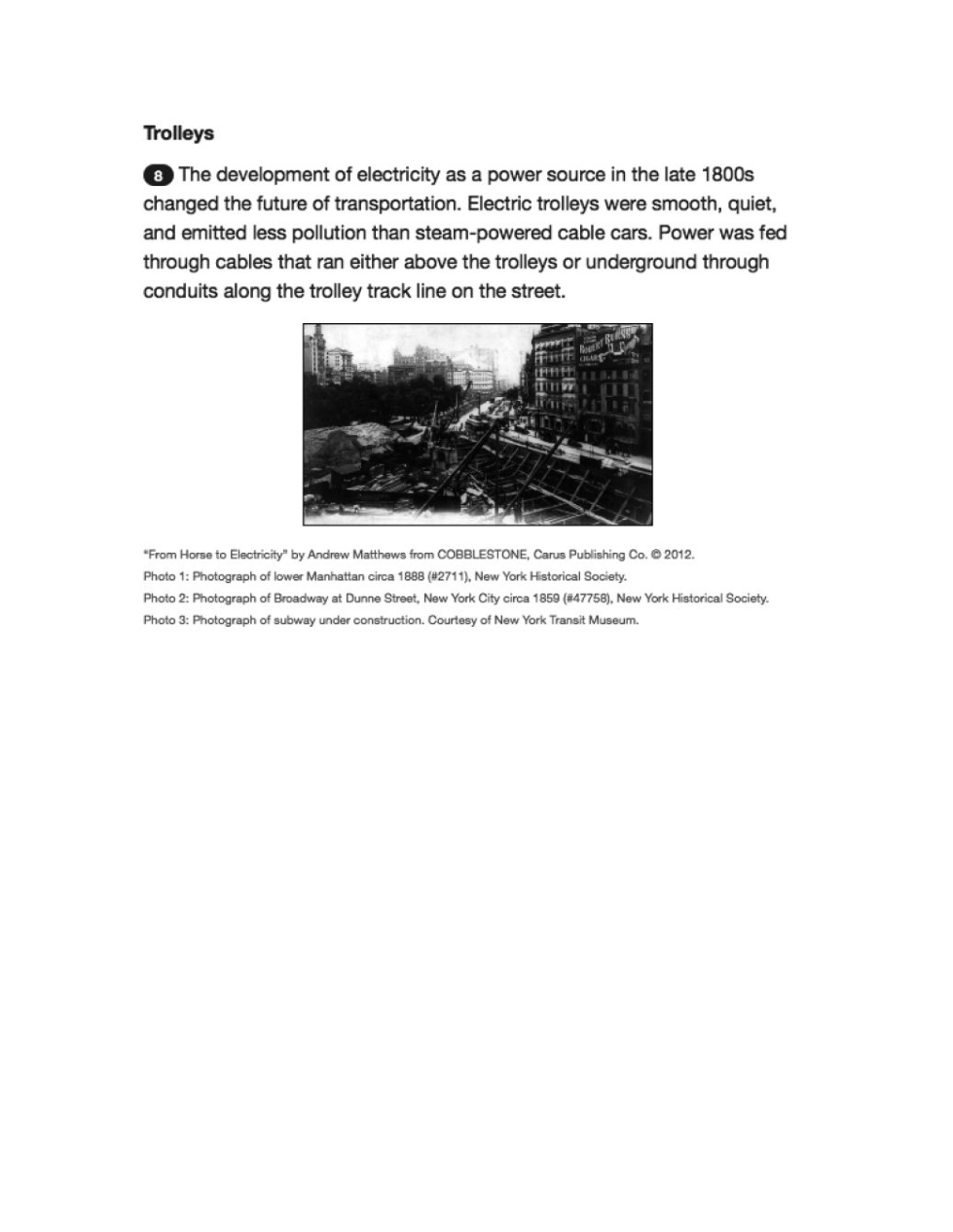
Electric power had many more advantages than other forms of power.
Steam power made it possible for rails to be safely placed in the streets.
Electric-powered cable cars were not considered when the city was originally designed.
Steam-powered cable cars were not fast enough to keep up with the demands of the growing city.
Question 12
12.
Part B: Which sentence
best
supports the answer to Part A?
"The first cable car in New York City was incorporated as part of the design for the newly constructed Brooklyn Bridge, which opened in 1883." (paragraph 7)
"Like horsecars, cable cars ran on rails embedded in the streets, but they were powered by steam-driven machines at either end of the line that moved the cars along a long, looped cable." (paragraph 7)
"The development of electricity as a power source in the late 1800s changed the future of transportation." (paragraph 8)"
"Power was fed through cables that ran either above the trolleys or underground through conduits along the trolley rack line on the street." (paragraph 8)
Question 13
13.
Part A: What is the author's
main
purpose in writing the passage?
to inform the reader how public transportation developed through the 19th century in New York City
to persuade the reader that current technology has improved public transportation in New York City
to entertain the reader with examples of early public transportation in New York City
to convince the reader that regulating public transportation is an important part of keeping street traffic moving in New York City
Question 14
14.
Part B: Which sentence from the passage is an example of the author's purpose?
"Lacking the means or desire to move any farther, many of these immigrants settled where they landed - in New York City." (paragraph 2)
"They were mostly private enterprises that were largely unregulated by any single overseeing body." (paragraph 3)
"Here's a look at some of the early forms of transportation in New York City before the first subway tracks were laid." (paragraph 3)
"Electric trolleys were smooth, quiet, and emitted less pollution than steam-powered cable cars." (paragraph 8)