Grubbs American Lit Final 2022-2023

Last updated almost 3 years ago
35 questions

PART I: Read the following poem, "A September Night," by George Marion McClellan (1916). Then, answer questions 1-5.

“A September Night”
By George Marion McClellan (1916)

The full September moon sheds floods of light,
And all the bayou’s face is gemmed with stars,
Save where are dropped fantastic shadows down
From sycamores and moss-hung cypress trees.
[5] With slumberous sound the waters half asleep
Creep on and on their way, ’twixt rankish1reeds,
Through marsh and lowlands stretching to the Gulf.
Begirt with cotton fields, Anguilla sits
Half bird-like, dreaming on her Summer nest.
[10] Amid her spreading figs and roses, still
In bloom with all their Spring and Summer hues,
Pomegranates hang with dapple cheeks full ripe,
And over all the town a dreamy haze
Drops down. The great plantations, stretching far
[15] Away, are plains of cotton, downy white.
O, glorious is this night of joyous sounds;
Too full for sleep. Aromas wild and sweet,
From muscadine, late blooming jessamine,
And roses, all the heavy air suffuse.
[20] Faint bellows from the alligators come
From swamps afar, where sluggish lagoons give
To them a peaceful home. The katydids
Make ceaseless cries. Ten thousand insects’ wings
Stir in the moonlight haze and joyous shouts
[25] Of Negro song and mirth awake hard by
The cabin dance. O, glorious is this night!
The Summer sweetness fills my heart with songs
I cannot sing, with loves I cannot speak.
1

PART A: What does the speaker’s description of the setting reveal about Anguilla?

1

PART B: Which piece of evidence from the poem best supports your response to Part A?

1

As used in line 21, what does the word “sluggish” mean?

1

What do lines 27-28 reveal about the speaker’s point of view?

1

What effect does the use of personification have on the meaning of the poem? Choose TWO answers.

Part II: Read the following excerpt from Upton Sinclair's 1920 novel, 100%: The Story of a Patriot. Then, answer questions 6-15.

[1] A young man is walking down the street, quite casually, with an empty mind and no set purpose; he comes to a crossing, and for no reason that he could tell he takes the right hand turn instead of the left; and so it happens that he encounters a blue-eyed girl, who sets his heart to beating. He meets the girl, marries her--and she became your mother. But now, suppose the young man had taken the left hand turn instead of the right, and had never met the blue-eyed girl; where would you be now, and what would have become of those qualities of mind which you consider of importance to the world, and those grave affairs of business to which your time is devoted?

[2] Something like that it was which befell Peter Gudge. Peter was walking down the street one afternoon, when a woman approached and held out to him a printed leaflet. "Read this, please," she said. And Peter, who was hungry, and at odds with the world, answered gruffly: "I got no money." He thought it was an advertising dodger, and he said: "I can't buy nothin'."

[3] "It isn't anything for sale," answered the woman. "It's a message."

[4] "Religion?" said Peter. "I just got kicked out of a church."

[5] "No, not a church," said the woman. "It's something different; put it in your pocket."

[6] "Read it some time when you've nothing else to do." And so Peter, just to get rid of her, took the leaflet and thrust it into his pocket, and went on, and in a minute or two had forgotten all about it.

[7] Peter was thinking that this was a heck of a life. Who could have foreseen that just because he had stolen one miserable fried doughnut, he would lose his easy job and his chance of rising in the world? Peter's whole being was concentrated on the effort to rise in the world; to get success, which means money, which means ease and pleasure.

[8] But who could have foreseen that Mrs. Smithers would have kept count of those fried doughnuts every time anybody passed through her pantry? And it was only that one ridiculous circumstance which had brought Peter to his present misery. But for that he might have had his lunch of bread and dried herring and weak tea in the home of the shoe-maker's wife, and might have still been busy with his job of stirring up dissension in the First Apostolic Church.

[9] Always it had been like that, through Peter's twenty years of life. Time after time he would get his feeble clutch fixed upon the ladder of prosperity, and then something would happen--some wretched thing like the stealing of a fried doughnut--to pry him loose and tumble him down again into the pit of misery.

[10] So Peter walked along, with his belt drawn tight, and his restless blue eyes wandering here and there, looking for a place to get a meal. There were jobs to be had, but they were hard jobs, and Peter wanted an easy one. There are people in this world who live by their muscles, and others who live by their wits; Peter belonged to the latter class; and had missed many a meal rather than descend in the social scale.

[11] Peter looked into the faces of everyone he passed, searching for a possible opening. Some returned his glance, but never for more than a second, for they saw an insignificant looking man, undersized, undernourished, and with one shoulder higher than the other, a weak chin and mouth, crooked teeth, and a brown moustache too feeble to hold itself up at the corners. Peters' straw hat had many straws missing, his second-hand brown suit was become third-hand, and his shoes were turning over at the sides. In a city where everybody was "hustling," everybody, as they phrased it, "on the make," why should anyone take a second glance at Peter Gudge? Why should anyone care about the restless soul hidden inside him, or dream that Peter was, in his own obscure way, a sort of genius? No one did care; no one did dream.

[12] It was about two o'clock of an afternoon in July, and the sun beat down upon the streets of American City. There were crowds upon the streets, and Peter noticed that everywhere were flags and bunting. Once or twice he heard the strains of distant music, and wondered what was "up." Peter had not been reading the newspapers; all his attention bad been taken up by the quarrels of the Smithers faction and the Lunk faction in the First Apostolic Church, otherwise known as the Holy Rollers, and great events that had been happening in the world outside were of no concern to him. Peter knew vaguely that on the other side of the world half a dozen mighty nations were locked together in a grip of death; the whole earth was shaken with their struggles, and Peter had felt a bit of the trembling now and then. But Peter did not know that his own country had anything to do with this European quarrel, and did not know that certain great interests throughout the country had set themselves to rouse the public to action.
1

PART A: Which of the following best identifies a theme of the text?

1

PART B: Which section from the text best supports the answer to Part A?

1

What is the meaning of “miserable” as it is used in paragraph 7?

1

How do paragraphs 2 through 6 contribute to the development of the plot?

1

PART A: Which of the following best describes the effect of the descriptive language in paragraphs 9-11?

1

PART B: Which set of words from paragraphs 9-11 best supports the answer to Part A?

1

PART A: Which of the following sets of adjectives best characterizes Peter as he is seen in this passage?

1

PART B: Which TWO details from the text best support the answer to Part A? Select TWO answers.

1

What is the effect of the final paragraph (paragraph 12) on the excerpt as a whole?

2

CONSTRUCTED RESPONSE: Consider the recurring references to the fried doughnut story. What is its significance within the passage, and how is it an example of irony? Be sure to include specific references to the excerpt.

PART III: Read the following excerpt from Andrew Jackson's 1830 speech to congress on "Indian Removal." Then, answer questions 16-24.

1It gives me pleasure to announce to Congress that the benevolent policy of the Government, steadily pursued for nearly thirty years, in relation to the removal of the Indians beyond the white settlements is approaching to a happy consummation. Two important tribes have accepted the provision made for their removal at the last session of Congress, and it is believed that their example will induce the remaining tribes also to seek the same obvious advantages.

2The consequences of a speedy removal will be important to the United States, to individual States, and to the Indians themselves. The pecuniaryA advantages which it promises to the Government are the least of its recommendations. It puts an end to all possible danger of collision between the authorities of the General and State Governments on account of the Indians. It will place a dense and civilized population in large tracts of country now occupied by a few savage hunters. By opening the whole territory between Tennessee on the north and Louisiana on the south to the settlement of the whites it will incalculably strengthen the southwestern frontier and render the adjacent States strong enough to repel future invasions without remote aid. It will relieve the whole State of Mississippi and the western part of Alabama of Indian occupancy,6and enable those States to advance rapidly in population, wealth, and power. It will separate the Indians from immediate contact with settlements of whites; free them from the power of the States; enable them to pursue happiness in their own way and under their own rude institutions; will retard the progress of decay, which is lessening their numbers, and perhaps cause them gradually, under the protection of the Government and through the influence of good counsels, to cast off their savage habits and become an interesting, civilized, and Christian community.

3What good man would prefer a country covered with forests and ranged by a few thousand savages to our extensive Republic, studded with cities, towns, and prosperous farms embellished with all the improvements which art can devise or industry execute, occupied by more than 12,000,000 happy people, and filled with all the blessings of liberty, civilization and religion?

4The present policy of the Government is but a continuation of the same progressive change by a milder process. The tribes which occupied the countries now constituting the Eastern States were annihilated or have melted away to make room for the whites. The waves of population and civilization are rolling to the westward, and we now propose to acquire the countries occupied by the red men of the South and West by a fair exchange, and, at the expense of the United States, to send them to land where their existence may be prolonged and perhaps made perpetual. Doubtless it will be painful to leave the graves of their fathers; but what do they more than our ancestors did or than our children are now doing? To better their condition in an unknown land our forefathers left all that was dear in earthly objects. Our children by thousands yearly leave the land of their birth to seek new homes in distant regions. Does Humanity weep at these painful separations from everything, animate and inanimate, with which the young heart has become entwined? Far from it. It is rather a source of joy that our country affords scope where our young population may range unconstrained in body or in mind, developing the power and facilities of man in their highest perfection. These remove hundreds and almost thousands of miles at their own expense, purchase the lands they occupy, and support themselves at their new homes from the moment of their arrival. Can it be cruel in this Government when, by events which it cannot control, the Indian is made discontented in his ancient home to purchase his lands, to give him a new and extensive territory, to pay the expense of his removal, and support him a year in his new abode? How many thousands of our own people would gladly embrace the opportunity of removing to the West on such conditions! If the offers made to the Indians were extended to them, they would be hailed with gratitude and joy.

5And is it supposed that the wandering savage has a stronger attachment to his home than the settled, civilized Christian? Is it more afflicting to him to leave the graves of his fathers than it is to our brothers and children? Rightly considered, the policy of the General Government toward the red man is not only liberal, but generous. He is unwilling to submit to the laws of the States and mingle with their population. To save him from this alternative, or perhaps utter annihilation, the General Government kindly offers him a new home, and proposes to pay the whole expense of his removal and settlement.
_________________________________________________
A Relating to money.
1

According to Jackson, whom will the removal of the Native Americans benefit?

1

Examine Paragraph 2. Which of the following is NOT a claim that Jackson uses to develop his argument necessitating the Indian Removal Act?

1

In paragraph 4, Jackson compares the removal of Native Americans to the expansion of white settlement in America (and possible to European immigration to the New World). What logical fallacy--or false reasoning--lies in this comparison?

1

How does Jackson’s word choice in the first paragraph support his purpose for writing?

1

Read the sentence from paragraph 2:

It puts an end to all possible danger of collision between the authorities of the General and State Governments on account of the Indians.

What is the MOST LIKELY meaning of the underlined word?

1

What does Jackson's word choice reveal about his point of view regarding the Native Americans in this speech?

1

Which of the following does NOT describe a purpose of the final paragraph of this passage?

1

PART A: Which of the following best describes the word choice Jackson uses to describe the Native Americans?

1

PART B: Which of the following best supports the answer to Part A?

PART IV: Read the following article, “Teenage Brains are Malleable and Vulnerable, Researchers Say,” written by John Hamilton in 2012. Then, answer questions 25-32.

Adolescent brains have gotten a bad rap, according to neuroscientists.

It’s true that teenage brains can be impulsive, scientists reported at the Society for Neuroscience meeting in New Orleans. But adolescent brains are also vulnerable, dynamic and highly responsive to positive feedback, they say.

“The teen brain isn’t broken,” says Jay Giedd, a child psychiatry researcher at the National Institute of Mental Health. He says the rapid changes occurring in the brains of teenagers make these years “a time of enormous opportunity.”

Part of the bad rap has come from studies suggesting that adolescent brains are “wired” to engage in risky behavior such as drug use or unsafe sex, says BJ Casey of Weill Cornell Medical College.
These studies have concluded that teens are prone to this sort of behavior because the so-called reward systems in their brains are very sensitive while circuits involved in self-control are still not fully developed, Casey says. The result has been a perception that “adolescents are driving around with no steering wheel and no brake,” she says.

Casey says a new study from her lab makes it clear that this isn’t the case.

The study had teens and adults play a game where they got points for correctly answering questions about the motions of dots on a screen. Meanwhile researchers measured activity in brain regions involved in decisions and rewards.

When a lot of points were at stake, teens actually spent more time studying the dots than adults and brain scans showed more activity in brain regions involved in making decisions.

“Instead of acting impulsively, the teens are making sure they get it right,” Casey says. She says this shows how teens’ sensitivity to rewards can sometimes lead to better decisions.

Two other studies presented at the Society for Neuroscience meeting showed that the adolescent brain is literally shaped by experiences early in life.

One of the studies involved 113 men who were monitored for depression from age 10 and then had brain scans at age 20. The scans showed that men who’d had an episode of depression had brains that were less responsive to rewards.

“They can’t respond naturally when something good happens,” says Erika Forbes at the University of Pittsburgh. She says this shows why it’s important to treat problems like depression in teens.

The other study looked at how the brain’s outer layer of cortex, which plays a critical role in thinking and memory, was affected by childhood experiences in 64 people. It found that this layer was thicker in children who got a lot of cognitive stimulation and had nurturing parents, says Martha Farrah of the University of Pennsylvania.

Finally, a study by researchers in the U.S. and U.K. showed how much the brain changes during adolescence in regions involved in social interactions.

The study involved 288 people whose brains were scanned repeatedly starting at age 7. And the scans revealed dramatic structural changes during adolescence in four regions that help us understand the intentions, beliefs and desires of others, says Kathryn Mills of the Institute of Cognitive Neuroscience in London.

The results show that the tremendous social changes teenagers go through are reflected in their brains, Mills says. They also show that these changes continue beyond the teen years, she says.
1

PART A: Which of the following identifies the central idea of the text?

1

PART B: Which detail from the text best supports the answer to Part A?

1

PART A: How does the research provided in paragraphs 11-13 contribute to the development of ideas in the article?

1

PART B: Which section from the text best supports the answer to Part A?

1

Reread this sentence from Paragraph 2:

But adolescent brains are also vulnerable, dynamic, and highly responsive to positive feedback, they say.

What is the most likely meaning of the underlined word?

1

Refer to paragraphs 5 and 6. What is the purpose of this section of the article?

1

Based on the ideas in this article, which TWO of the following statements reflect implications for how parents and teachers should treat adolescents?

1

Which statement best expresses the effect of the first line of the article?

PART V: Answer the following questions (33-35) that will assess your knowledge of language conventions.

1

Which sentence contains correct capitalization?

1

Read the following sentence:

Visit our _______ shop today for the best prices on all your _______ wear.

Which option uses correct hyphenation to fill in the blanks?

1

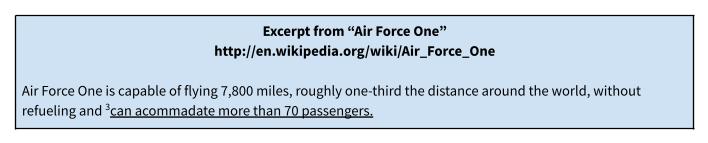
Read the underlined portion of the passage below. There may be a mistake in punctuation, capitalization, or spelling. If you find a mistake, choose the answer that corrects the mistake. If there is no mistake, choose “Correct as is.”