Your Results and Observations

Your Results and Observations
NGSS LS1-2 CCC: Cause and Effect/Models DCI: LS1.A
This covers Chapter 2 Media and Microscopes, Chapter 3 Prokaryotes, and Chapter 8 Genetics.
NGSS LS1-2 CCC: Cause and Effect/Models DCI: LS1.A
This covers Chapter 2 Media and Microscopes, Chapter 3 Prokaryotes, and Chapter 8 Genetics.
Your Results and Observations
Place your results in the table.
What bacteria or types of bacteria are in Sample I? Explain why you have made this determination.
If the staining of the respiratory secretions in the case file had been negative for bacteria and positive for fungi, what would be the likely organism?
Both EMB and MacConkey agars are differential and selective for gram-negative enteric bacteria. Explain how these media are different.
Describe what causes the color formation in MacConkey agar.
CCC: Cause and Effect
Create a model showing how the lac operon is affected by the addition of glucose to the MacConkey Agar.
Explain the process that your model is showing.
Be sure to label everything.
PE: Cause and Effect
A lab assistant is making media plates for use in the lab. The assistant is making MacConkey agar and Nutrient agar with glucose. The assistant accidently gets some nutrient agar mixed in with the MacConkey but does not feel like this is a big deal and decides to allow the media to go to the lab for use.
a. Explain why the supervisor would consider this a huge problem.
b. What cause and effect does this mistake make in our determination of organisms?
For full credits: use ideas from Chapter 8 Metabolism and Chapter 9 Lac operon to support your answer.
CER/Data:
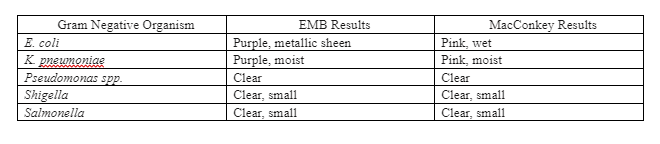
Could EMB and MacConkey agar plates be used as a quick identifier for gram negative lactose/nonlactose fermenters based on the above data?
a. Make a claim by answering the above question.
b. Use evidence from the given information and image to support your claim.
c. Give the scientific reasons/rationale/theory that allow you to use your evidence in support of your claim.
See the rubric to ensure you get the greatest amount of points for your answer.