Log in
Sign up for FREE
arrow_back
Library
Biochemistry Guided Reading
By Chelsa Burch
star
star
star
star
star
Share
share
Last updated over 3 years ago
40 questions
Add this activity
Note from the author:
Macromolecules, Biomolecules, Carbohydrates, Lipids, Proteins, Nucleic Acids
zoom_in
1
Question 1
1.
All living things are made of _______ molecules.
1
zoom_in
1
Question 3
3.
1
1
1
1
1
zoom_in
1
Question 9
9.
The ____ determines how organic molecules will look and behave.
zoom_in
1
Question 10
10.
1
1
1
1
1
zoom_in
1
Question 16
16.
What are the three classes of carbohydrates?
List your answers separated by commas and in alphabetical order.
1
1
1
zoom_in
1
Question 20
20.
What reagent is placed into food to test for the presence of starch?
1
1
zoom_in
1
Question 23
23.
What is the building block of lipids?
1
1
zoom_in
1
Question 26
26.
Solube means _____.
1
zoom_in
1
Question 28
28.
What is the building block of proteins?
1
zoom_in
1
Question 30
30.
How many different amino acids are there?
1
1
zoom_in
1
Question 33
33.
What are the two types of nucleic acids?
Enter your answers separated by a comma and in alphabetical order.
1
1
zoom_in
1
Question 36
36.
What is the building block of nucleic acids?
1
zoom_in
1
Question 38
38.
The twisted ladder of DNA is called a _____.
1
1
Question 2
2.
Name the four categories of organic molecules which form the basis of all living things.
Separate your four answers with a comma and list them in alphabetical order.
All of the organic molecules are based on which element?
Question 4
4.
What is the building block of carbohydrates?
Question 5
5.
What is the building block of lipids?
Question 6
6.
What is the building block of proteins?
Question 7
7.
What is the building block of nucleic acids?
Question 8
8.
Another name for a large molecule is a ____.
What are the elements contained in carbohydrates?
Enter your answers separated by a comma and in alphabetical order.
Question 11
11.
The building block of carbohydrates is called sugar or m_______.
Question 12
12.
When two sugars join, they form a _____.
Question 13
13.
di = ___
Question 14
14.
When more than two sugars join, they form a _____.
Question 15
15.
poly = ____
Question 17
17.
Which class of carbohydrate involves food storage in plants?
Question 18
18.
Which class of carbohydrate involves food storage in animals?
Question 19
19.
Which class of carbohydrates is used for structural support in plants?
Question 21
21.
A color change to ____ indicates that starch is present.
Question 22
22.
What reagent is added to see if food contains simple sugars?
Question 24
24.
_________ fats are unhealthy fats like butter and crisco.
Question 25
25.
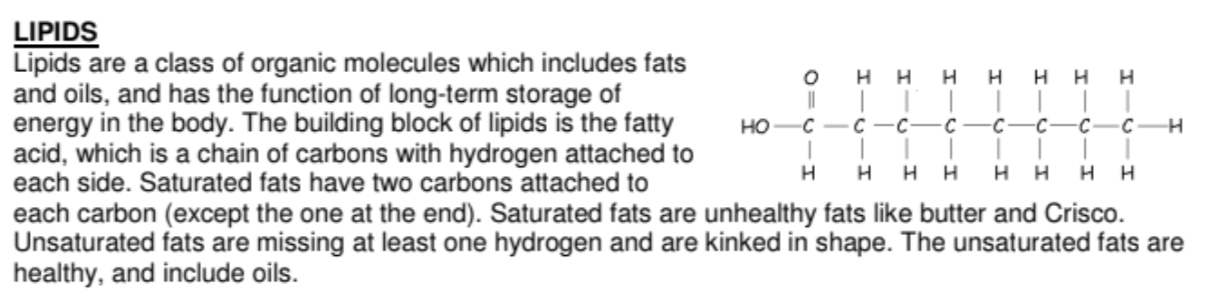
According to the picture, which elements are contained in lipids?
List your answers separated by commas and in alphabetical order.
Question 27
27.
A positive test result for lipids would be for a piece of brown paper to turn ____.
Question 29
29.
A ______ bond holds together building blocks to make a protein.
Question 31
31.
Amino acids contain a central carbon atom joined to a hydrogen atom, an amino group, an 'R' group, and a _____ group.
Question 32
32.
The ___ group determines the shape and structure of a protein.
Question 34
34.
_________ contains instructions for how to make proteins.
Question 35
35.
_____ carries instructions from the nucleus to the cytoplasm for protein assembly.
Question 37
37.
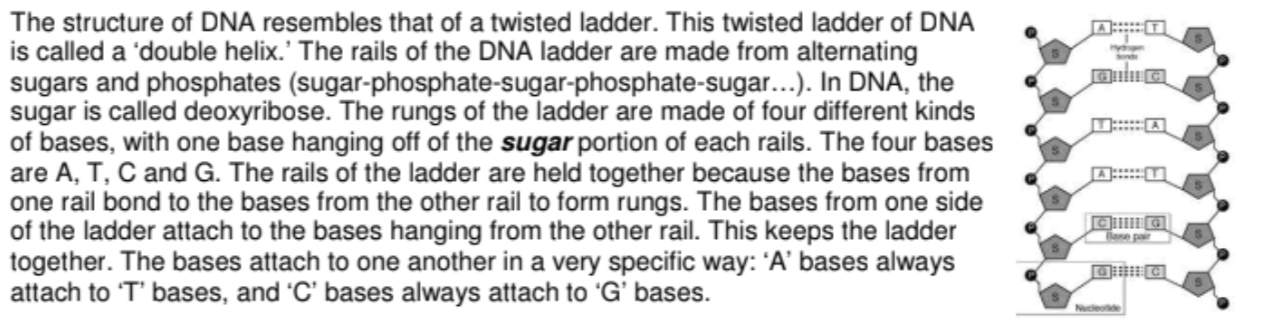
What are the three parts of this monomer?
Enter your answers separated by commas and in alphabetical order.
Question 39
39.
The rails of the ladder are made of alternating ____ and ______.
Enter your answers in alphabetical order and separated by a comma.
Question 40
40.
What are the four DNA bases?
Enter your answers in alphabetical order and separated by commas.