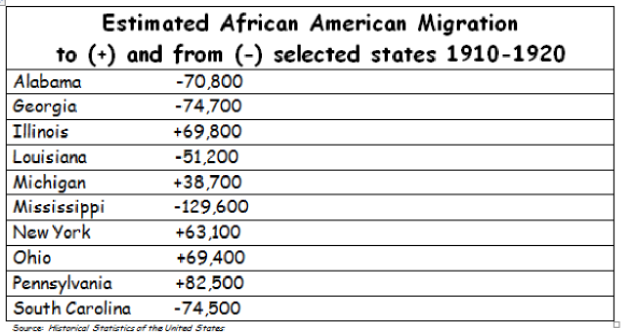
Examine the chart. A plus (+) in front of a number means the number of people ADDED to a state (people who arrived). A minus (-) in front of a number means the number of people LEAVING a state (people who left).
Follow the directions for each section carefully and complete the assignment to your best ability!
Use the video above to answer the following question:
The mass migration of Black people from the rural South to the urban North is known as the-
Use the video to answer the question:
True or false: Sharecropping in the South was still very similar to being enslaved.
The destroyed in the South in the early 1900s, which caused farms to fail. Sharecroppers were unable to survive this disaster. Beginning around World War I, about million African Americans left the to move to in the North and Midwest. There were jobs available there because World War I slowed immigration, and many workers joined the military. Before 1910, of Black people lived in the South. By the 1970s it was that number. This led to conflict in Northern cities due to racism. It also led to the , which was an explosion of art, music, and literature in New York City.
half
Harlem Renaissance
cotton crops
90%
boll weevil
factory
six
rural South
cities
Use the Sound Smart video above to put each item in the correct category.
Tenant Farming
leads to the Civil Rights Movement
Crop-lien System
1910-1940
Sharecropping
1940-1970
Unfair Labor Practices
Waves of Migration
According to the chart, which state had the most African Americans LEAVE between 1910 and 1920?
According to the chart, which state had the most African Americans ARRIVE between 1910-1920?
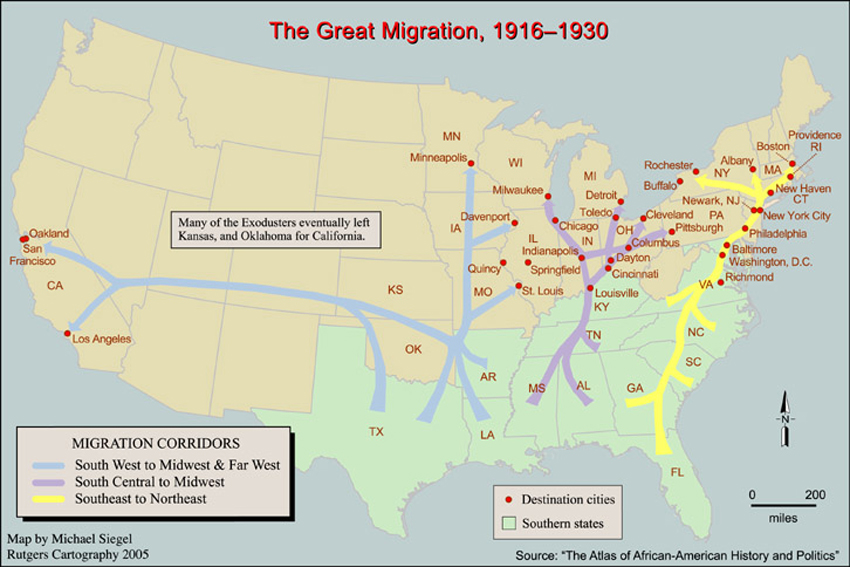
According to the map, where did African Americans in these states move to during the Great Migration?
| Draggable item | arrow_right_alt | Corresponding Item |
|---|---|---|
Mississippi, Alabama, Tennessee, Kentucky | arrow_right_alt | moved to Midwest and Far West |
Florida, Georgia, South Carolina, North Carolina, Virginia | arrow_right_alt | moved to Midwest |
Texas, Louisiana, Arkansas | arrow_right_alt | moved to Northeast |
The Great Migration was about African Americans moving from the South to what regions of the country? (Hint: look at the map, there is more than one correct answer. Please select all correct answers)
What is the estimated number of African Americans that migrated from the South to Northern cities?
What is the name of the Black art, literature and music movement that occurred during the Great Migration?
Which of the following unfair labor practices caused African Americans to move? (hint: there is more than one right answer, select all that apply)
In recent studies, researchers have found that there is a new trend of African Americans moving from the North to what region of the country?