0
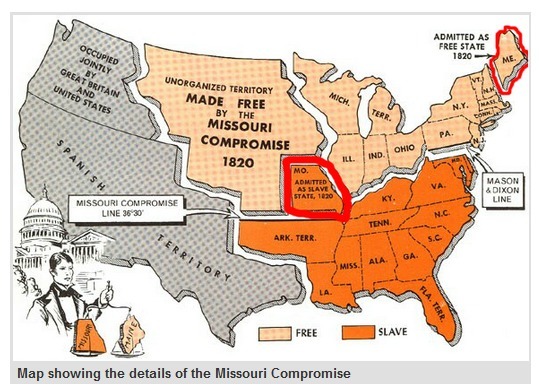
Based on the map (on left), what can you infer about the terms of the Missouri Compromise in 1820?
Based on the map (on left), what can you infer about the terms of the Missouri Compromise in 1820?
Content Objective: I will be able to determine the short-term and long-term success of the Missouri Compromise.
Standard Objective: I will be able to draw reasonable inferences and logical conclusions from text.
Absent? Just want to review the guided notes? Slides are linked here.
Content Objective: I will be able to determine the short-term and long-term success of the Missouri Compromise.
Standard Objective: I will be able to draw reasonable inferences and logical conclusions from text.
Absent? Just want to review the guided notes? Slides are linked here.
Based on the map (on left), what can you infer about the terms of the Missouri Compromise in 1820?
When Missouri applied to become a state in 1820, there were currently

The main purpose of the passage is to

Note how Question #1 is about the entire article. Hence, you should wait until you read the entire article before your answer it!
According to the passage, the reaction to the Missouri Compromise can best be described as
The MOST likely reason for including information about the Kansas-Nebraska Act is to show
Which answer choice BEST describes the central tension that led to the Missouri Compromise?
It can be reasonably inferred that "self-determination" is
The passage indicates that Thomas Jefferson believed that the question over slavery would eventually lead to
Based on the information in the passage, it can be reasonably inferred that
Which choice provides the best evidence for the answer to the previous question? (from Paragraph 4)
As used in the sentence, "sentiment" most nearly means
The final paragraph develops a key concept of the article by
