Log in
Sign up for FREE
arrow_back
Library

CFU for 6.LS2.3 Food Chains, Food Webs, and Energy Pyramids 2023-24

star
star
star
star
star
Last updated over 2 years ago
15 questions
1
1
1
1
1
1
1
1
1
1
1
1
1
1
1
Question 1
1.

Question 2
2.

Question 3
3.

Question 4
4.

Question 5
5.

Question 6
6.

Question 7
7.

Question 8
8.

Question 9
9.

Question 10
10.

Question 11
11.

Question 12
12.

Question 13
13.

Question 14
14.

Question 15
15.

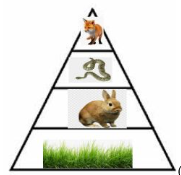
If the producers have 4500 kcal of energy, how much energy will the secondary consumer receive?
.045 kcal
4.5 kcal
45 kcal
450 kcal
Which food chain correctly shows the flow of energy through an ecosystem?
sun --> grass --> deer --> mountain lion
mountain lion --> deer --> grass --> sun
grass --> sun --> mountain lion --> deer
deer --> mountain lion --> grass --> sun
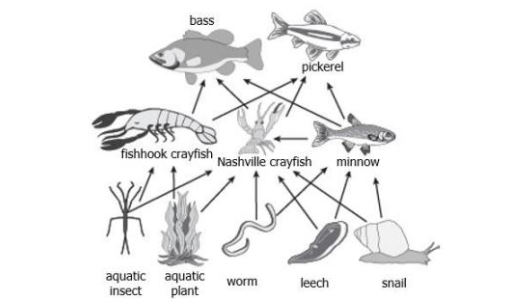
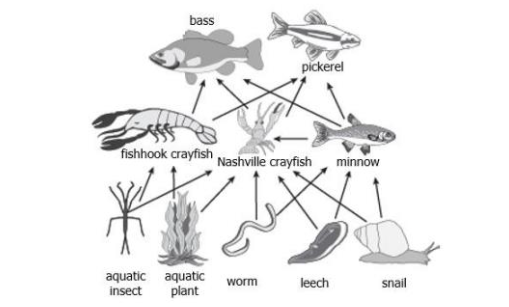
The image shows an aquatic food web.

The Nashville crayfish is found in a specific region of Tennessee. Due to water pollution and other factors, the species was at risk for extinction. However, improvements to maintain a healthy ecosystem have helped the Nashville crayfish population expand.

From which sources do the Nashville crayfish gain energy? Select ALL that apply.
aquatic plant
bass
fishhook crayfish
minnow
Which organism is an herbivore in the food web?

minnow
pickerel
fishhook crayfish
snail
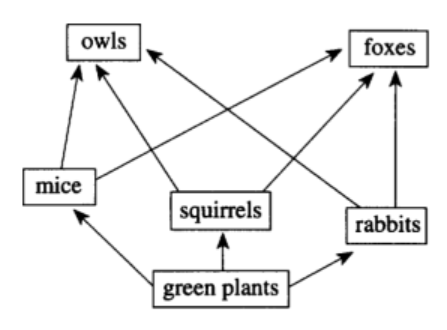
Which of the following correctly shows one pathway for the flow of energy to an owl?

owls --> squirrels --> foxes
green plants --> squirrels --> owls
owls --> green plants --> mice
foxes --> rabbits --> owls
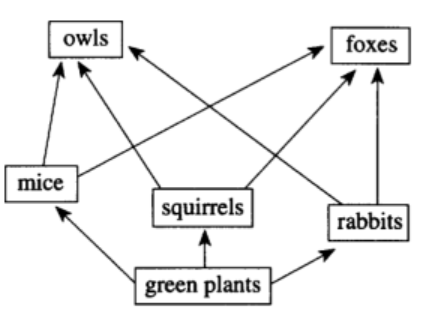
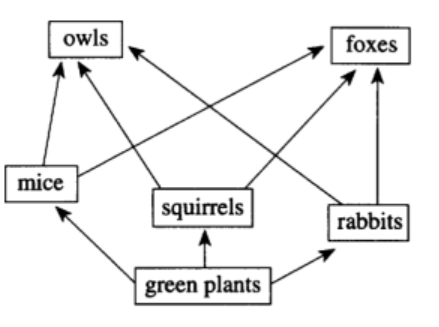
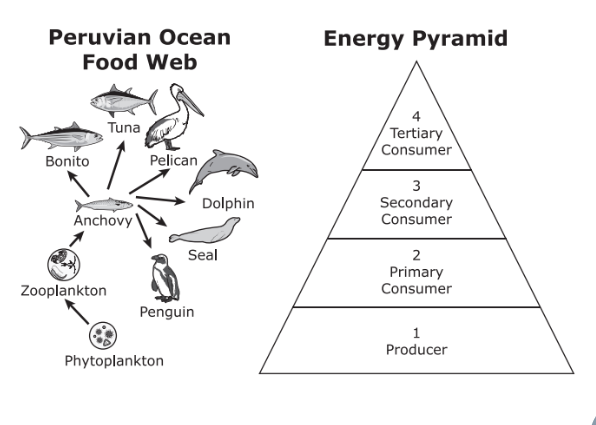
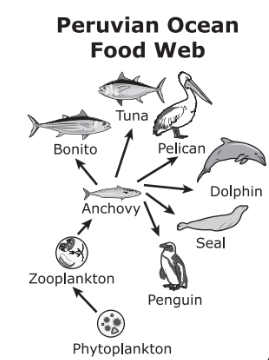
Use the food web below to answer the following question.

Based on the food web shown, you would hypothesize that the green plants, unlike the animals, can
make their own food
avoid being eaten by other organisms
get energy from other organisms
pass their energy directly to only secondary consumers
Based on the food web, how would the owls most likely respond if all of the mice died out?

The owls would start eating foxes.
The owls would eat more squirrels and rabbits.
The owls would eat more green plants.
The owls would die out.
According to the food web, in which trophic level of the energy pyramid does the anchovy belong?

Producer
Primary Consumer
Secondary Consumer
Tertiary Consumer
Based on the food web, if the zooplankton all died out, which organism would most directly be impacted?

penguin
tuna
anchovy
bonito
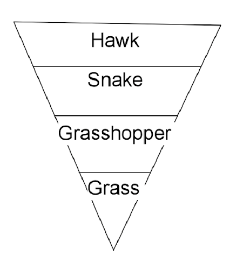
Why would an energy pyramid like the one above would not work long-term?
There is too much grass.
The snakes will eat hawks.
There are not enough hawks and the snakes will take over.
There are not enough producers and the consumers will die out.
Which of these best identifies biotic factors in a forest environment?
plants, animals, and their surroundings; including wildflowers, birds, rocks, and water
the features of the habitat and decaying material; including soil, air, dead trees, and bactera
the things living plants and animals need; including air, water, soil, and nutrients
producers, consumers, and decomposers; including wildflowers, deer, songbirds, and mushrooms
An example of a biotic factor in a lake ecosystem would be...
sand in the bottom of the lake
the fish swimming in the lake
the amount of oxygen in the lake
a rock at the bottom of the lake
An example of a biotic factor in a forest ecosystem would be...
a tree in the forest
a rock on the ground
the amount of shade
a creek
Which statement describes only biotic factors in a forest ecosystem?
Birds and clouds are moving in the wind.
A bird and a squirrel are living in a tree.
Sunlight, air, and water are used by the grass
A fish, rocks, and a turtle exist within a stream
Which of the following shows the relationship between a biotic and an abiotic factor?
Acidity of a lake due to high amounts of acid rain
Erosion of a river banks due to flooding
Fungi breaking down dead leaves
Hares turning white in the winter to blend in with the surroundings