Log in
Sign up for FREE
arrow_back
Library

Period 4, Day 1: To Compromise or Not to Compromise?

star
star
star
star
star
Last updated almost 2 years ago
11 questions
Note from the author:
0
1
0
1
1
Required
1
CCSS.ELA-LITERACY.RH.11-12.1
IIRC.02
Required
1
CCSS.ELA-LITERACY.RH.11-12.1
IITE.01
KC 4.3.II
0
0
Content Objective: I will be able to determine the short-term and long-term success of the Missouri Compromise.

Standard Objective: I will be able to draw reasonable inferences and logical conclusions from text.

Absent? Just want to review the guided notes? Slides are linked here.
Content Objective: I will be able to determine the short-term and long-term success of the Missouri Compromise.

Standard Objective: I will be able to draw reasonable inferences and logical conclusions from text.

Absent? Just want to review the guided notes? Slides are linked here.
Question 1
1.

Question 2
2.

Warm Up: Have you ever traveled to another state? If so, where did you go and what was it like?

As you share out with your small group, use the "Show Your Work" function to look up where each state mentioned is on the U.S. map!

Question 3
3.

Warm Up: One interesting historical fact I learned from the pre-work is…

Building Knowledge Together: Let's make sure we're all on the same page!

1
Question 4
4.

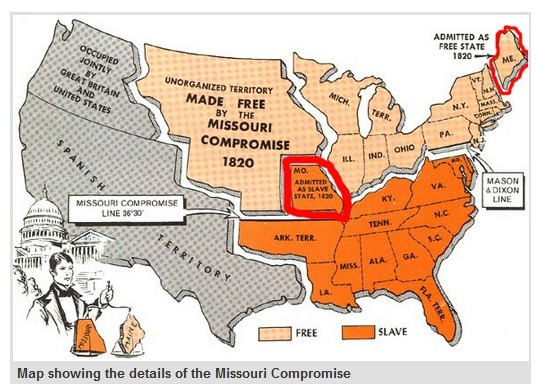
Based on the map (on left), what can you infer about the terms of the Missouri Compromise in 1820?

Question 5
5.
When Missouri applied to become a state in 1820, there were currently _______ free states and 11 _______ states. The addition of Missouri into the Union would have upset the _______ of free states and slave states, so Henry Clay proposed a compromise which allowed Missouri to join as a _______ state if Maine joined as a free state, thereby keeping the balance between Northern and _______ state representation equal in the _______. This agreement is known by historians as the Missouri Compromise that established the 36°30' line, which determined that all states _______ the line would become free states - except for _______ - while all states below the line would become slave states.
Question 6
6.

Make a Prediction: What do you think would happen if only one slave labor OR one Free Soil territory petitions for statehood in the future (after 1820)? Explain.
Required
1
CCSS.ELA-LITERACY.RH.11-12.9
IIRC.01
Question 8
8.

Question 9
9.

Question 10
10.

Exit Ticket: Do you feel like the Missouri Compromise was able to successfully address the issue of slavery? Explain why or why not.

Question 11
11.

Warm Up: Please rate how well you understood last night's pre-work on a scale from 1 to 4. If you have any questions, drop them in the "Show Your Work" area.
0 - I recognize that this is not a good start to the new unit, especially since we were only assigned 1 page front-and-back.
1 - I do not understand the pre-work yet.
2 - I need to review.
3 - I can understand the pre-work on my own.
4 - I can explain the pre-work to someone else.
Question 7
7.

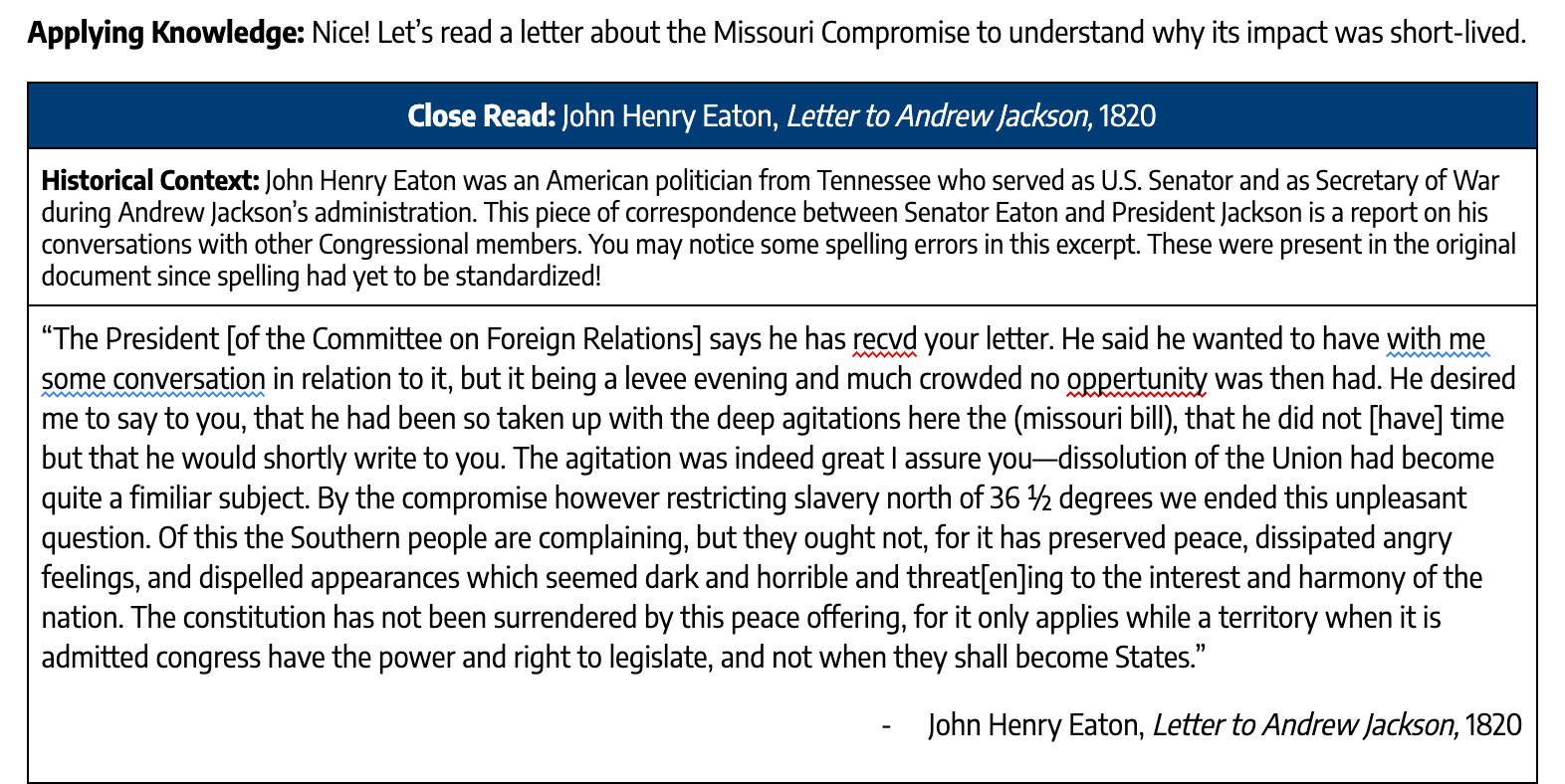
The excerpt suggests that Southerners were opposed to the Missouri Compromise because it
closed most of the Louisiana Purchase to slavery.
prohibited slavery from future territorial acquisitions.
excluded slavery from all territory north of the Ohio River and east of the Mississippi River.
provided for the gradual emancipation of slaves in Missouri.
Which choice provides the best evidence for the answer to the previous question?
Line 4-5 ("The President...then had")
Line 7-9 ("The agitation...unpleasant question")
Line 9-11 ("Of this... the nation")
Line 11-12 ("The constitution...become states")
Exit Ticket: Please evaluate how well you understood today’s lesson on a scale from 1 to 4:
1 - I need to seek out extra help from someone else.
2 - I need to find resources and relearn on my own.
3 - I understood the lesson on my own, and should pass on the knowledge!
4 - I was able to successfully explain and help someone else’s understanding.
Sourcing: The historical context surrounding this document was the Missouri Compromise, which
finally settled the question of congressional power over slavery in the territories.
prohibited slavery in all the territory of the Louisiana Purchase.
allowed Maine to enter the Union as a free state.
provided for admission of the Union of all future states in pairs of one free, one slave.