Log in
Sign up for FREE
arrow_back
Library

Period 5, Day 3: The Mexican-American War & the Compromise of 1850

star
star
star
star
star
Last updated almost 2 years ago
15 questions
Note from the author:
0
Required
1
0
Required
1
Required
0
Required
0
Required
1
Required
1
Required
1
CCSS.ELA-LITERACY.RH.11-12.6
KC 5.2.I
…
Required
1
CCSS.ELA-LITERACY.RH.11-12.3
IICI.01
…
0
Content Objective: I will be able to identify at least two causes of the Compromise of 1850.

Standard Objective: I will be able to identify explicitly stated relationships between groups and events, (e.g., cause-effect).

Absent? Just want to review the guided notes? Slides are linked here.
Content Objective: I will be able to identify at least two causes of the Compromise of 1850.

Standard Objective: I will be able to identify explicitly stated relationships between groups and events, (e.g., cause-effect).

Absent? Just want to review the guided notes? Slides are linked here.
Question 1
1.

Question 2
2.

Warm Up: What do you recall about the Missouri Compromise?

Stuck? Click here for a visual reminder.

Question 3
3.

Warm Up: One interesting historical fact I learned from the pre-work is…

Question 4
4.

Draggable itemarrow_right_altCorresponding Item
arrow_right_alt
arrow_right_alt
arrow_right_alt
arrow_right_alt
arrow_right_alt
Question 5
5.

Guided Viewing: Based on what you know about the historical context of the United States in the Antebellum era, why do you think the United States picked a fight with Mexico in the mid-1800s?

Required
1
Question 6
6.
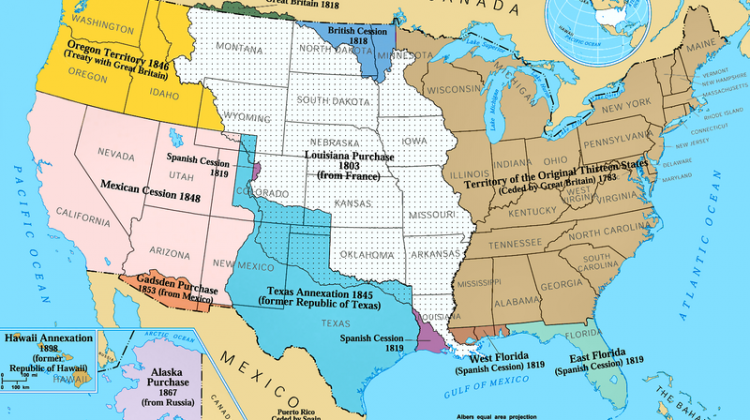
The Treaty of Guadalupe-Hidalgo ended the Mexican-American War (1846-1848). Mexico agreed to _______ territory reaching northwest from _______ to Oregon in exchange for $18.25 million in cash and assumed debts. This total expanse was about _______ of Mexico.
Question 7
7.

Make a Prediction: Analyze the map above. What do you think will happen as a result of the Treaty of Guadalupe-Hidalgo?
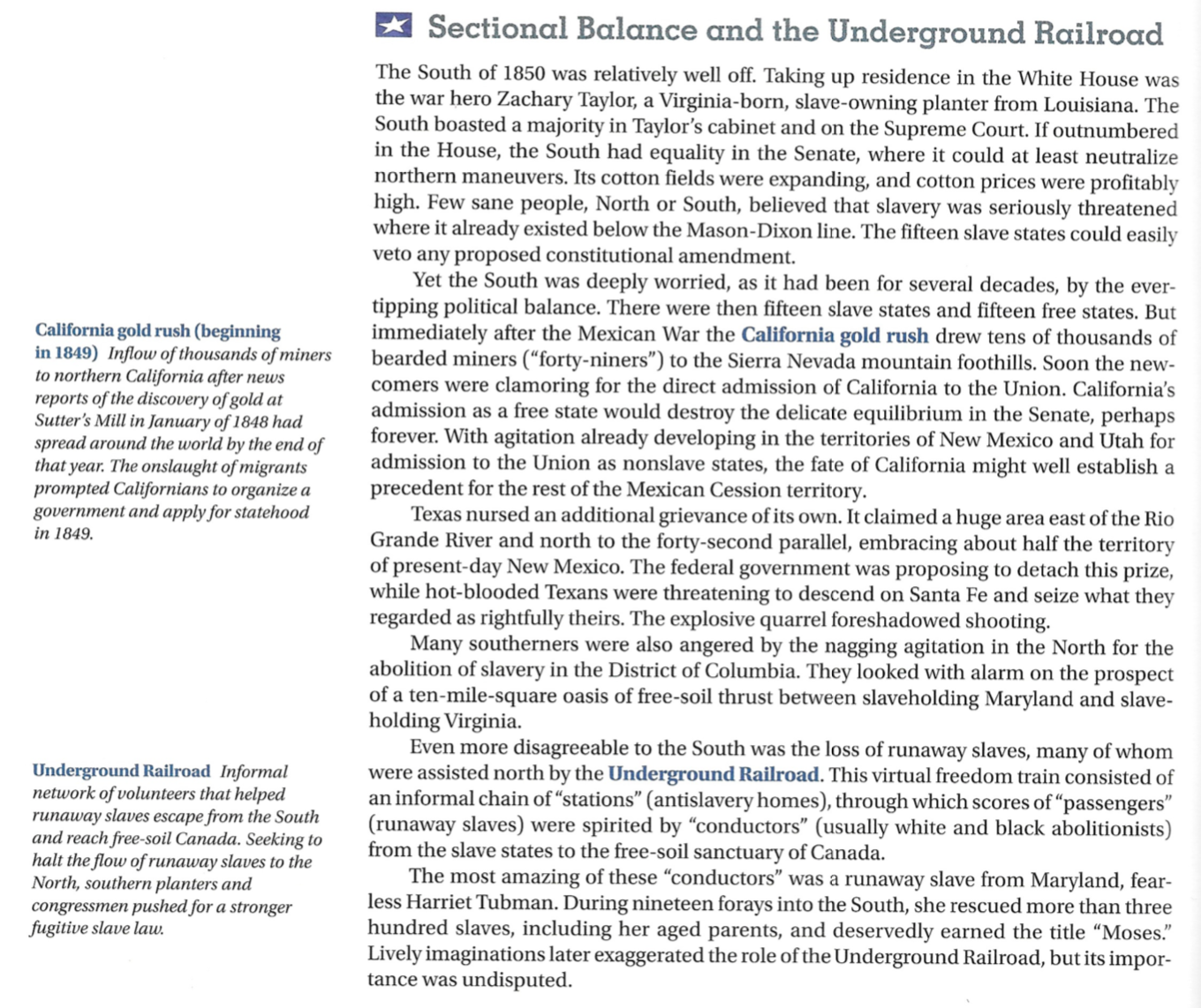
Applying Knowledge: Well done! Today, we are going to go over two key ideas from last night's reading. In particular, we will focus on Chapter 18, #4-5 (p. 285) and #8-9 (p. 287).

Required
1
Question 9
9.

Required
1
Question 11
11.

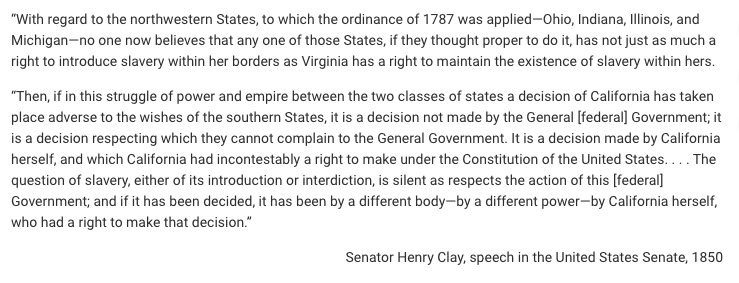
Exit Ticket: Good work! Let's prep for Friday's quiz and the AP exam by analyzing a speech by Senator Henry Clay from Kentucky, a former Speaker of the House and Secretary of the state who was known as the "Great Compromiser" of this time period.

Required
1
CCSS.ELA-LITERACY.RH.11-12.2
IICI.01
…
Question 13
13.

Question 14
14.

Question 15
15.

Warm Up: Please rate how well you understood last night's pre-work on a scale from 1 to 4. If you have any questions, drop them in the "Show Your Work" area.
0 - I recognize that there is a Mastery quiz on Friday, 1/27 and I am not setting myself up for success.
1 - I do not understand the pre-work yet.
2 - I need to review or attend office hours.
3 - I can understand the pre-work on my own.
4 - I can explain the pre-work to someone else.
Building Knowledge Together: First, let's make sure we're all on the same page regarding vocabulary. Here is a combination of old terms and new terms:
Popular Sovereignty
The idea that the United States is destined by God to expand and spread democracy and capitalism across the entire North American continent
Antebellum
The mid-nineteenth century idea that the people of a given territory should decide whether or not to allow slavery
Manifest Destiny
A phrase from the Declaration of Independence, which means that a Republican form of government gets its power from the people
36°30′ Line
The time period before the Civil War
Consent of the Governed
The northern limit for slavery to be legal in the territories of the west established by the Missouri Compromise when Maine (formerly a part of Massachusetts) was admitted as a free state in exchange for Missouri becoming a slave state (even though it was above this line)
Question 8
8.

Which choice provides the best evidence for the answer to the previous question?

Please explain why you chose the evidence in your own words under "Show Your Work."
Paragraph 3, Line 18-20 ("Texas nursed...New Mexico")
Paragraph 4, Line 23-26 ("Many Southerners... slaveholding Virginia")
Paragraph 2, Line 13-15 ("California's admission... perhaps forever")
Paragraph 5, Line 27-28 ("Even more... Underground Railroad")
Question 10
10.

Which choice provides the best evidence for the answer to the previous question?

Please explain why you chose the evidence in your own words under "Show Your Work."
Paragraph 1, Line 3-4 ("The territories... popular sovereignty")
Paragraph 3, Line 15-16 ("Most alarming... the North")
Paragraph 2, Line 7-10 ("Disgruntled Texas...modest sum")
Paragraph 2, Line 11-13 ("The South... federal district")
Question 12
12.

The position expressed by Clay in the excerpt best serves as evidence of which of the following?
The acquisition of new territories created disputes over the expansion of slavery.
Nativist groups opposed incorporating new states into the Union.
The United States Senate could not agree on treaty terms with Mexico.
Northern politicians showed less interest in California than Southern politicians.
Exit Ticket: Evidence in the excerpt best corroborates which of the following broader historical contexts?
New political parties such as the Know-Nothings threatened the system of slavery.
Abolitionist activity undermined the ability of new territories to achieve statehood.
Southern states sought more proslavery seats in the United States Congress.
Expanded trade between the East and West Coasts and with Asia divided the country in new ways.
Exit Ticket: Please evaluate how well you understood today’s lesson on a scale from 1 to 4:
1 - I need to seek out extra help from someone else.
2 - I need to find resources and relearn on my own.
3 - I understood the lesson on my own, and should pass on the knowledge!
4 - I was able to successfully explain and help someone else’s understanding.
According to the text, the event that threatened to destroy the balance between the number of free and slave states was the
the ban on the slave trade (not slavery itself) in the District of Columbia (Washington D.C.).
the impact of the Underground Railroad on the population of Southern states.
the shrinking borders of the Texas territory before it could become a state.
calls to admit California into the Union after the discovery of gold in 1848.
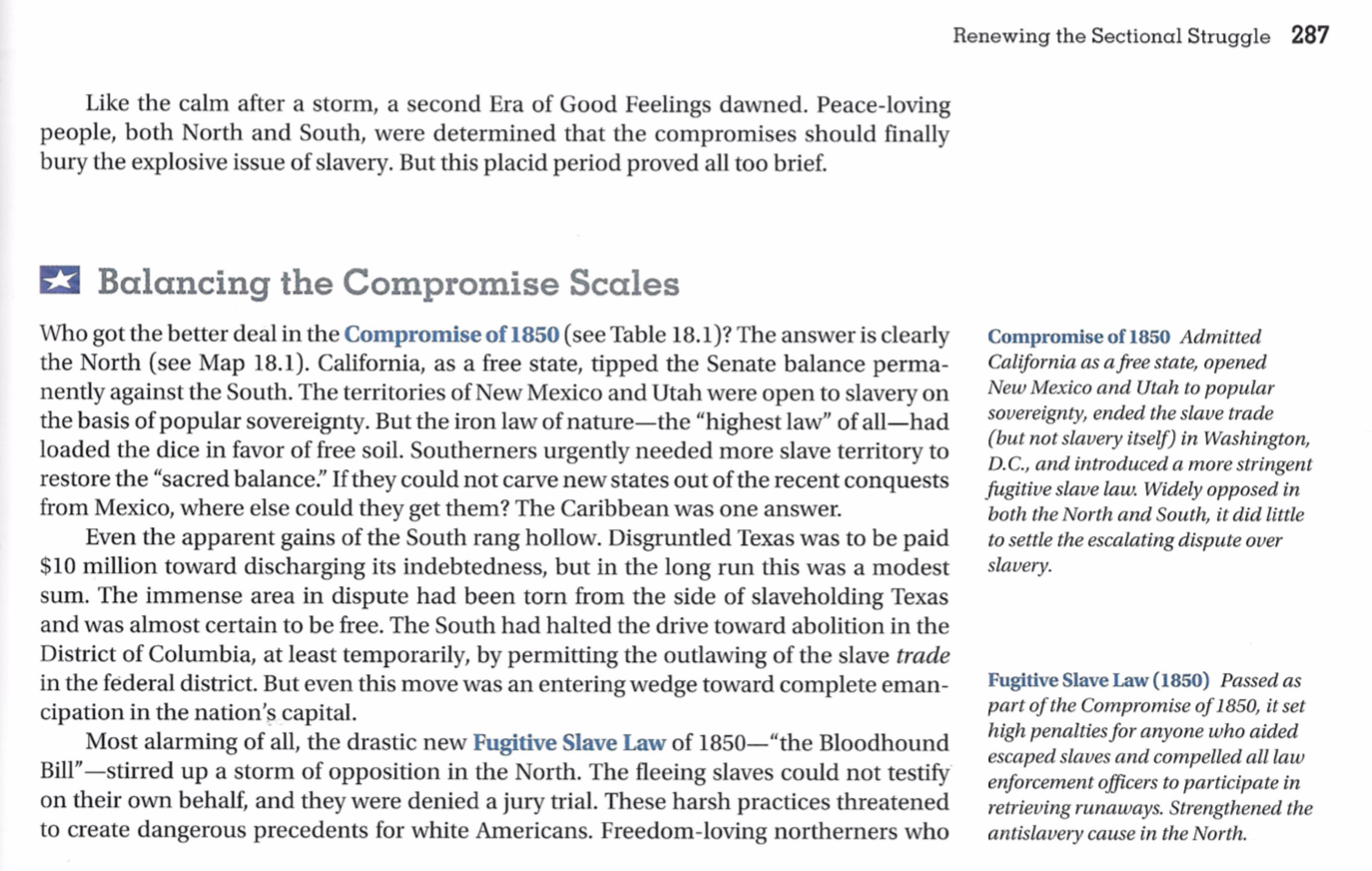
Although the Northerners benefited more from the Compromise of 1850 than the Southerners, the passage indicates that Northerners were most upset about
a substantial payment of $10 million to slaveholding Texas.
the continuation of slavery in the District of Columbia.
the possible expansion of slavery in the New Mexico and Utah territories.
a stricter and more punitive new Fugitive Slave Law.
The excerpt best reflects which of the following historical situations?
States in the Great Lakes region advocated to legalize slavery within their borders.
The Supreme Court decision in the Dred Scott case reduced sectional conflict within the United States.
Senators appealed to the idea of American exceptionalism to encourage national unity.
Congressional leaders sought political compromise to resolve discord between the North and the South.