Content Objective: I will be able to explain the concept of Manifest Destiny in my own words.
Standard Objective: I will be able to determine implicit relationships between and among individuals and events, (e.g., cause-effect).
Absent? Just want to review the guided notes? Slides are linked here.
Content Objective: I will be able to explain the concept of Manifest Destiny in my own words.
Standard Objective: I will be able to determine implicit relationships between and among individuals and events, (e.g., cause-effect).
Absent? Just want to review the guided notes? Slides are linked here.
Warm Up: Be sure to answer in complete, college-ready sentences!
Required
0 points
0
Question 1
1.
What is a compromise?
Note: This was a vocabulary term last semester and should be review!
Required
0 points
0
Question 2
2.
If a compromise resolves (fixes) conflict short-term, but not long-term, is it still beneficial to compromise? Explain why or why not.
Note: There are no right or wrong answers here! Only valid or invalid answers, meaning you are supporting your opinion with reasoning.
Building Knowledge Together: Let's make sure we're all on the same page!
Required
0 points
0
Question 3
3.
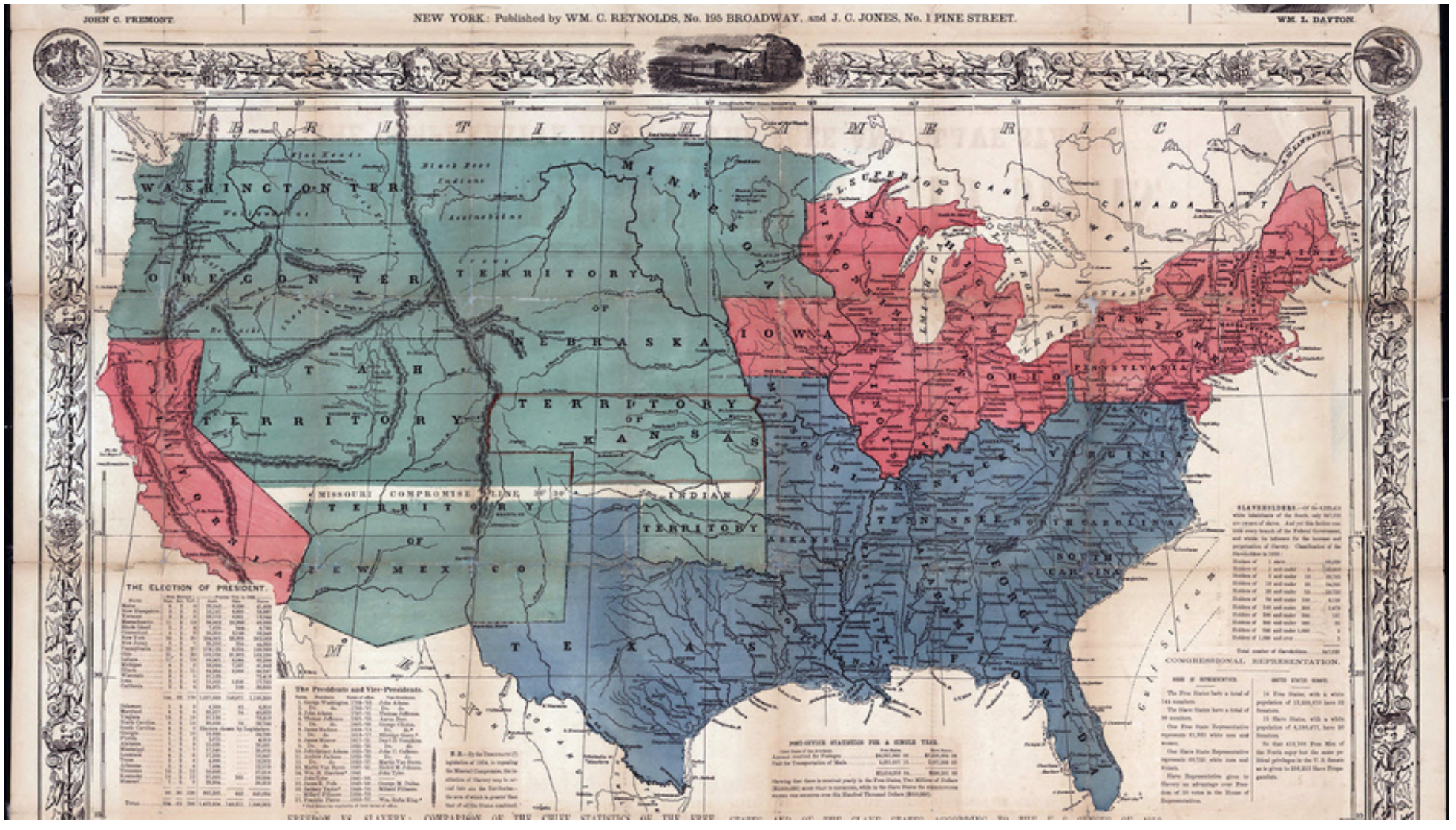
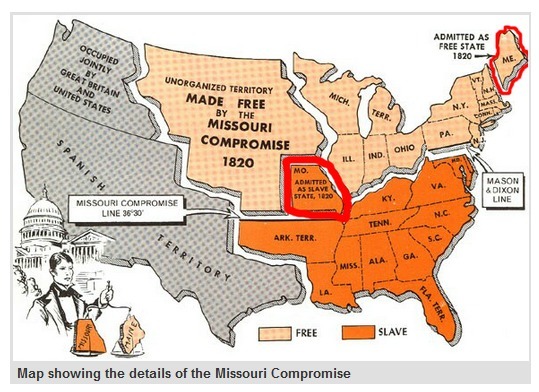
Examine the details of the secondary source map to the left. Based on the map, what can you infer (gather) about the terms of the Missouri Compromise in 1820?
Required
1 point
1
Question 4
4.
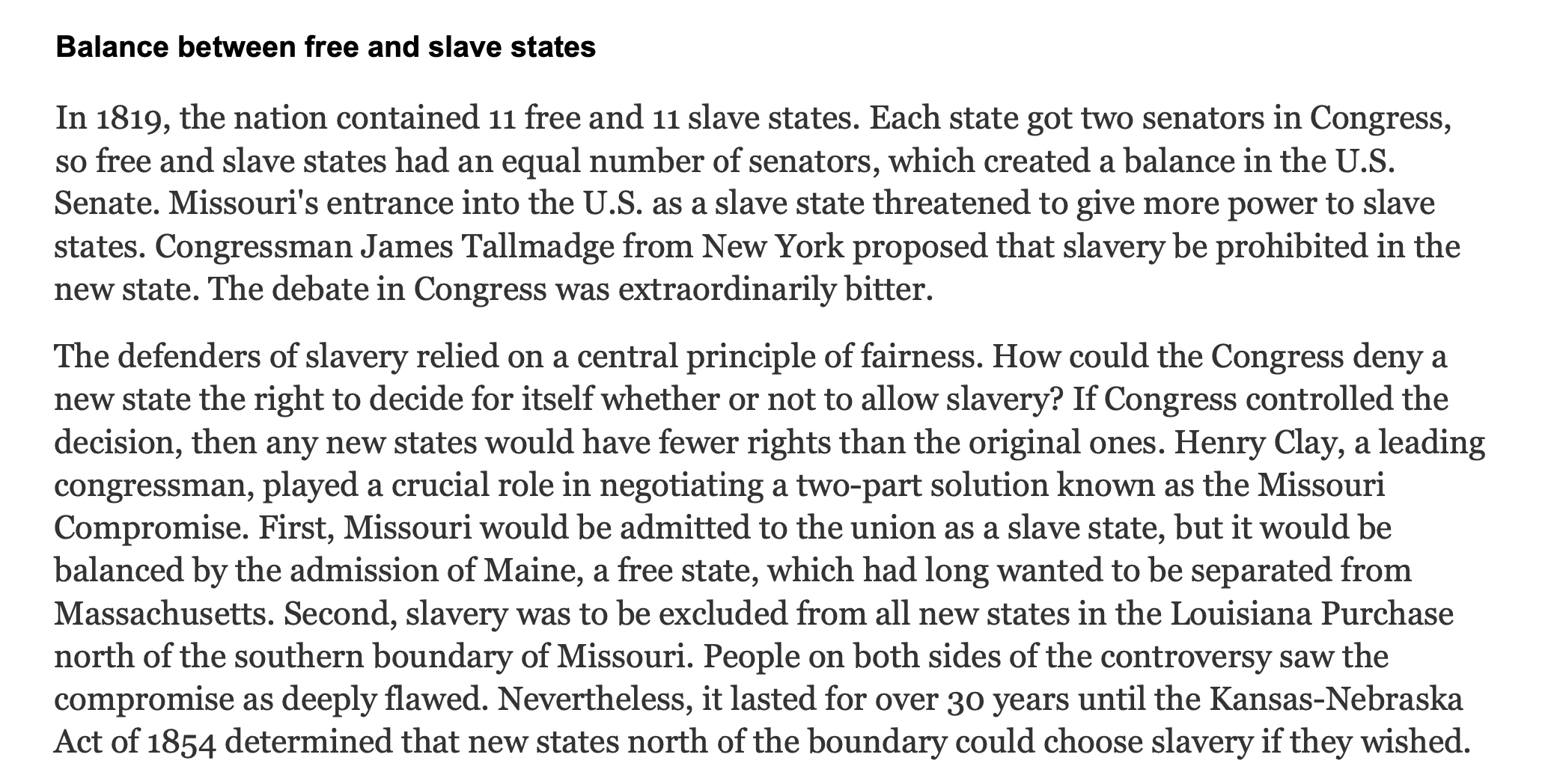
When Missouri applied to become a state in 1820, there were currently _______ free states and 11 _______ states.
The addition of Missouri into the United States would have upset the _______ of free states and slave states, so Henry Clay proposed a compromise which allowed Missouri to join as a _______ state if Maine joined as a free state, thereby keeping the balance between Northern and _______ state representation equal in the _______.
This agreement is known by historians as the Missouri Compromise that established the 36°30' line, which determined that all states _______ the line would become free states - except for _______ - while all states below the line would become slave states.
Applying Knowledge: Now it's your turn to read up on the Missouri Compromise and its historical significance.
Printed on Map: "Designed to exhibit the comparative area of the free and slave states and the territory open to slavery or freedom by the repeal of the Missouri compromise. With a comparison of the principal statistics of the free and slave states, from the census of 1850."
Map Key
Red = Free state
Dark Blue= Slave states are in dark blue
Green Blue= Territories that could be slave or free if the Missouri compromise was ended
Required
0 points
0
Question 5
5.
The main purpose of the passage is to
Note how Question #1 is about the entire article. Hence, you should wait until you read the entire article before you answer it! (Hint: You should do the same thing on the SAT Reading exam.)
Required
1 point
1
Question 6
6.
According to the passage, the reaction to the Missouri Compromise can best be described as
Required
1 point
1
Question 7
7.
The MOST likely reason for including information about the Kansas-Nebraska Act of 1854 is to show
1 point
1
Question 8
8.
It can be reasonably inferred that "self-determination" is
Required
1 point
1
Question 9
9.
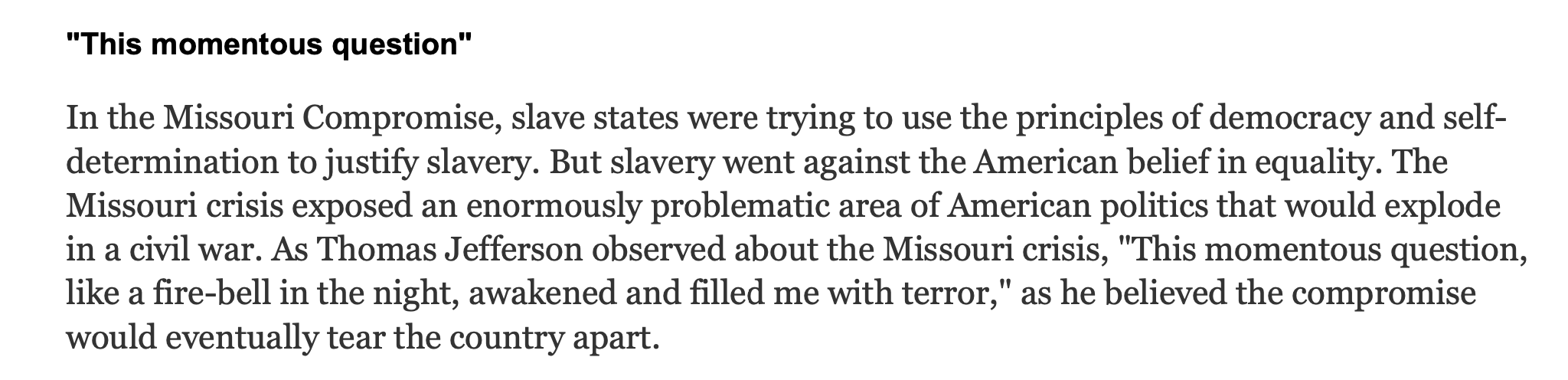
The passage indicates that Thomas Jefferson believed that the question over slavery would eventually lead to
Required
1 point
1
Question 10
10.
Which answer choice BEST describes the central tension that led to the Missouri Compromise?
Required
1 point
1
Question 11
11.
Based on the information in the passage, it can be reasonably inferred that
Required
1 point
1
Question 12
12.
Which choice provides the best evidence for the answer to the previous question? (from Paragraph 4)
Required
1 point
1
Question 13
13.
As used in line 1, "sentiment" most nearly means
Required
1 point
1
Question 14
14.
The final paragraph develops a key concept of the article by
Still feeling confused? Check out this 2 minute video for more support!