Log in
Sign up for FREE
arrow_back
Library

7th Grade 2.2a test

star
star
star
star
star
Last updated over 3 years ago
40 questions
1
1
1
1
1
MS-LS1-3
1
MS-LS1-1
5
5
1
1
1
1
5
1
1
1
1
1
1
1
1
1
1
1
1
1
1
1
1
5
7
1
1
2
1
1
2
1
MS-LS1-3
5
5
Question 1
1.

Question 2
2.

Question 3
3.

Question 4
4.

Question 5
5.

Question 6
6.

Question 7
7.
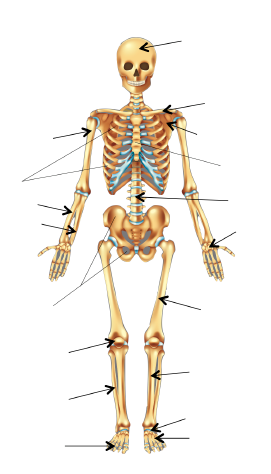
Label the parts of the skeleton
Other Answer Choices:
Clavicle
Skull
Femur
Radius
Vertebral Column
Metatarsals
Fibula
Humerus
Question 8
8.
Other Answer Choices:
Ball and Socket
The joint is immobile
Hinge
Gives the widest range of motion, allows person to move the limb 180 degrees
Pivot
Allows side to side and back and forth motion
Allows person to twist at the joint
Gliding
Allows for back and forth motion
Sutures (Fixed Joint)
Question 9
9.

Question 10
10.

Question 11
11.

Question 12
12.

Question 13
13.

Question 14
14.

Question 15
15.

Question 16
16.

Question 17
17.

Question 18
18.

Question 19
19.

Question 20
20.

Question 21
21.

Question 22
22.

Question 23
23.

Question 24
24.

Question 25
25.

Question 26
26.

Question 27
27.

Question 28
28.

Question 29
29.

Question 30
30.

Draggable itemarrow_right_altCorresponding Item
arrow_right_alt
arrow_right_alt
arrow_right_alt
arrow_right_alt
arrow_right_alt
arrow_right_alt
arrow_right_alt
arrow_right_alt
arrow_right_alt
Question 31
31.

Question 32
32.
The _______ tissue in plants provides protection and helps reduce water loss.
Question 33
33.
After a bone breaks, a blood clot forms, then a cartilage callus forms. The cartilage contains _______, which makes new bone tissue.
Question 34
34.
_______ connect muscle to bone, while _______ connect bone to bone.
Question 35
35.
_______ tissue in animals provides structure and support and often connects other types of tissues together to make organs.
Question 36
36.
Striated means _______ .
Question 37
37.
The 2 major organ systems of plants are the _______ and _______ systems.
Question 38
38.
The skin is a(n) _______ that is made of billions of cells that are grouped together to form tissues.
Question 39
39.

What is the function of vascular tissues in plants?

Question 40
40.

Using complete sentences, describe what cell differentiation is and give an example.

The leaf is a vital organ used for photosynthesis. It is made of more than 1 type of tissue.
True
False
The human skeleton can be divided into 2 parts, the axial, which is the core, and the appendicular, which are the limbs.
True
False
Cardiac muscle can be found in the spinal cord.
True
False
Cartilage is extremely smooth to reduce friction in the joint
True
False
All living things are made of cells. Some are only made of one single cell.
True
False
Not all living things have tissues, organs, and/or organ systems.
True
False
Which diagram shows the correct levels of organization in a unicellular plant organism? 
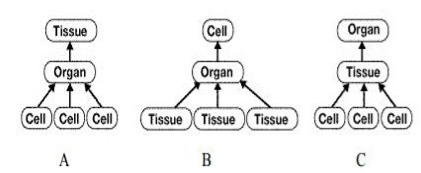
A
B
C
None of the above show a unicellular organisms organization.
Which of the following is an organ system? ​
Heart
Circulatory
Pancreas
Intestine
What type of human tissue is most similar to dermal tissues in plants?
Connective ​
Epithelial ​
Nervous 
Muscular ​
What type of tissue is specialized to react to stimuli by conducting impulses to various organs in the body? ​
Connective ​
Muscular
Nervous
Epithelial ​
Why is the skeletal system important to your body? ​
It supports the body ​
It allows the body to move ​
All choices are correct 
It protects internal organs ​
Ball and Socket Joint
Hinge Joint
Fixed Joint
Pivot Joint
What type of muscle is found in the heart? ​
Smooth muscle 
Both skeletal and cardiac
Skeletal muscle ​
Cardiac muscle ​
Why is cartilage important? ​
It stores calcium ​
It adds structure to parts of the body, such as the ears and nose ​
It provides cushion between joints ​
It provides cushion between joints ​and adds structure to parts of the body
The bones in movable joints are held together by strong connective tissues called​
muscles.​
tendons.
ligaments.​
cartilage.​
The joint in your shoulder is an example of a​
ball and socket joint.​
gliding joint.
hinge joint.​
pivot joint.​
What is made inside bones? ​
Skin cells ​
Cartilage
Nerve cells
Blood cells
What type of muscle is most important to moving food through the ​
digestive system? ​
Skeletal muscle
Both skeletal and cardiac
Cardiac muscle
Smooth muscle
What type of muscle can be consciously controlled? ​
Both smooth and cardiac
Skeletal muscle
Cardiac muscle
Smooth muscle
Which of the following is NOT a function of the skin? ​
To help digest nutrients   ​
To protect the body from disease and injury ​
To help excrete waste 
To help regulate body temperature ​
Muscles are classified according to their-
color and pattern
structure and function
length and use
size and location
Organs that work together to perform a life function make up a(n): ​
Cellular System
Tissue
Organ System
Organism
Which type of tissue provides support for the human body and attaches the various parts together? ​
Muscle
Connective
Sensory
Nervous
The heart, brain, and stomach are made up of groups of ​
Tissues
Organ System
Blood
Organelles
Which list describes the organization of the human body from the most complex to the least complex?
stomach, small intestine, large intestine
cardiovascular system, respiratory system, digestive system
digestive system, large intestine, epithelial tissue
epithelial tissue, large intestine, digestive system
Fixed Joint
Pivot Joint
Hinge Joint
Ball and Socket Joint
Which of the following best describes a tissue?
the smallest functional unit of an organism
a group of cells working together to perform a specific function
a group of organs that work together to perform a specific function
a specialized unity within a cell that has a specific function
Put the following items in order from smallest to largest
Organism
1 (smallest)
Organelle
2
Population
3
Ecosystem
4
Organ
5
Tissue
6
Community
7
Organ System
8
Cell
9 (largest)
Categorize the type of tissue with the organism that it belongs in.
epithelial
vascuar
dermal
nervous
ground
connective
muscle
Plant
Animal