Density Test
star
star
star
star
star
Last updated almost 2 years ago
30 Nsɛmmisa
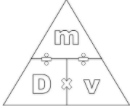
Ɛhia
5
Ɛhia
5
Ɛhia
5
Ɛhia
1
Ɛhia
5
Ɛhia
2
Ɛhia
3
Ɛhia
1
Ɛhia
1
Ɛhia
1
Ɛhia
1
Ɛhia
1
Ɛhia
1
Ɛhia
1
A sample of a substance that has a density of 0.824 g/mL has a mass of 0.451g. Calculate the volume of the sample. (Use the formula V=M/D.)
The density of sulfuric acid is 1.84 grams per cubic centimeters. what is the mass of 75.0cm3 of sulfuric acid? (Use the formula M=DxV round the the nearest hundredth)
What volume of silver will weigh exactly 2500.0g if the density of silver is 10.5g/mL? (Use the formula V=M/D.)
Will the object in the problem above float or sink in water? (Density of water is 1 g/cm^3)
A rock has a density of 4.85 g/mL. what is the mass if it displaces 22.5mL of water(Use the formula M=DxV round to the nearest hundreths.)
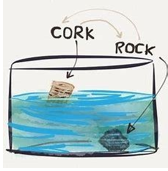
Given the following image, which of the following statements is correct?
In exploring the incredible world of science, one must become familiar with the fundamental concepts of mass, volume, and density. Mass refers to the measure of the quantity of matter in an object. Think of it as the amount of stuff in an object, especially when you can’t observe it directly. For instance, an elephant has more mass than an ant because it contains more matter. Volume, on the other hand, conveys the space an object occupies. Think about a swimming pool and a bathtub. Both can hold water, but because the swimming pool is larger, it has more volume - it takes up more space than a bathtub. Now, where volume and mass intersect is where we find density. Put simply, density is the mass of an object divided by its volume. It reveals how tightly matter is packed into a particular space. To illustrate, let's consider an ordinary ping-pong ball and a same-sized ball of lead. Both have the same volume because they occupy the same amount of space, yet the lead ball has a greater mass. Consequently, the lead ball is denser than the ping-pong ball. In summary, while mass tells us about the amount of matter in an object, volume indicates the space that the object occupies. Density, however, is the relationship between mass and volume. By understanding these foundational concepts, you've unlocked the door to deeper scientific exploration.
Match the term to its definition
| Draggable item | arrow_right_alt | Corresponding Item |
|---|---|---|
Meniscus | arrow_right_alt | The amount of matter that will fit into a given amount of space |
Density | arrow_right_alt | The amount of matter in something |
Miscible Liquids | arrow_right_alt | The amount of space that an object occupies |
Volume | arrow_right_alt | Liquids that do not mix together |
Mass | arrow_right_alt | Liquids that are able to mix together |
Immiscible Liquids | arrow_right_alt | The curved surface of the liquid in the graduated cylinder |
What is the formula for density?
What is the unit of measurement for mass?
How would you measure the mass of an object?
Which of the following is a unit of volume?
In order to accurately measure volume, take the measurement of the liquid in a _____________________________.
Since ice is less dense than water, it will float.
An object that is more dense than water will sink.
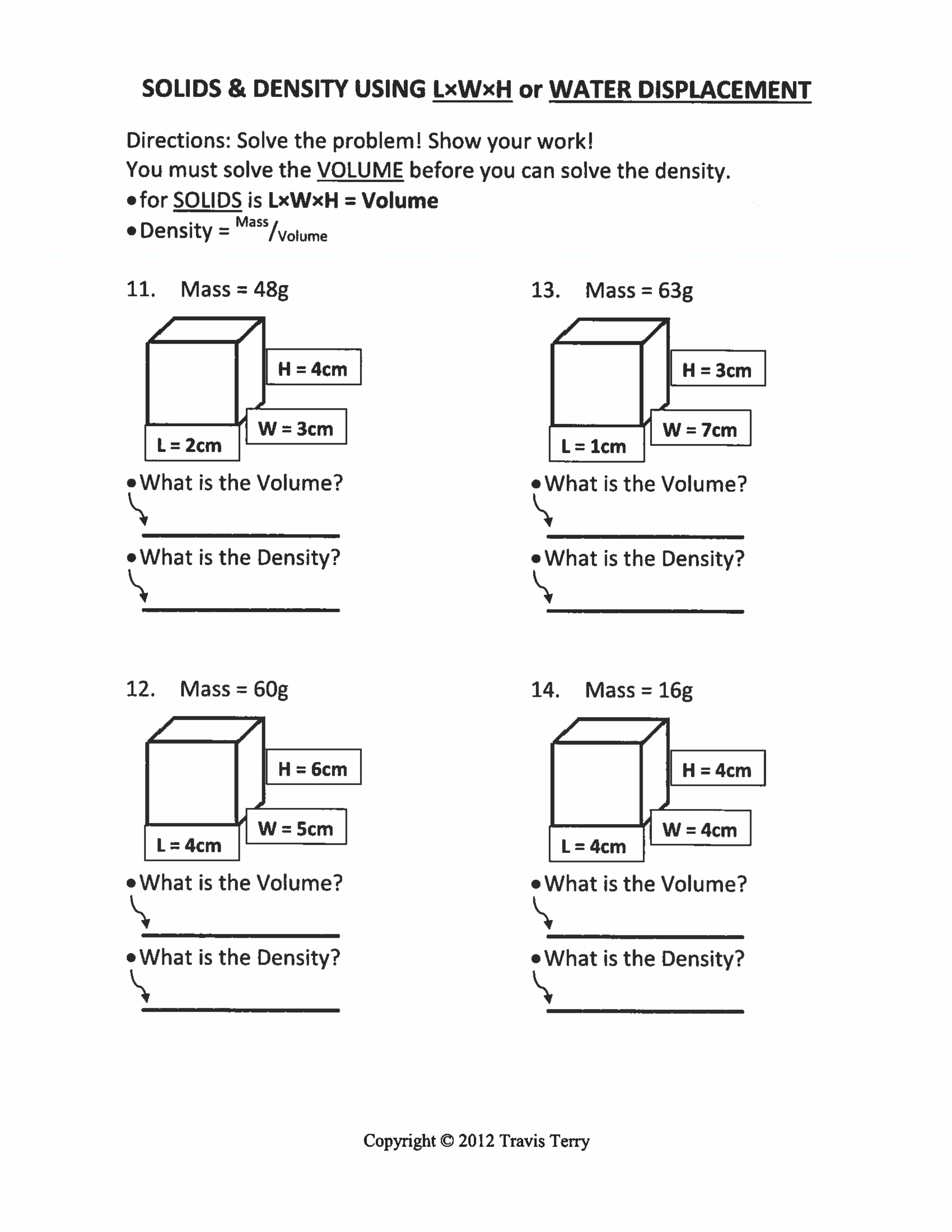
What is the volume of the block?
What is the density of the block?
What is the volume of the block?
What is the density of the block?
What is the volume of the block?
What is the density of the block?
What is the volume of the block?
What is the density of the block?
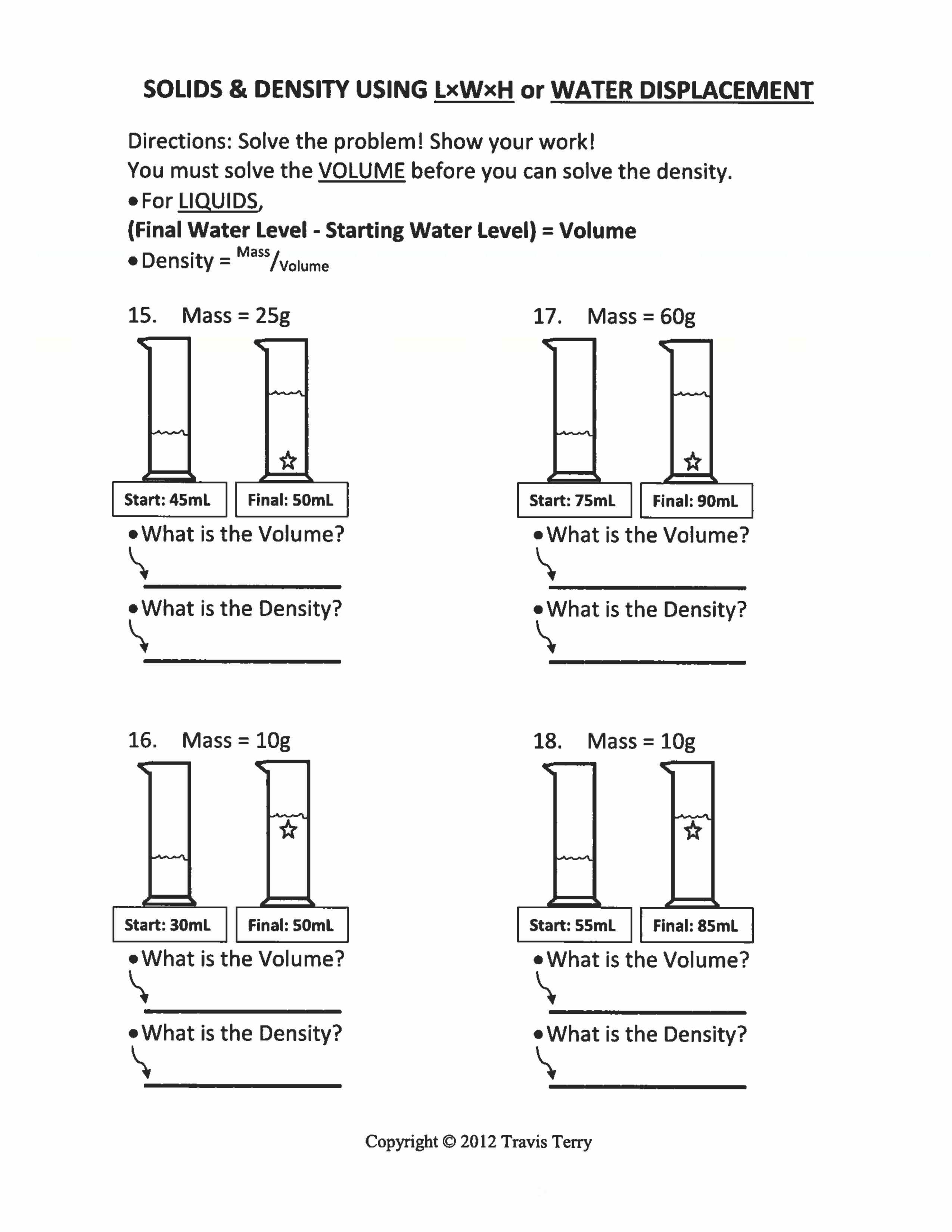
What is the volume of the star?
What is the density of the star?
What is the volume of the star?
What is the density of the star?
What is the volume of the star?
What is the density of the star?
What is the volume of the star?
What is the density of the star? (round to nearest 100th)